
Multi-Site Facilities Management: A London Guide for 2026

At 08:15 on a Tuesday, a portfolio manager is already dealing with a lift fault in Canary Wharf, a contractor delayed near Camden, a failed access badge in Stratford and a tenant complaint about reception cover in Westminster. Each issue is manageable on its own. Together, across buildings with different ages, occupier profiles, transport links and local operating constraints, they expose whether the estate is being managed as one portfolio or as a collection of disconnected emergencies.
Multi-site facilities management works when central control sets consistent standards without stripping sites of the local judgement they need. It fails when suppliers, systems and responsibilities multiply faster than anyone can see them. The following guide focuses on the decisions that make a London portfolio reliable: contract structure, governance, technology, staffing continuity, cost control and partner selection.
Table of Contents
Running Buildings Across London and Why It Gets Complicated - The operating burden sits between sites
What Multi-Site Facilities Management Actually Means - Three operating positions - Why portfolios move towards the model
Centralised Vendor Model Compared With Single Integrated Supplier
Governance Structures That Keep Multiple Sites Accountable - A response structure people can use - Audit the work, not just the report
Technology and Reporting Across a London Portfolio - Build the information chain
Staffing Continuity and Dedicated Teams - Design cover around the operating day
Choosing the Right Multi-Site FM Partner - Test the operating team - Stress-test mobilisation and exit
Running Buildings Across London and Why It Gets Complicated
The lift problem in Canary Wharf may be a familiar mechanical fault. In Camden, the same fault may involve an older asset, restricted access and a contractor route that takes longer than the repair itself. In Stratford, the immediate issue may be the security team's inability to admit the engineer because a badge profile hasn't been updated. The technical incident is only one part of the service failure. The rest sits in access, communication, travel and ownership.
London portfolios amplify these details. A Grade II listed building in Westminster demands a different maintenance conversation from a newer tower in Nine Elms. A mixed-use block may have residents, retail tenants, deliveries and visitors moving through the same entrance. A corporate office may need a polished front-of-house service during the day, then security patrols and remote monitoring overnight.

The operating burden sits between sites
Running every building independently creates duplicated decisions. Each site develops its own contractor contacts, escalation habits, reporting language and interpretation of acceptable service. That can feel responsive at first, but the portfolio manager loses the ability to compare performance or move support quickly when one location comes under pressure.
The UK workplace and facilities management sector contributes an estimated £102 billion to the economy and supports about 1.2 million jobs, according to the Institute of Workplace and Facilities Management market outlook referenced by RICS. That scale reflects how much operational activity FM coordinates, from engineering and compliance to cleaning, security and workplace services.
The risk isn't just that one building performs poorly. One weak handover, overdue action or unplanned absence can expose a gap in the operating model across the estate. Without common standards, shared information and named accountability, a London portfolio fragments into borough-by-borough firefighting.
What Multi-Site Facilities Management Actually Means
Multi-site facilities management is the coordinated delivery of hard and soft services across multiple occupied buildings under one accountable operating structure. The services may include M&E maintenance, cleaning, security, reception, front-of-house, waste, concierge and statutory compliance.
That definition matters because multi-site FM isn't just single-site outsourcing repeated at different addresses. Single-site FM usually has one building, one local rhythm and one immediate decision chain. Multi-site FM adds a portfolio layer that sets standards, manages dependencies and compares outcomes between locations.
Three operating positions
A London client normally sits somewhere on this spectrum:
One integrated contract: One supplier carries responsibility for the core service bundle, with a single account structure and escalation route.
A bundled supplier model: Several services are grouped, but specialist providers remain responsible for distinct disciplines.
A central management layer: The client retains portfolio control and appoints separate specialists for cleaning, security, engineering and other services.
The right model depends on the estate, not on the fashion of the procurement market. A technically complex portfolio may need specialist engineering control. A landlord with many similar buildings may value one accountable provider that can standardise reception, cleaning, security and reporting.
Why portfolios move towards the model
Acquisitions often create the first trigger. The client inherits different suppliers, asset registers, reporting formats and local practices, then discovers that the cost of leaving them untouched is difficult to measure. New-build completions can create a similar problem when adjacent boroughs are added faster than the management structure evolves.
Investors and occupiers also expect consistent reporting. The RICS UK Facilities Management Survey provides a structured indicator of demand, activity and sentiment across the UK FM industry. For portfolio operators, the underlying principle is important: performance needs to be measured consistently across sites.
Multi-site FM is therefore governance applied across geography. The buildings remain different, but the client should know who owns the result, what the standard is and where the evidence sits.
Centralised Vendor Model Compared With Single Integrated Supplier
The centralised vendor model keeps the client's FM team in the middle. The portfolio manager contracts with separate specialists, perhaps one cleaning provider, one security company and one M&E contractor, then uses a CAFM platform and service reviews to coordinate them.
The single integrated supplier removes many of those interfaces. One provider delivers the agreed bundle, manages the operational teams and gives the client one principal escalation route. Neither structure is automatically superior. The decision turns on how much internal management capacity the client has and how costly service interfaces have become.
Criterion | Centralised vendor model | Single integrated supplier |
|---|---|---|
Contract complexity | Several contracts, schedules and renewal dates require active coordination | One principal contract, with service schedules and specialist subcontracting managed within the model |
Cost transparency | Competitive discipline can produce clear discipline-specific pricing | Bundled pricing simplifies administration, but the client must demand open-book clarity |
Accountability | Responsibility can become disputed at the boundary between suppliers | One account structure owns coordination and escalation |
ESG and compliance reporting | Data must be consolidated from separate providers | A single reporting process can aggregate evidence across services |
Mobilisation | Existing specialists may reduce disruption at the outset | One mobilisation can align the estate, but poor planning creates portfolio-wide risk |
Staffing consistency | The client can select or replace individual teams by discipline | The supplier can deploy one operating standard, provided it protects dedicated site knowledge |
The vendor model suits buyers who want strong control over specialist procurement and are prepared to manage the interfaces. It also offers flexibility when one discipline needs to change without reopening the entire service structure. The weakness appears during incidents. If a security report identifies a door fault, the client may need to coordinate security, access control, engineering and the landlord's representative before anyone owns the resolution.
An integrated supplier reduces that handoff burden. The trade-off is that the contract needs rigorous service definitions, transparent pricing and credible performance deductions. A single supplier isn't a substitute for active client governance.
For a fuller explanation of the operating model, compare this decision with the principles in integrated facilities management.
If the supplier can't explain who owns the issue at 3am, the contract isn't integrated in practice.
Choose centralised vendors when specialist control and procurement flexibility outweigh coordination cost. Choose one integrated supplier when repeated handoffs, inconsistent reporting and slow escalation are damaging the tenant experience.
Governance Structures That Keep Multiple Sites Accountable
Governance should make failure visible before it becomes a tenant complaint. Start with one master services agreement for each discipline or service bundle, then attach borough-level schedules that record site conditions, access arrangements, hours, assets and local exceptions.
A single RACI matrix should name the person who authorises overtime, approves variations, signs off corrective actions and attends the monthly QBR. Don't leave those decisions to whoever happens to answer an email. The account director should be named in the contract and reachable through a defined escalation route, not hidden behind a generic call centre.
A response structure people can use
Escalation tier | Response time | Example incident | Accountable role |
|---|---|---|---|
P1 | Within 30 minutes | Security breach, lift entrapment or flooding | Named account director and duty operations lead |
P2 | Within 2 hours | Material HVAC failure, access control fault or significant cleaning failure | Service manager and site supervisor |
P3 | Next business day | Routine defect, minor consumable issue or non-urgent request | Site lead with portfolio oversight |
These response times are operating recommendations, not universal legal requirements. The client should define the clock, the communication method and the evidence required to close each tier.
Audit the work, not just the report
Unannounced site visits should cover a representative proportion of the portfolio each quarter, with the frequency determined by site risk, service performance and the client’s audit programme.
The compliance calendar needs a rolling 12-month view. Depending on the building, this may include electrical inspection and testing records, F-Gas documentation, Legionella controls and applicable fire-safety inspections and records. The FM Standard 002 asset data guidance supports the wider principle that asset data should be consistent, interoperable and usable across an estate.
The commercial mechanism matters just as much. KPIs should connect to service credits or financial deductions, so repeated under-delivery costs the supplier rather than reducing landlord value.
Hold weekly operational calls for live risks, monthly performance reviews for SLA and compliance evidence, and quarterly business reviews for trends, investment and contract changes. Governance works when each meeting produces an owner, a due date and a record.
Technology and Reporting Across a London Portfolio
A spreadsheet can record an incident. It can't reliably show whether the same access fault is recurring across boroughs, whether patrols are being completed or whether corrective actions are ageing at one building.
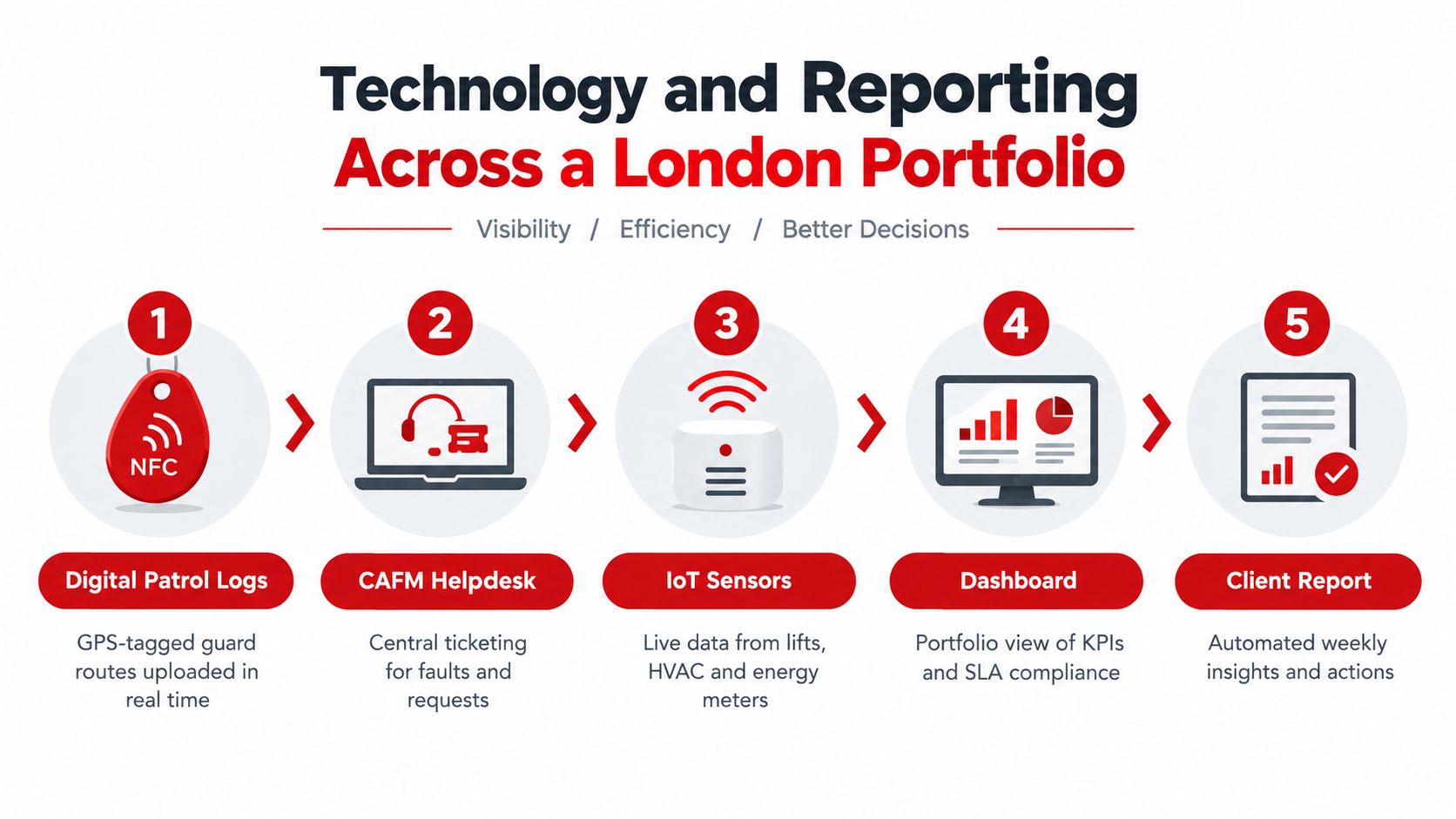
Use one CAFM or IWMS platform as the portfolio source of truth. Cleaning, security, M&E and front-of-house suppliers should feed work orders, inspections, incidents, asset records and close-out evidence into the same environment. If the client stitches separate reports together every Friday, the reporting process is already too fragile.
Build the information chain
Digital patrol logs should record NFC or GPS-tagged checkpoints, timestamps and exceptions. A central incident log should tag each event by borough, building, service and severity. CCTV alarms should route verified events to the control room, with an audit trail showing who reviewed the footage, what action they took and when the matter was escalated.
The reporting rhythm should be simple enough to operate and detailed enough to challenge suppliers:
Weekly site pack: Open incidents, completed tasks, overdue actions and immediate risks.
Monthly portfolio dashboard: SLA performance, compliance status, corrective actions and energy exceptions.
Quarterly executive summary: Plain-English trends, recurring causes, financial exposure and decisions required.
Use access control systems as part of a wider workflow, not as an isolated technology purchase. Badge failures, visitor events and security incidents need to connect to the building record and the responsible service team.
Before activating cameras, patrol tracking or body-worn video, document the lawful basis, retention rules and access permissions. Provide GDPR-compliant signage, maintain audit trails for footage and define how data is shared when sub-tenants occupy part of a managed building.
The technology should answer three questions quickly: what happened, who owns it and what prevents recurrence. If it only produces attractive dashboards, it isn't managing the estate.
Staffing Continuity and Dedicated Teams
A London portfolio loses value when the people delivering services change constantly. Tenants recognise familiar security officers, receptionists and supervisors. Engineers who know each building's plant room, access restrictions and recurring defects resolve faults faster than temporary cover unfamiliar with the site.
Build a dedicated team around the portfolio manager. Assign supervisors and engineers exclusively, or primarily, to the estate. Moving them between unrelated client accounts whenever another contract has a gap weakens handovers and makes borough-level accountability harder to maintain.
Design cover around the operating day
Set the rota against actual demand, not a generic staffing template. For many office estates, that means staggered shifts across the 06:00 to 22:00 operating window, backed by a 24/7 on-call engineer rota for building-critical plant.
Agree named holiday cover at least six weeks in advance. Pre-induct relief staff, issue their access permissions and test their understanding of emergency procedures before a vacancy occurs.
The staffing design should include:
Portfolio manager: One accountable decision-maker for service, risk and client communication.
Dedicated supervisors: Borough-aware leaders who inspect standards and coordinate local teams.
Engineers: M&E specialists who know the assets, records and critical plant.
Security and front-of-house teams: Staff trained against common procedures, with site-specific induction.
Relief pool: Approved cover that can step in without restarting mobilisation.
Retention requires practical investment. Fund SIA licences where security staff require them, provide structured CPD for M&E engineers and run an annual engagement survey that allows results to be compared across buildings.
The financial case is direct. High staff turnover creates recruitment, vetting, induction and training costs while reducing familiarity with the estate. Excessive churn can therefore consume some of the savings that consolidation was intended to create.
Maintain continuity of service through planned cover, documented handovers and stable site assignments. A dedicated team is an operating control. It reduces missed information, inconsistent standards and avoidable escalation across buildings in different boroughs.
Cost and Efficiency Outcomes for London Operators
A consolidated contract should reduce the work required to run the estate, not just move costs between budget lines. One commercial relationship can replace several administration cycles. Portfolio procurement can standardise consumables and service rates. Coordinated mobile patrols can cut duplicated journeys, while a single supervision structure can remove overlapping account-management overhead.
The UK outsourced FM market overview describes a fragmented market spanning soft, hard and integrated delivery models. That makes the operating model more important than the label on the contract. Test whether the proposed savings come from fewer interfaces, better scheduling and clearer ownership, rather than from reducing site coverage.
Cost or efficiency lever | Fragmented multi-vendor baseline | Consolidated single-supplier outcome |
|---|---|---|
Contract administration | Separate invoices, reviews, renewals and escalation routes | One commercial relationship and one portfolio review structure |
Consumables procurement | Site-by-site ordering and inconsistent specifications | Common standards and portfolio purchasing where demand justifies it |
Patrol coverage | Separate routes and duplicated travel between buildings | Coordinated routes with local exceptions retained |
Supervision | Several account managers and discipline leads | A unified management layer with clear service ownership |
Reporting | Manual reconciliation across supplier formats | One dashboard and one audit trail |
Out-of-hours cover | Separate arrangements that may leave gaps between services | A planned duty structure, priced transparently in the contract |
For a five-site office portfolio of roughly 250,000 square feet, potential savings should be modelled against the existing cost baseline rather than assumed in advance. Define the included services, record exclusions and measure the same scope after consolidation to establish whether bundling cleaning, security and other services is actually delivering value.
London can erode savings quickly. Congestion, central-city night rates and out-of-hours attendance all affect the cost model. A 50-storey tower should not share an SLA template with a small estate office. Asset risk, staffing requirements and escalation consequences differ, so price and service levels by building type.
The strongest gains may sit outside the headline tender price: one invoice, one QHSE reporting line and one corrective-action register. Fragmented delivery often leaves duplicated helpdesk licences, account-management time and tenant dissatisfaction buried in separate budgets.
Industry trend coverage for 2025 identifies cost and value for money as the top purchasing driver for 77% of experts, alongside service quality, flexibility and data insight. Buyers should score proposals on total operating value, including management time, response coordination and reporting quality, rather than selecting the lowest tender figure.
Choosing the Right Multi-Site FM Partner
Ask the supplier to show its London operating footprint, relevant accreditations and live references in a borough mix that resembles your own estate.
Test the operating team
Meet the proposed account director, portfolio manager and operational leads face to face. Ask them to work through a lift entrapment, a security incident, a failed cleaner handover and an urgent compliance action.
Stress-test mobilisation and exit
Require a 30, 60 and 90-day mobilisation plan with named milestones. Those milestones should cover asset data, access permissions, TUPE assessment and any applicable information and consultation requirements, uniforms, training, patrol routes, supplier handover and reporting. Contractual payment or retention should be tied to evidence that the milestones have been achieved.
Confirm how records, keys, access credentials, asset information and open corrective actions will transfer. TUPE obligations need specialist legal review when incumbent staff work across occupied buildings.
The board's decisive question is simple: who carries the risk when a site goes dark at 2am?
For London clients comparing integrated options, Solomon's Facilities Management provides security, cleaning, reception and concierge services under one contract.
Solomon's Facilities Management can help London portfolios coordinate security, cleaning, reception and concierge services across dispersed buildings through one accountable operating model. Visit Solomon's Facilities Management to discuss your borough coverage, staffing requirements and multi-site mobilisation plan.

Comments