
Office Cleaning Schedule: A Practical Guide for UK Managers

British employees lose 13 working hours per year cleaning their office or workspace, according to a UK workplace hygiene survey reported by Marie Claire. That figure exposes the weakness in many office cleaning schedules. A timetable can look complete while still pushing routine work back onto employees, leaving shared areas under-serviced and wasting time that should be spent on business operations.
A useful schedule isn't a laminated list of chores. It's a risk-based operational document that changes with footfall, hot-desking, room turnover, visitor activity and the condition of the building. The strongest schedules also name the person responsible, record what happened, and show what happens when a task fails.
Table of Contents
Why Most Office Cleaning Schedules Quietly Fail - The checklist problem
Mapping Your Office Before You Write a Schedule - Build the room inventory
Building the Daily, Weekly, and Monthly Cadence - Daily cadence - Weekly cadence - Monthly cadence
Checklists, Handovers, and Escalation Paths - Use two levels of detail - Escalate to a resolution
KPIs and Spot Checks That Keep Standards Honest - Inspect at unpredictable times
A 30-Day Rollout Plan and Common Questions - Questions managers usually ask
Why Most Office Cleaning Schedules Quietly Fail
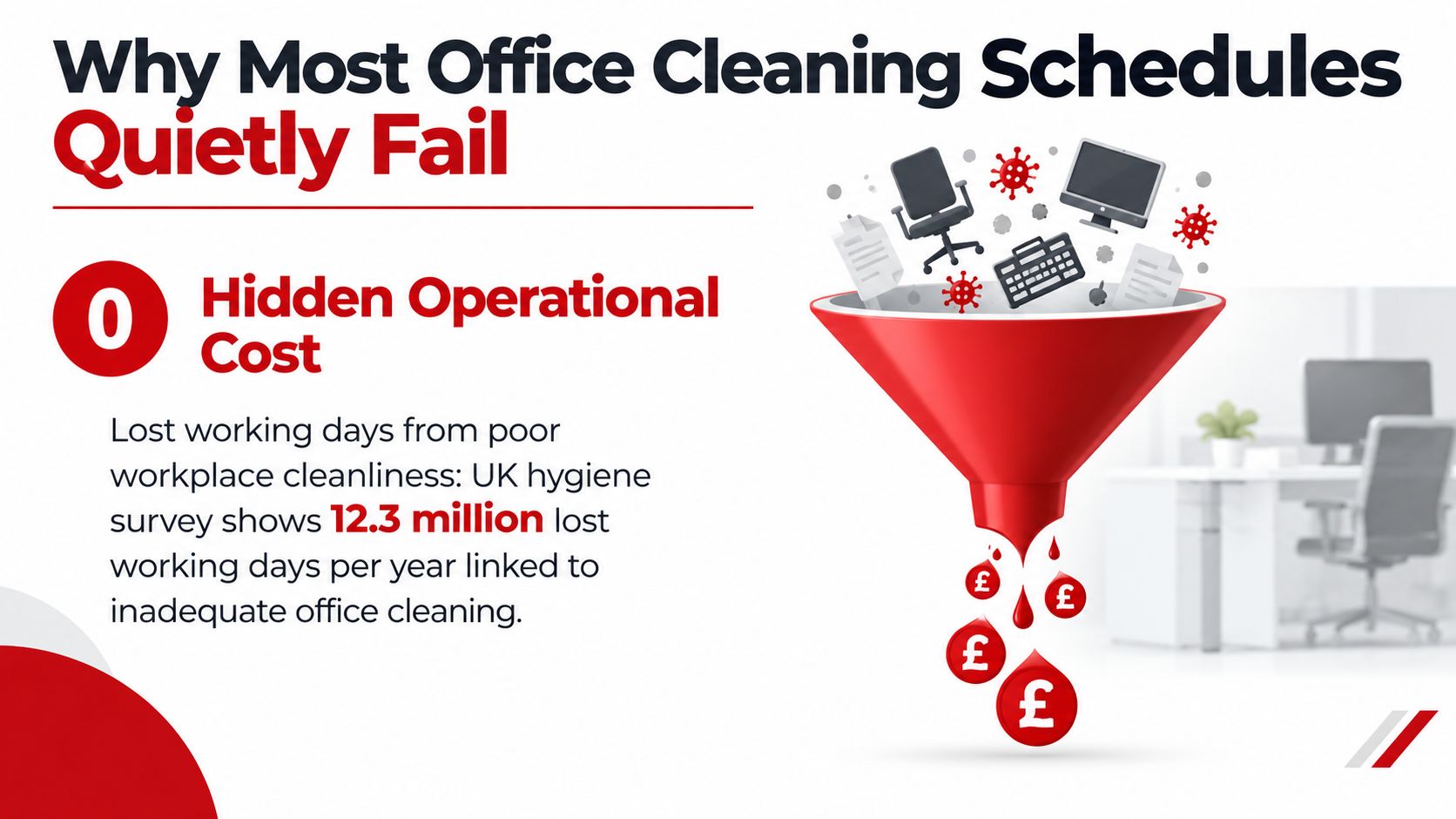
Poor scheduling leaves employees doing paid cleaning work. A UK workplace survey found that 85% of employees were still asked to clean desks every week, even though 85% said their company already employed a cleaner. Staff were also expected to clean kitchen or communal food-preparation areas, and many were asked to vacuum. The survey findings expose a service-design failure: the contract exists, but the rota does not match how the office operates.
The practical consequences are predictable. Desk cleaning becomes inconsistent, shared kitchens have no clear owner, and facilities teams receive complaints without a dependable service record. Attendance alone is a weak measure. The schedule must show whether the right room received the right treatment at the right point in the day.
The checklist problem
A schedule copied from one site to another quickly becomes inaccurate. Hybrid attendance, newly occupied floors, changing tenant arrangements and room turnover all alter demand. A quiet meeting room does not require the same cadence as a busy washroom, and a static checklist cannot make that distinction.
The hygiene gap is visible in UK workplace reporting. One industry study found that only 35% of workers said their desk was cleaned daily, while 37% said their computer mouse was never cleaned and 31% said the same of keyboards. The UK office-cleaning guidance connects the problem with shared equipment and frequently touched surfaces.
Treat the schedule as a live risk-control document. Map the site, rank rooms by footfall and touchpoint intensity, and set different frequencies for washrooms, kitchens, reception, meeting rooms and low-use offices. Record handovers, missed tasks and defects, then change the rota when spot checks or complaints show that the cadence is failing.
Mapping Your Office Before You Write a Schedule
A facilities manager needs a concise site map that explains who uses each space, when they use it, and which surfaces receive repeated contact.
Walk the premises during a normal operating period, not only during a quiet inspection. Record the footprint, desk density, headcount pattern, opening hours, shift changes, visitor route and any shared areas managed with a landlord or neighbouring tenant. Note where cleaners can store equipment, how waste leaves the building, and whether access restrictions prevent service at particular times.
Build the room inventory
List every room type separately. Reception, lifts, stair cores, kitchens, washrooms, meeting rooms, open-plan desks, private offices and breakout areas don't belong in one generic line labelled “clean office”. For each room, capture door handles, push plates, taps, flush controls, appliance handles, switches, shared screens, keyboards, mice, table edges and waste points.
Ask the following before setting frequency:
Usage: Which rooms have the heaviest footfall and highest turnover?
Touchpoints: Which surfaces are handled by several people throughout the day?
History: When was the last deep clean, and what defects recur in incident or complaint logs?
Timing: Which areas need servicing before arrival, during occupancy, or after the last shift?
Constraints: Are there accessibility requirements, secure zones, tenant boundaries or waste-handling limits?
Resilience: What happens if the usual cleaner is absent or a room becomes unavailable?
Building the Daily, Weekly, and Monthly Cadence
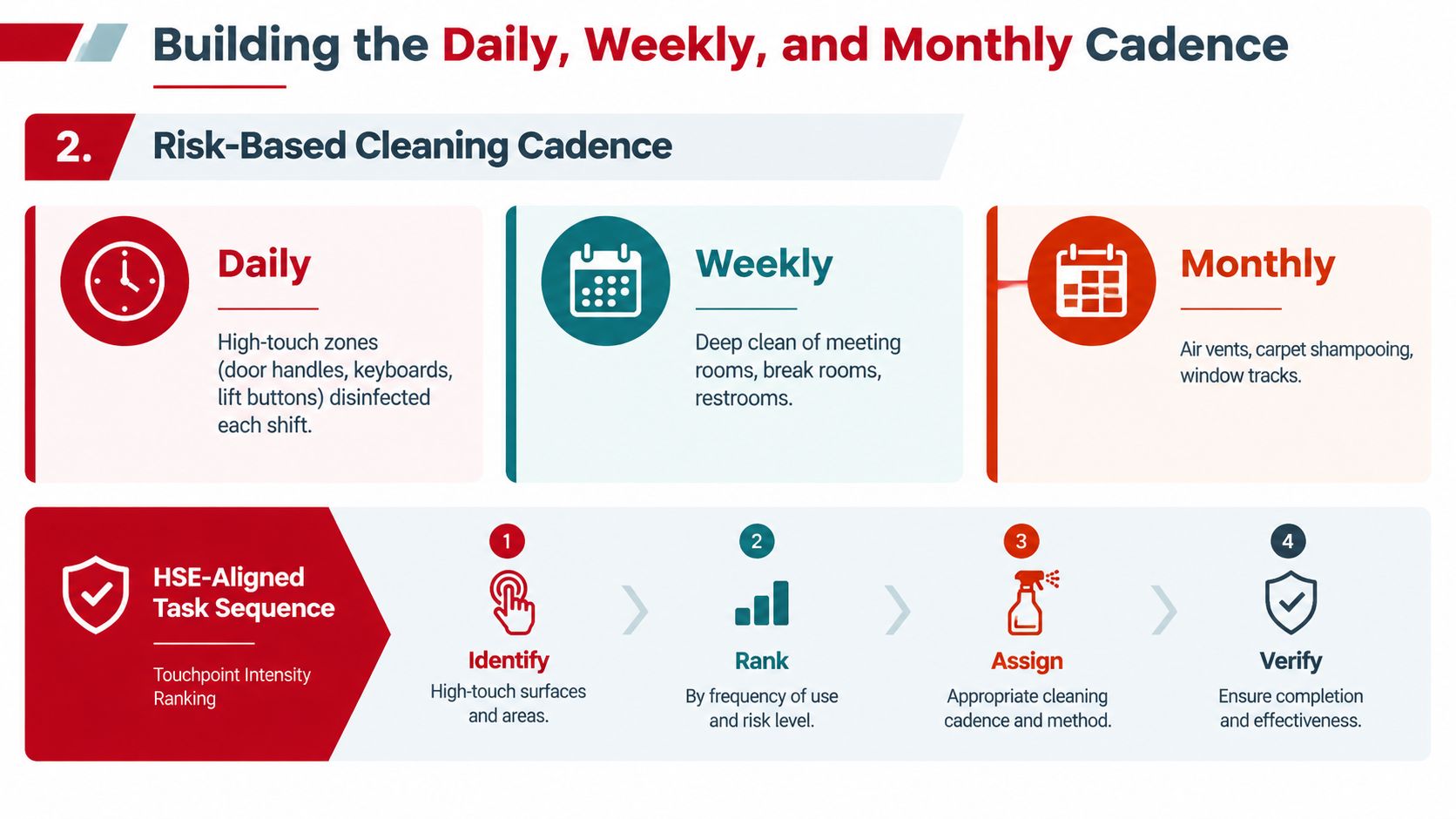
A practical office cleaning schedule has three layers. Daily work controls immediate hygiene and presentation risks, weekly work removes detail build-up, and monthly work handles tasks that don't justify daily attention but still affect the building's condition.
The sequence matters. UK workplace guidance from the Health and Safety Executive emphasises safe chemical handling, suitable ventilation and protective equipment where required. The operational order should also reduce rework:
Prepare and inspect: Check hazards, spills, sharps, damaged equipment and access restrictions before starting.
Remove waste: Empty bins, replace liners and separate waste according to site procedures.
Clean washrooms and kitchens: Deal with hygiene-critical rooms before lower-risk presentation tasks.
Dust from high to low: Prevent settled dust from falling onto surfaces already cleaned.
Clean and disinfect touchpoints: Follow the product instructions and respect contact time.
Vacuum, then mop: Remove loose debris before wet floor care.
Replenish and inspect: Restock consumables, record defects and obtain sign-off.
Daily cadence
Daily service should cover washrooms, kitchens, reception, breakout areas, corridors, lifts, staircases, bins and occupied work zones. Empty waste, wipe kitchen worktops and appliance handles, reset washrooms, clean visible spills, and sanitise high-touch points such as door handles, lift buttons, taps, switches and shared equipment.
Workstations need a clear boundary. If employees are responsible for personal items, the cleaner should still service agreed desk surfaces, chair touchpoints and shared devices. Don't leave “desks” on the schedule without specifying whether that means an empty surface, monitor stands, phones or keyboards.
Weekly cadence
Use the weekly rotation for internal glass, partitions, skirting, detailed desk cleaning, meeting-room edges, furniture joints and more intensive vacuuming. Inspect corners, cable routes, under-desk areas and places where routine vacuuming misses debris.
Monthly cadence
Monthly work should rotate through high-level dusting, ventilation grilles, carpet extraction where appropriate, window tracks, difficult-to-reach ledges and a full deep-clean review. Carpets still need routine vacuuming, while extraction belongs in a planned periodic cycle. External windows are usually a separate planned service rather than part of the daily indoor rota.
The cadence should change when use changes. A meeting room with repeated bookings may need a reset between sessions, while a low-occupancy private office may remain on the standard route. Don't add tasks to make the schedule look thorough. Add them when footfall, contact intensity, complaints or inspection results justify the labour.
Assigning Task Owners Without Creating Gaps
Consider a 120-person London office across three floors. The cleaning contract covers washrooms, kitchens, shared touchpoints, meeting rooms, floors and waste. In-house facilities manages plant rooms, post, access arrangements and consumable ordering. Staff and tenants clear their own mugs, personal items and food from designated fridges.
That division can work, but only if the schedule distinguishes between responsible, accountable, consulted and informed people. A RACI exercise is useful because it exposes tasks that have been assigned to everybody, which usually means they've been assigned to nobody.
Task Area | Contracted Cleaners | In-House Facilities | Staff / Tenants |
|---|---|---|---|
Washrooms | Clean, disinfect, replenish agreed supplies and report defects | Manage access, defects and contract escalation | Report spills, damage and supply issues |
Kitchens | Clean worktops, sinks, appliance exteriors and floors | Coordinate appliance repairs and waste arrangements | Clear personal items, mugs and food |
Workstations | Service agreed clear surfaces and shared equipment | Define desk-cleaning protocol and access rules | Remove confidential papers and personal belongings |
Meeting rooms | Reset tables, touchpoints, floors and presentation areas | Manage booking information and room defects | Leave rooms clear and report spills |
Plant rooms | Service only where included and safe | Own access, compliance and maintenance coordination | No routine responsibility |
Consumables | Flag low stock during checks | Order, store and distribute stock | Report missing items through the agreed channel |
Limited contractor cover can create predictable gaps in offices that operate heavily during the week. Add a named daytime supervisor or porter who can check washrooms, kitchens and spillages while the building is occupied. Build cover instructions for absence, agency staff and access changes into the service folder, not into someone's memory.
The most fragile moments are shift start, lunch cover and end-of-day lock-up. At each handover, record unfinished work, restricted rooms, low consumables and hazards.
A consolidated provider such as Solomon's Facilities Management can be considered where a manager wants cleaning and other site functions coordinated under one contract.
Checklists, Handovers, and Escalation Paths
A checklist earns its place when another person can use it to verify work without relying on the cleaner's memory. At minimum, include the date, shift, named cleaner, room set, pass or fail status, time stamp and free-text notes. Add a defect code or photo reference where the site uses a digital reporting system.
The wording should reflect the task. “Kitchen cleaned” is too broad to audit. “Worktops wiped, sink cleaned, appliance handles disinfected, floor free of visible debris and bin liner replaced” gives the cleaner a usable instruction and the supervisor a meaningful inspection point.
Use two levels of detail
A daily washroom checklist might read:
Fixtures: Toilets, basins, taps and flush controls cleaned and disinfected.
Touchpoints: Door handles, locks, dispensers and switches checked and treated.
Presentation: Mirrors clear, floors clean, odour controlled and waste removed.
Supplies: Soap, toilet tissue, hand towels and sanitary products replenished.
Defects: Leaks, blocked drains, broken dispensers and damage recorded.
A weekly kitchen deep-clean checklist should ask for a more detailed inspection:
Appliances: Exterior surfaces and handles cleaned, with internal tasks completed where included.
Hidden edges: Plinths, corners, splashbacks and areas beneath movable items checked.
Waste points: Bins washed or detailed according to the specification.
Condition: Grease, residue, staining and odour sources recorded rather than marked as clean.
The handover log should cover the outgoing shift's completed work, incomplete tasks, consumable reorder alerts, incidents, room restrictions and the next action. “Dispenser broken” is a poor entry. “Second-floor washroom, soap dispenser empty because pump is seized, supervisor informed, replacement requested, check at next round” is actionable.
Escalate to a resolution
Use a simple route. The cleaner flags the issue. The supervisor reviews it within one hour, where that service level is agreed. The facilities manager is notified within the agreed escalation period if the matter remains unresolved, and the building manager or affected tenants are included when the defect threatens access, hygiene, safety or business continuity.
Set the threshold in the contract. A blocked washroom, bodily-fluid incident, significant leak or unavailable hygiene consumable shouldn't sit in a general comments field. The escalation entry must include containment, ownership, target action and closure evidence.
For further examples of task wording and coverage, managers can compare their document with this commercial cleaning checklist resource. Use it as a prompt, then adapt the checklist to the actual rooms and risks found on site.
KPIs and Spot Checks That Keep Standards Honest
A schedule becomes credible when inspection data changes the next rota. Keep the dashboard small enough to review every month, but specific enough to expose weak points.
The most useful measures are operational rather than decorative:
Washroom audit score: use a structured check covering fixtures, touchpoints, supplies, odour, floors and defects. Set an agreed pass threshold within the cleaning specification and use repeated failures to trigger corrective action. For broader guidance on cleaning frequency, see this article published by MNS Services
High-touch pass rate:Inspect handles, buttons, switches, taps and shared equipment against the agreed site standard. Record failures by area and use recurring issues to adjust cleaning frequency, supervision or the cleaning route.
Consumable stock-outs: Count each incident and identify whether the cause was ordering, storage, delivery or an incomplete cleaning round.
Reactive callouts: Track requests for spills, odour, overflowing bins, missed rooms and urgent washroom attention.
Tenant complaints: Group complaints by room, shift, contractor and defect type rather than recording only the total.
Inspect at unpredictable times
A ten-minute floor walk during occupied hours often reveals more than a scheduled end-of-month inspection. Check washrooms after peak use, kitchen surfaces after lunch, lift touchpoints, reception presentation, bin capacity and whether the handover log matches reality.
Run a formal facilities-led deep audit monthly. Compare results by floor and shift. If the same washroom fails repeatedly, increase attention there or investigate the underlying cause, such as inadequate consumables, poor ventilation, damaged fixtures or a route that gives the cleaner too little time.
A facilities-management operating model should connect cleaning, maintenance, front-of-house reports and incident handling. Guidance on that broader coordination is available through soft services facilities management.
A 30-Day Rollout Plan and Common Questions
A new office cleaning schedule shouldn't be launched as a document alone. Give the building a short controlled rollout, test the route, and adjust the scope before treating it as the operating standard.
Week | Key Actions | Deliverable |
|---|---|---|
Week 1 | Audit every floor, map footfall and room use, review complaints and incidents, confirm access windows | One-page site map and risk register |
Week 2 | Draft daily, weekly and monthly tasks, consult the cleaning contractor, confirm chemical and equipment requirements, assign owners | Cadence matrix and named RACI |
Week 3 | Pilot the checklist and handover log on one floor, brief cleaners and facilities staff, test absence cover and escalation | Completed pilot records and revised forms |
Week 4 | Set the KPI baseline, run the first formal spot check, hold the contractor sign-off meeting, publish the approved rota | Signed schedule, audit record and review date |
Questions managers usually ask
How should the schedule adapt to a two or three-day hybrid office? Keep hygiene-critical areas and high-touch points on a cadence linked to actual occupancy, not a presumed five-day pattern. Use lighter maintenance on quiet days, then schedule stronger resets after the busiest attendance periods. Shared desks and meeting rooms need particular attention because turnover can be high even when the average headcount looks modest.
When should a quarterly deep clean replace a monthly rotation? Use monthly attention for build-up that affects hygiene, access or presentation, such as high-level dust, ventilation grilles and difficult edges. Use a quarterly deep clean when inspection findings, seasonal conditions, construction dust, heavy visitor use or accumulated carpet and fabric soil justify a larger intervention. The decision should come from condition evidence, not a calendar alone.
When does the contract need a retender rather than a tweak? Retender when missed tasks continue after clear instructions, named supervision and reasonable corrective action. Persistent failures across different shifts, unreliable cover, incomplete records, recurring supply gaps and a provider unable to explain KPI results point to a structural service problem. A minor route adjustment won't repair a contract that lacks accountability, competence or capacity.
Solomon's Facilities Management can help London managers structure office cleaning, janitorial routines, quality checks and wider site coordination around a defined operating schedule.
Visit Solomon's Facilities Management to discuss a cleaning plan built around your building's occupancy, touchpoints, handovers and inspection requirements.

Comments