
Concierge Services for Office Buildings in London

At 8.30am, a London office reception desk can be handling three visitors on tablets, a courier queue, a failed access card, and a contractor arriving for a riser inspection. If the concierge treats those as unrelated interruptions, the building feels disorganised. If the desk controls each hand-off properly, tenants experience a calm front of house while the facilities team gains a reliable operational record.
That distinction matters. Concierge services in office buildings aren't a prestige greeting role. They're the control layer where visitor management, access requests, deliveries, tenant communication, contractor movements, and first-response incidents meet. The right service improves accountability. The wrong one is a dressed-up security rota.
Table of Contents
What a Concierge Actually Does in a Modern Office Building - The desk as a control layer - Why the job description matters
The Core Duties of an Office Concierge Service - Nine duties to put into the specification
KPIs, Training Standards and Compliance That Matter - A balanced measurement set - Compliance must be designed into the role
How Concierge Shapes Tenant Experience and Security - Security is a service responsibility
An Implementation Checklist for London Offices - Build the tender around six decisions
What a Concierge Actually Does in a Modern Office Building
The visitor scans in, the host receives an alert, and the concierge checks that the name, company and destination match the booking. At the same time, a courier needs a signature, a tenant reports that an access card has stopped working, and a contractor must be recorded before entering a restricted area. None of this looks dramatic, but every action affects safety, service quality and the building manager's ability to understand what happened later.
A modern concierge owns those hand-offs. The role covers the welcome desk, but it also protects the integrity of the information moving through the lobby. The operative knows who has arrived, why they're there, where a parcel has gone, which tenant needs support and when an issue must move to security, engineering or property management.
The best way to understand the role is to treat the desk like an air traffic control point. Aircraft don't arrive because someone waves them towards a runway. Movements are checked, prioritised and recorded. Office front-of-house needs the same discipline, adapted to visitors, staff, deliveries and contractors.
The desk as a control layer
A visitor-management platform should replace informal notebooks and disconnected email chains. The system should support pre-registration, identity or booking checks, host alerts, visitor badges and an auditable record. Guidance on visitor management systems is useful when deciding how the technology should support, rather than obscure, the concierge's judgement.
The concierge also becomes the first point of contact for tenant requests. A failed pass may belong with access control, a cooling complaint with engineering, and a missing delivery with the mailroom or courier. The desk doesn't need to solve every problem, but it must route each one to a named owner and retain enough information to track the response.
Why the job description matters
The UK facilities management picture supports this broader interpretation. A 2023 survey of UK facilities managers found that 82% still had a receptionist, and 82% expected to still have one in five years' time. The same survey found that 52% said the reception role had expanded, while 42% said it had become less paper-based and more technology-driven. These findings are reported in Bellrock's service charge operating report for offices.
A specification that says “provide a welcoming reception” is too vague for a multi-tenant building. It leaves parcel custody, incident escalation and data ownership open to interpretation. Write the role as an accountable operational function, then measure the work created at the desk.
The Core Duties of an Office Concierge Service
A credible specification should name the duties, systems and hand-offs. If the contract doesn't say who records a visitor, owns a parcel log or escalates an incident, the building will discover the gap during the busiest part of the day.
Nine duties to put into the specification
Visitor reception and pre-registration. The concierge validates bookings, checks arrivals against tenant instructions, issues credentials and alerts hosts. The visitor platform, not a loose sheet of paper, should be the system of record.
Access pass issue and audit. Temporary cards need controlled issuance, return checks and escalation when a card is lost or retained. The concierge should liaise with the access-control administrator, not make undocumented changes.
Parcel and courier handling. The desk receives, labels, stores and releases deliveries against a recipient or tenant record. Chain-of-custody matters most when the package is urgent, valuable or disputed.
Tenant request triage. Calls, emails and desk requests should enter the FM helpdesk with a clear category, priority and owner. A concierge who only says “I'll pass that on” creates no accountability.
Meeting room and visitor support. Room bookings, taxis, parking instructions and guest directions belong in the service design where tenants expect the desk to coordinate them. The limits should be explicit, especially for premium or executive assistance.
Incident first response. The concierge records what was seen, protects the immediate area where appropriate and contacts the correct emergency or management lead. They must follow the building's documented emergency procedure rather than improvise.
Contractor sign-in and permit checks. Contractor arrival, employer, work area, induction status and permit-to-work requirements should be verified before access. The desk must know when to stop the process and call building management.
Information and communication. Planned works, access changes, deliveries and tenant notices need a controlled communication route. The concierge should use approved messages and record important notifications.
End-of-day checks and handover. Outstanding visitors, uncollected parcels, unresolved requests, temporary passes and incidents must transfer to the next shift. A concise handover prevents the night team from starting blind.
Practical rule: If the desk can't produce visitor, parcel and incident records on request, it isn't operating a concierge service. It's operating a security rota with a smile.
Digital check-in, host alerts and reporting platforms create traceability across these duties. A UK commercial concierge specification should cover reception, visitor verification, access-control liaison, parcels, tenant communication and documented emergency response, as outlined in guidance on what a commercial building concierge service should include.
Shared Reception Versus Dedicated Concierge Models
The staffing model controls more than the welcome at the desk. It decides who owns tenant requests, access issues, parcel queries, incident records and the digital visitor trail when the building is under pressure.
A shared reception team serves several properties or occupier environments. It suits a smaller office with predictable traffic, especially where the building manager already handles tenant communication and technical escalation. Spreading staff across sites can reduce the service cost, but it also creates a continuity risk: the person on duty may not know the tenants, access rules or open issues.
A dedicated team works in one building or one occupier environment. Staff learn tenant names, delivery patterns, access arrangements and escalation routes. Choose this model for a high-profile multi-tenant tower, headquarters or managed office where the front of house must take ownership, maintain records and coordinate with the wider facilities team.
Factor | Shared Reception Model | Dedicated Concierge Model |
|---|---|---|
Cost structure | Usually lower because staff cover more than one site | Higher because the team is assigned to one building |
Coverage resilience | Portfolio cover can help with absences, but another site may compete for attention | Local resilience depends on the supplier's relief plan and team depth |
Staff continuity | Tenants may see different operatives and repeat information | Staff build working knowledge of occupants and building routines |
Accountability | Responsibility can sit between the desk, supplier and property manager | A named building lead can own records, handovers and escalation |
Best fit | Smaller offices with steady demand and strong building-management support | Trophy towers, headquarters, serviced offices and complex multi-tenant assets |
London's managed-office market shows why the choice needs evidence rather than branding. Buildings offering managed office space reached 755 by the end of 2025, a 66% increase over three years, according to Priority First's London corporate concierge report. As buildings combine multiple occupiers with service-led operations, a pooled desk must prove that it can still provide consistent ownership, accurate records and prompt escalation.
A hybrid model is often the practical answer. Assign a dedicated day lead, then use shared or relief cover outside peak periods. Put the accountable lead, handover method, absence cover and escalation route in the contract. Do not accept “shared coverage” without naming who checks the visitor data, outstanding tenant requests and incident log.
Reception also needs to connect with security, cleaning, maintenance and reporting. Solomon's guidance on integrated facilities management across connected building services supports that operating view. A concierge desk that only greets people is a staffed entrance. A desk that controls information, access coordination and follow-through is front-of-house management.
KPIs, Training Standards and Compliance That Matter
Concierge should be managed like any other FM service. Appearance and warmth matter, but they don't prove that the building is controlled. The contract needs operational measures that show whether visitors move efficiently, requests reach the right team, parcels remain traceable and incidents receive a documented response.
One caution is important. The brief examples often used in tenders, such as a visitor sign-in target under 30 seconds, parcel throughput per shift, closure rates or tenant satisfaction scores, are only useful when the building has first established its own baseline. Don't copy a target into a contract because it sounds impressive. Test it during mobilisation, adjust for the building's visitor profile and then attach reporting and service consequences.
A balanced measurement set
KPI | Target | Reporting cadence |
|---|---|---|
Visitor sign-in time | Agree a site-tested threshold after baseline measurement | Weekly during mobilisation, then monthly |
Parcel handling | Full receipt and release records, with no unexplained custody gaps | Daily exception review, monthly trend report |
Call and enquiry handling | Agreed response standard for calls and desk requests | Monthly |
Tenant request closure | Requests assigned, tracked and closed by the agreed owner | Weekly operational review |
Tenant satisfaction | Quarterly tenant pulse with comments and actions | Quarterly |
Incident reporting | Same-shift record and escalation according to the building procedure | Per incident, reviewed monthly |
Shift handover | Complete transfer of passes, visitors, parcels and open actions | Every shift |
The soft side belongs in observation, not guesswork. Use mystery shopping to test tone, discretion, disability etiquette, identification checks and escalation behaviour. Review the result with the team lead, then link coaching to a repeatable standard. Front-of-house training guidance can help structure the service around both hospitality and control.
Compliance must be designed into the role
Where concierge staff undertake licensable security activities, such as contracted security guarding or certain key-holding and CCTV duties, the appropriate SIA licence may be legally required. Routine reception and administrative visitor-management duties do not automatically require an SIA licence.
The National Protective Security Authority access-control guidance also stresses formal policy, risk assessment and an Operational Requirement. The building should therefore match controls to its assessed threat profile rather than copy a generic reception model.
Require evidence of identity and employment checks, shift handovers, emergency training, first aid arrangements, GDPR awareness and a written visitor-data retention rule. The provider should explain who can access records, how incidents are exported, when data is deleted and how subject-access requests are handled. Service credits or corrective-action clauses should apply when agreed standards fail. Without that mechanism, the KPI is decoration.
How Concierge Shapes Tenant Experience and Security
At 8:45, three visitors arrive, a courier is waiting for a signature and a tenant reports a failed access pass. A capable concierge keeps all three moving while recording who approved what. That is the front-of-house control layer. The welcome matters, but reception, access, parcels, tenant requests, incidents and visitor data must work as one accountable process.
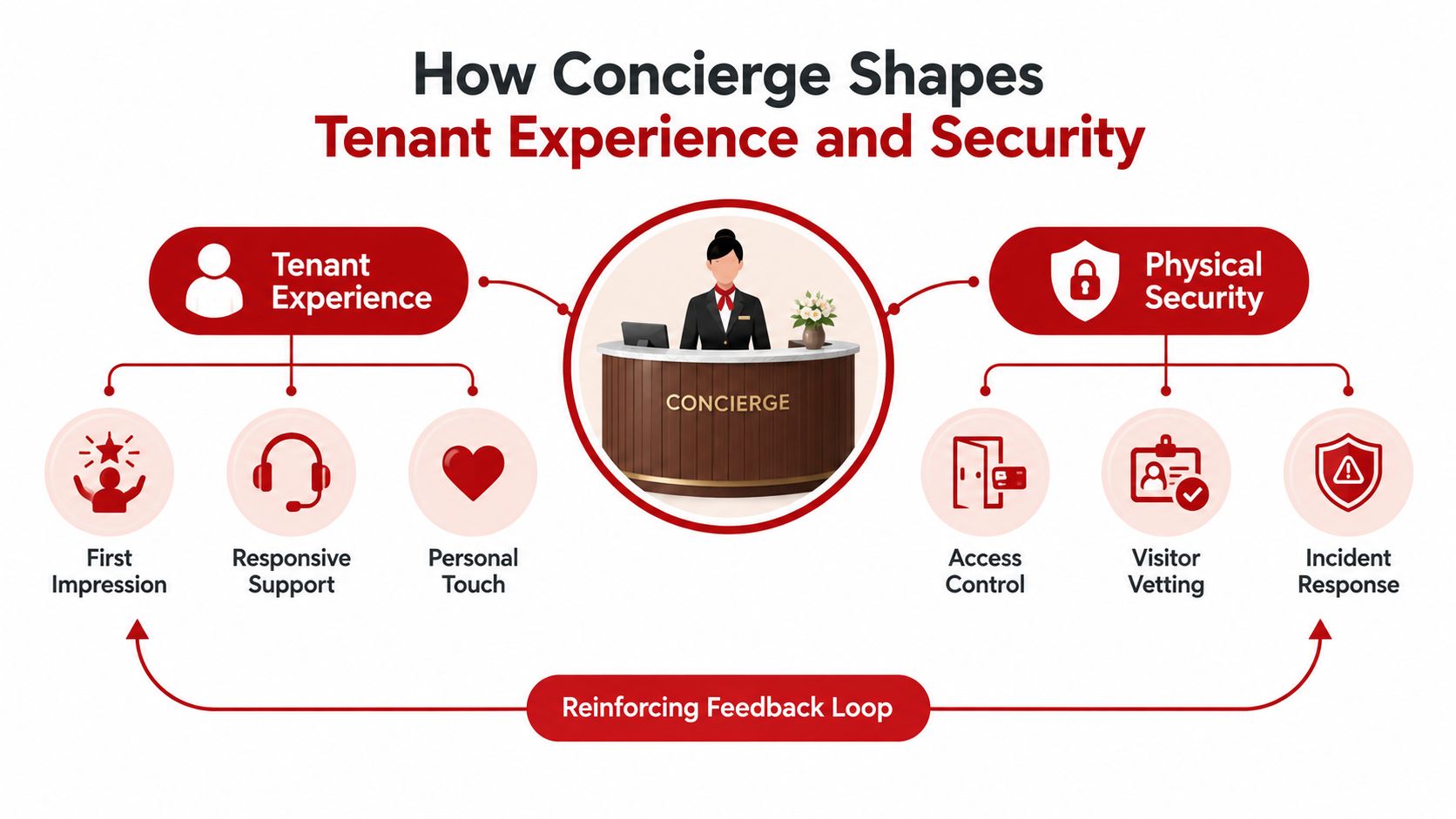
Independent UK office research identifies communication with the property manager, responsiveness to requests and understanding the occupier's business needs as major satisfaction drivers. The Reading University research on office occupier satisfaction supports a practical conclusion: concierge contributes to retention when it helps the building communicate and respond. A polished lobby alone does not.
The British Council for Offices' move from “space as a commodity” to “space as service” makes the standard clear. Tenants should not need a second email to locate a parcel, explain a recurring access problem or chase a contractor update. The desk should provide an answer, an owner and a recorded next action.
Security is a service responsibility
The concierge should own the front-of-house process for visitor pre-registration, contractor induction, temporary credentials and incident logging. Security officers, facilities managers and property managers may hold separate responsibilities, but the desk must know each boundary and escalate cleanly.
Poor integration creates predictable weaknesses:
Tailgating risk: An unmanaged queue encourages staff to wave people through.
Contractor uncertainty: Work begins before induction or permit checks finish.
Fire-accountability gaps: Visitor records cannot be reconciled with evacuation information.
Communication failure: Tenants receive late warnings about access changes or incidents.
A friendly reception that cannot explain who entered, who approved access and what happened next is not a secure front of house.
The commercial case for concierge services rests on accountability rather than market size. Value becomes apparent when the front-of-house team improves response times, strengthens communication, maintains accurate records and supports effective coordination between tenants, security and facilities management.
Review the operation through tenant satisfaction, response records, unresolved requests, access incidents and visitor data quality. Smiles are part of the service. They are not the measure of it.
An Implementation Checklist for London Offices
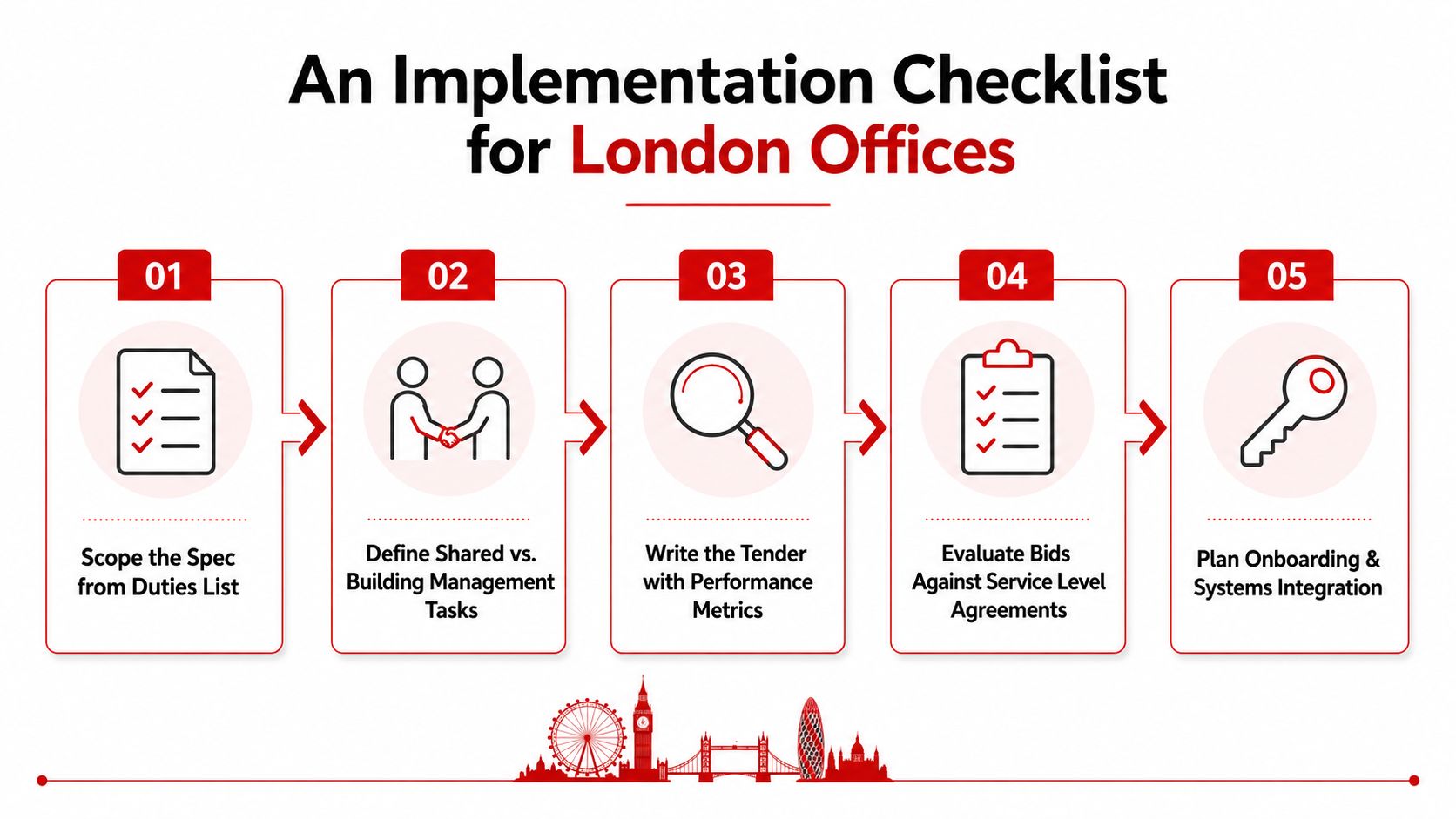
Procurement should begin with the building's operating reality, not a supplier's brochure. Walk the reception floor at opening, lunchtime, delivery peaks and close. Record where visitors wait, where parcels accumulate, which access decisions reach the desk and how tenant requests currently disappear.
Build the tender around six decisions
Define the service boundary. Start with the duty list. Mark each task as concierge-owned, shared with building management, or excluded. Include visitors, access passes, deliveries, contractor arrivals, tenant requests, meeting rooms, incidents and out-of-hours cover.
Select the staffing model. Choose shared, dedicated or hybrid cover using tenant mix, footfall, building complexity and the amount of decision-making expected at the desk. Don't choose shared cover merely because the hourly rate looks lower.
Shortlist credible suppliers. Ask for named London office references, shift structures, relief arrangements, sample reports and evidence of staff training. Visit comparable sites. A polished tender presentation doesn't reveal how the team handles a courier surge or an evacuation.
Write measurable contract terms. Include the KPI framework, reporting cadence, escalation rules, service credits and remedies. If an incumbent exists, review TUPE implications with the appropriate advisers before mobilisation.
Mobilise systems before launch. Configure the visitor-management platform, access-control permissions, parcel workflow and tenant request channel together. Test host alerts, badge recovery, data permissions and handover reports with real operating scenarios.
Review at agreed checkpoints. Use a 30, 60 and 90-day plan, then maintain regular performance reviews. Include tenant pulse feedback, not just supplier statistics. Ask which requests were delayed, which incidents exposed a gap and what the concierge team needs from property management.
Tender test: Ask each bidder to show the record a building manager would receive after a busy day. The answer will reveal more than a list of hospitality promises.
Mobilisation also needs a live-cover plan. The incoming team should shadow the current operation where possible, while the outgoing provider hands over access rules, tenant preferences, emergency contacts, open actions and system permissions. Treat the data transfer as a controlled operational change, not an administrative afterthought.
Two Illustrative London Office Concierge Scenarios
Consider a hypothetical serviced office tower near Liverpool Street using a dedicated concierge team. The lead concierge owns reception, visitor bookings, meeting-room coordination and the connection between tenant requests and the building's FM contacts. Visitors pre-register through the building app, parcel receipts appear on a dashboard for the building manager, and the team can explain the status of an access or IT issue without sending the tenant back to property management.
Now consider a hypothetical managed office building in Holborn using shared reception. One concierge covers several buildings, and the core tasks are still understood. The weakness appears when priorities collide. During a fire drill, parcels wait. Without a named lead on site, visitor records become inconsistent, and tenant requests move through the property manager instead of remaining visible at the desk.
Dimension | Liverpool Street Tower, Dedicated | Holborn Managed Block, Shared |
|---|---|---|
Reception ownership | Named building lead | Pooled cover across buildings |
Visitor workflow | Pre-registration and host alerts through the building app | Basic booking checks with less consistent records |
Parcel control | Dashboard reviewed by the building manager | Parcels can wait during competing duties |
Tenant requests | Concierge acts as the visible first point of contact | Requests often route through the property manager |
Continuity | Team retains tenant and building knowledge | Coverage is more resilient across sites, but local continuity is weaker |
Main lesson | Dedicated accountability turns the duty list into a service | Shared cover needs stronger handover and named ownership |
Neither model is automatically wrong. The Liverpool Street arrangement makes sense because the building sells service and needs a concierge who can make decisions locally. The Holborn arrangement can work where demand is predictable, but only if the supplier protects the desk during drills, deliveries and absences.
The critical question is not whether the operative is pleasant. Ask who owns the record, who answers the tenant and who remains accountable when the concierge is pulled away.
What to Decide This Week Before You Tender Concierge
A tender fails before suppliers see it if property management, tenant representatives and facilities teams want different outcomes. Hold one internal workshop and agree who owns the brief, who signs off changes and who will judge the service after mobilisation. Record disagreements rather than hiding them in vague wording.
Set the commercial guardrails before requesting prices. Build the budget around the building's size, tenant count, expected visitor and delivery demand, and the hours requiring coverage. Ask suppliers to price the same staffing assumptions and identify exclusions separately. That gives you comparable bids and exposes a low quote built around gaps in cover.
Set a practical tender timetable. Allow time for stakeholder sign-off, supplier questions, site visits, bid evaluation, clarification meetings, contract approval and mobilisation. Name an owner for each milestone, with a decision date for the preferred bidder. Do not leave mobilisation until the contract is signed.
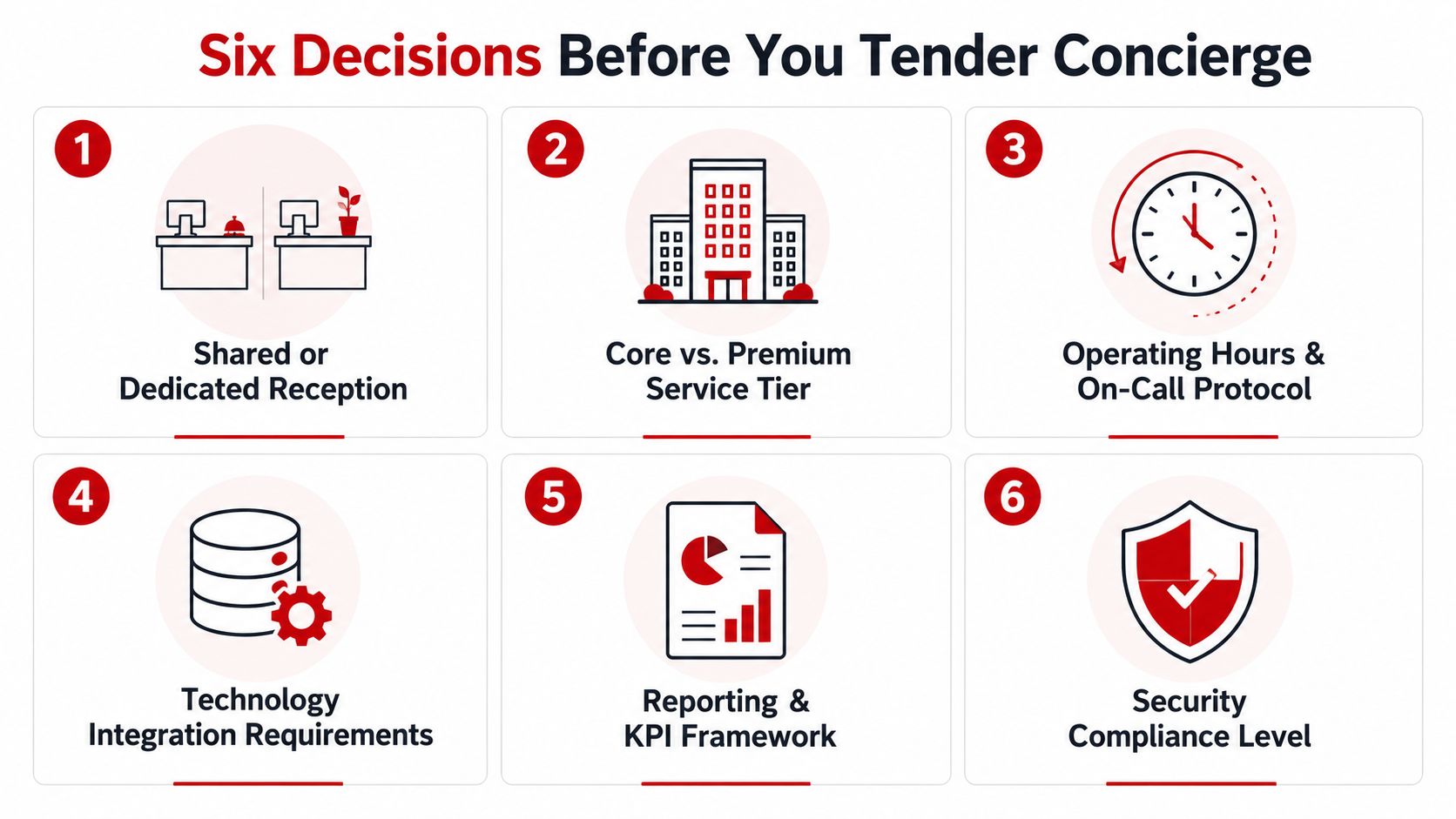
Use the tender to test accountability. Require bidders to show how they will report tenant issues, maintain handovers and evidence performance, rather than selling a polished greeting.
Solomon's Facilities Management provides commercial business concierge support for visitor management, tenant liaison, meeting-room coordination, deliveries, contractor scheduling and telephone handling. Visit Solomon's Facilities Management to discuss a London office specification built around accountable front-of-house control.

Comments