
Safety & Security Programme for London Sites

128 workers were killed in work-related accidents across Great Britain in 2024/25, according to the Health and Safety Executive's historical injury report. That's a useful corrective to a security conversation that starts and ends with trespassers. A London building's safety & security programme also needs to cover the contractor entering a restricted plant room, the cleaner finding a blocked exit and the receptionist handling a threatening caller.
Visible guarding matters, but it isn't the programme. The practical test is whether someone owns each control, whether the next shift receives the right information and whether the building can operate safely when its systems stop working.
Table of Contents
Suggested safety and security controls for a London site - Give each control an operating instruction
How to Score Risk on a Working Site - Use a repeatable assessment cycle - Test the score against a changed evening
Who Logs, Escalates and Hands On Each Threat - Follow the threat through to handover - Combine observations without encouraging confrontation
Running the Building When Systems Fail - Give the duty manager clear decisions - Rehearse the Saturday decision
Training Every Front-Line Role - Match instruction to exposure - Check behaviour, not attendance
KPIs Training and the Monthly Audit - Ask what changed after the action - Finish with the audit checks
Confirm One Contract Before You Renew - Make the renewal decision operational
Suggested safety and security controls for a London site
Start this week by putting a named person against every control, not by extending the guard rota. A job title establishes responsibility, but the operating sheet needs the actual owner, their deputy and a working contact route.
Suggested safety and security controls
Control | Minimum standard | Owner | Review |
|---|---|---|---|
Visitor and access control | Check-in, contractor screening, lock and unlock routine | Security or reception | Daily exceptions |
Violence, threats and abuse | Log in-person, phone and online threats, not only assaults | Reception with security | Same shift |
Workplace hazards | Blocked routes, falls risks, roof and plant access | Cleaning and maintenance to FM | Weekly |
CCTV and alarms | Defined monitoring or response, clips retrievable | Security provider | Monthly trends |
Shared incident register | One log with owner, deadline and review date | Facilities manager | After every incident |
Offline fallback | Manual access rules and a paper log | FM with IT and security | Rehearsal scheduled in the site plan |
Out-of-hours cover | Perimeter and lock check with a same-night report | Mobile patrol | Each visit |
These are proposed operating standards, not a substitute for the site's risk assessment. Set the review rhythm deliberately: access exceptions need attention before the next busy arrival period, while an injury needs an immediate management response.
Give each control an operating instruction
“Manage access” isn't an instruction. State who approves contractors, how reception verifies a changed booking and who checks that the rear entrance has locked. A practical guide to implementing access control can help turn that responsibility into a usable arrival and departure routine.
The scale of the wider threat supports this layered approach. For the year ending March 2025, the Crime Survey for England and Wales estimated approximately 9.4 million headline crime incidents, up 7%, while fraud increased 31% to around 4.2 million incidents, according to the Office for National Statistics. Those are England and Wales figures, not a London building's risk score, but they're a reason to test fraudulent access requests as well as forced entry.
For the wider management framework, HubEngage, Inc.’s resource on managing health and safety regulatory requirements offers a useful companion to site-specific procedures. Keep the distinction clear: a policy describes expectations; the operating sheet tells the duty team what to do.
Say a Shoreditch shop and the office above share an entrance. Shop staff hear repeated abuse, but the office patrol receives only lock-check instructions. Both suppliers may complete their tasks while nobody addresses the behaviour at the shared door.
Practical rule: A completed rota doesn't prove that a control has an owner.
Mark every blank owner, missing instruction and untested response in the table. Those gaps deserve attention before another camera or extra patrol visit.
How to Score Risk on a Working Site
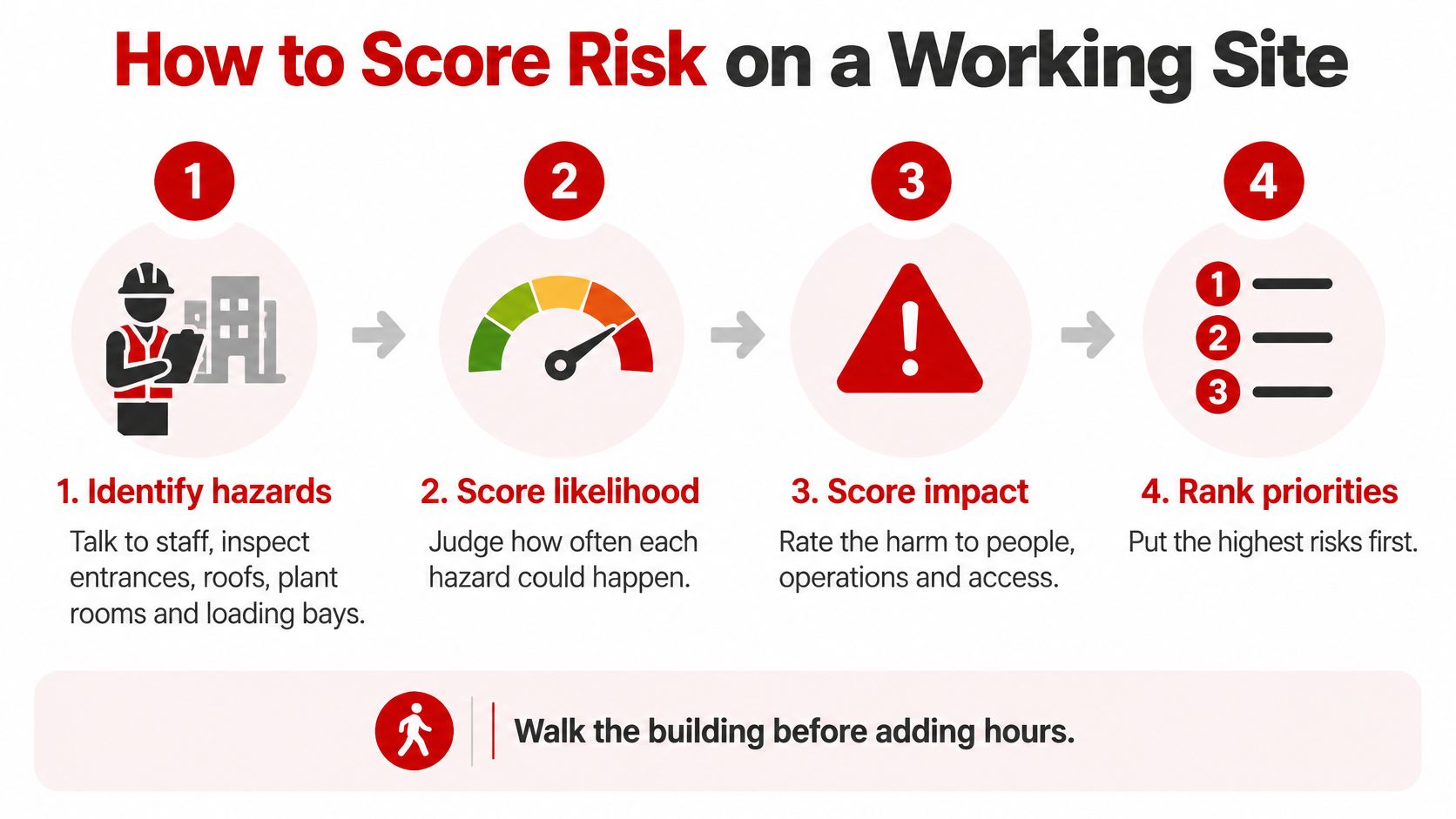
Walk the building before adding hours. Speak to the people who work away from the main desk, and inspect the route they use rather than the route drawn on the reception plan.
The HSE's guidance on assessing violence risks recommends combining staff consultation, observation and incident records, then applying multiple controls. It cautions against relying on a single measure, which is why “guard present” or “CCTV installed” shouldn't close an assessment.
Use this visual prompt during the walk, then complete the full assessment cycle below.
Use a repeatable assessment cycle
Identify hazards. Interview reception, guards, cleaning supervisors and maintenance staff separately before comparing their accounts. Walk entrances, roofs, plant rooms, loading bays and lone-worker routes. Read recent logs for patterns that staff may have accepted as normal, such as a delivery driver repeatedly holding open a service door.
Identify who is exposed. List receptionists, officers, cleaners, maintenance staff, contractors and late-shift workers. Describe the exposure rather than naming the role alone: a cleaner crossing an empty loading bay faces a different situation from a concierge behind an occupied desk.
Score likelihood and severity. Use agreed descriptions such as unlikely, possible and likely, alongside clear harm categories. Record the reason for each judgement. Include threats and near misses, and don't downgrade severity just because the last incident ended without injury.
Apply layered controls. Improve lighting, sightlines and queue layout before assuming more equipment is the answer. Remove trapping points, give staff an escape route, and combine appropriate CCTV, alarms, radios, signage and de-escalation skills. A camera can help establish what happened; it can't give a trapped receptionist a safe exit.
Record the findings. Use a digital register that accepts patrol reports, reception observations, CCTV alerts, access events and cleaning or maintenance notes. Give every action an owner, response deadline and review date. Restrict sensitive details to those who need them rather than giving every user unrestricted access.
Review when conditions change. Reopen the assessment after an incident, altered layout, new tenant or changed opening hours. Don't wait for the scheduled review if the way people use the building has already changed.
Test the score against a changed evening
Consider a Canary Wharf residential lobby that introduces evening food deliveries. In this hypothetical case, arrivals concentrate after 19:00, couriers wait beside residents collecting parcels, and the concierge has to resolve competing demands alone.
The assessment should change because the exposure has changed. Move the waiting point away from the desk, clarify delivery access, provide a reliable assistance call and reassess whether the evening staffing arrangement is adequate. Adding a camera without changing the congestion leaves the immediate problem intact.
Finish with a one-page assessment summary showing the hazard, exposed people, reasoning, controls and outstanding actions. The managing agent should share the relevant instructions with every employer working in the building, while keeping personal incident information appropriately controlled.
Who Logs, Escalates and Hands On Each Threat
Who records what on a London site
Role | First signs | Must record | Escalate when |
|---|---|---|---|
Static security officer | Tailgating, alarms, people still on site | Incident log and access exceptions | Threat, injury or crime |
Reception or concierge | Queue friction, repeat callers, unknown contractors | Refusals and verbal abuse | Repeat threats or distress |
Cleaner or janitorial | Isolated areas, hazards, signs of overnight entry | Hazard and near-miss note | Unsafe area or person on site |
Mobile patrol | Perimeter, locks, lighting | Same-night patrol report | Open door or intrusion |
CCTV operator | Live alerts | Alert and clip request | Violence or forced entry |
Facilities or building manager | Patterns across employers | Monthly review | Injury, outage or police call |
Separate notebooks make each team's account incomplete. Reception may record a refusal, cleaning may find evidence of entry, and the officer may see neither before beginning the evening shift.
The HSE's employer guidance on work-related violence covers threats and abuse face-to-face, online and by telephone, and sets out employers' responsibilities to assess risks, provide training and cooperate in shared workplaces. A caller doesn't have to enter the building for their behaviour to need a response.
Follow the threat through to handover
Name the behaviour. Write “blocked the desk exit” or “called repeatedly after access was refused”, not “difficult visitor”. Record observable actions without guessing at motive or making a diagnosis.
Log it during the same shift. Include the time, entrance or telephone line, people present, actions taken and the words used where staff can recall them accurately. Separate exact words from the recorder's summary.
Connect the evidence. Add the relevant CCTV reference, call record or access event to the incident entry promptly. Preserve material through the authorised process, with access limited to appropriate staff.
Escalate on behaviour and harm. A threat to return, repeated targeting, a lone worker left exposed or an employee who remains shaken should reach the duty manager that day. Immediate danger, a weapon, serious injury or forced entry warrants emergency escalation, not a message left for the morning.
Provide aftercare. Arrange a private check-in, relief from the desk where needed and a clear explanation of what will change before the next shift. Don't make the affected employee repeat the account to every supplier.
The written incident response procedures should name the person receiving each escalation, including the alternative when that person doesn't answer. “Tell management” leaves too much room for delay.
Combine observations without encouraging confrontation
Say a retail cleaner finds a fire door chocked open after reception has refused the same visitor repeated access. The cleaner should move to a safe position and call the designated contact, not search the building alone.
The facilities manager or duty officer can then connect the observations, check occupancy and arrange a safe response. Closing the door without recording the circumstances could remove the immediate defect while leaving the access concern unresolved.
If it isn't in the shared register before the shift ends, the incoming team can't reliably act on it.
Running the Building When Systems Fail
Treat a dead access-control panel, missing CCTV picture or corrupted visitor list as a physical-security incident, not merely an IT ticket. The duty manager needs to decide whether safe access can continue while technical staff investigate.
Use a failed monitoring screen as a rehearsal prompt: what can the team still verify, and what must stop?
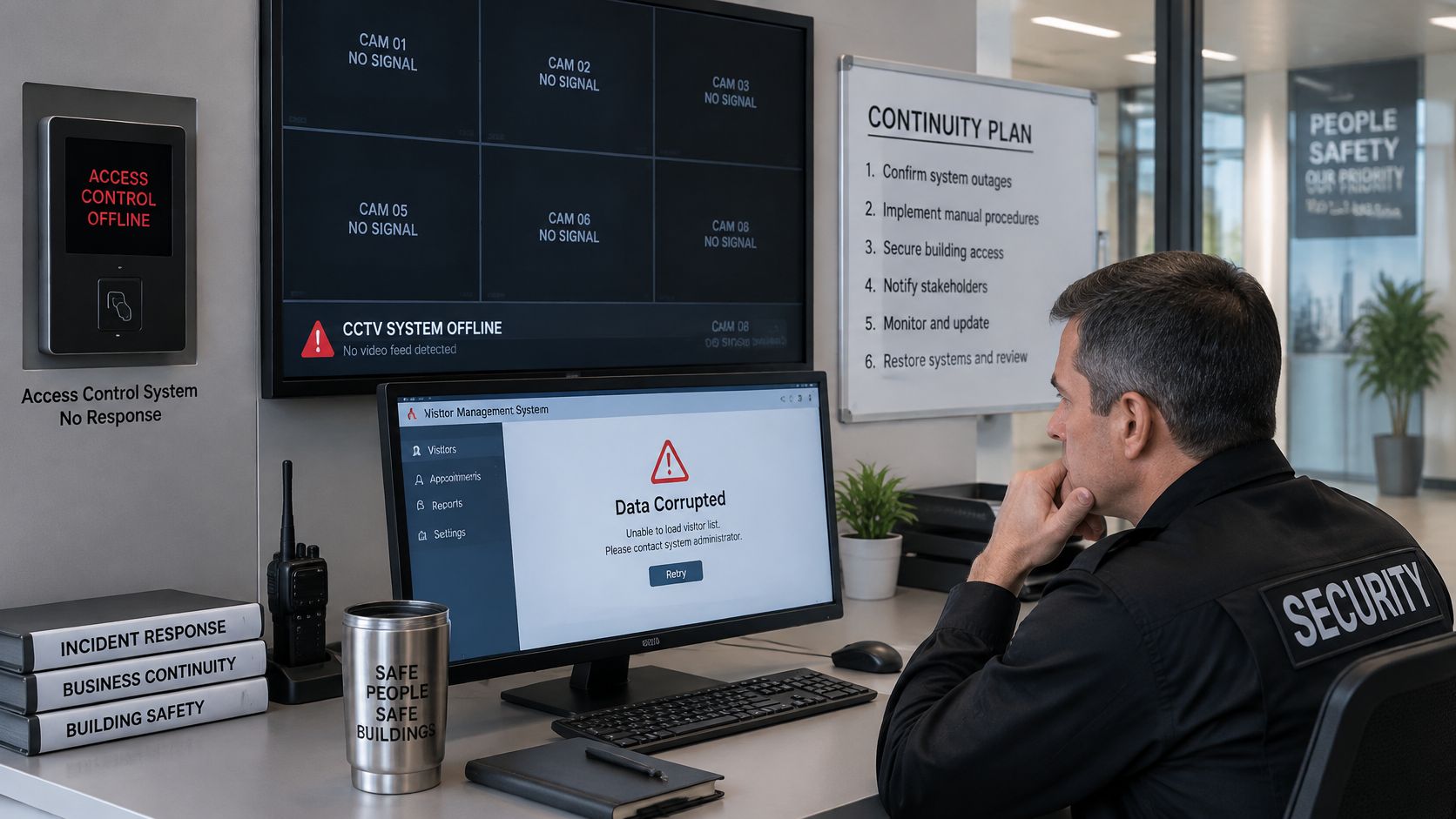
The National Protective Security Authority's security-planning guidance supports coordinated planning across building infrastructure and protective security. At site level, that means FM, IT and security must agree who controls the incident rather than passing it between helpdesks.
Give the duty manager clear decisions
Authorise manual mode. Name the manager who can activate it and the deputy who can act out of hours. Record the decision and the affected doors, systems and services.
Verify access independently. Use a controlled offline authorisation list and a known contact route. Check identity against the approved booking, not a telephone number supplied by the person seeking entry.
Restrict uncertain arrivals. Hold or refuse non-essential visitors and contractors when authorisation can't be established. Don't prop open a door to keep appointments moving.
Preserve a timed account. Use a paper incident sheet for arrivals, refusals, alarms, calls and decisions. Record the person making each entry so it can be transferred accurately later.
Protect evidence. Don't factory-reset a recorder, share administrator passwords or improvise changes to network equipment. Contact the named technical responder and document authorised changes.
Nutmeg Technologies' guidance on keeping operations running during outages is useful when coordinating the continuity conversation with IT. The site procedure still needs its own landlord, tenant, supplier and emergency notification routes.
Use this video as a discussion prompt alongside the written fallback exercise.
Rehearse the Saturday decision
Consider a Bank office on a Saturday: a contractor arrives, the reader fails and reception is unstaffed. The officer checks the controlled list and calls the duty manager; an unanswered call doesn't become permission to admit the contractor.
Include a night-time patrol arrival in the rehearsal, and test how the team works when access events aren't visible remotely. Set rehearsal frequency in the site plan and repeat the exercise after significant system changes.
More technology without a tested fallback creates dependency, not resilience. Keep the manual instructions with the operational procedures, where the duty team can reach them without the network.
Training Every Front-Line Role
Training starts before someone works the post, not after their first difficult interaction. A licence or previous experience doesn't tell a person where this building's safe room is, who answers the assistance call or which service entrance must remain secured.
Use role-specific learning rather than sending everyone the same presentation. The workplace training advice from Loresson is a useful starting point for organising instruction, but the site supervisor should check that staff can perform the actual task.
Match instruction to exposure
Security officers. Confirm appropriate licensing, then teach the site's access rules, incident protocol, de-escalation approach and offline authorisation process. Ask the officer to demonstrate a disputed contractor arrival.
Reception and concierge. Practise recognising escalation, recording phone and online threats, summoning assistance and leaving the desk safely. Staff need permission to disengage, not just advice to remain polite.
Cleaning and maintenance. Cover blocked exits, falls risks, unauthorised occupancy and safe reporting from isolated areas. Demonstrate lone-worker equipment where provided, including what happens when an alert receives no acknowledgement.
Patrol and CCTV teams. Rehearse live-alert decisions, evidence preservation and reports that the receiving team can act on without further explanation.
Check behaviour, not attendance
Set induction before the first shift, a refresher in the training plan and a recurring manual-mode exercise. Treat these as management commitments, with completion evidence and outstanding gaps visible to the facilities manager.
In a hypothetical Central London office, a lone cleaner hears an unregistered visitor shouting on an otherwise empty floor. The useful training outcome is a safe withdrawal, an assistance call and an accurate report, not an attempt to challenge or detain the visitor.
A signed attendance sheet proves someone attended. A short scenario shows whether they know what to do.
Record the assessment result as well as the course title. Retrain where someone can repeat the policy but can't locate the alarm or identify the duty contact.
KPIs, Training and the Monthly Audit
Site KPIs and when to act
Metric | How to count | Act when |
|---|---|---|
Threats | Per 100 staffed shifts, verbal threats included | Repeats at one entrance or line |
Assaults with injury | Physical injury only | Any injury, same-day review |
Near misses | Events that nearly became an assault or intrusion | Rising month on month |
Visitor incidents | Per 1,000 interactions, by door, time and tenant | A cluster at one door or hour |
Training cover | Guards, reception, concierge and cleaners | Any public-facing role untrained |
Register use | Notes from all teams in one log | A team still on a private book |
These are proposed site measures and action triggers, not national performance targets. The shift-based and visitor-based measures follow the practical approach in the HSE's work-related violence report, which estimates 689,000 incidents of violence at work in 2024/25, comprising approximately 370,000 assaults and 319,000 threats.
That distinction matters: an assault-only dashboard excludes threatening behaviour that managers need to address. Use the same incident definitions across employers so a contractor's “customer complaint” doesn't disappear from the building's threat count.
The national picture provides context for the monthly review, not a target for your site.
Ask what changed after the action
A monthly pack should show incident type, location, time, open actions and training gaps. Include the underlying counts alongside rates: a quiet entrance with limited footfall can produce a volatile rate from a small number of events.
Don't celebrate a falling total until you've checked reporting participation. If cleaning stopped submitting observations or reception changed its recording practice, managers may be looking at missing reports rather than improved conditions.
For repeated threats at a particular desk, inspect the queue, sightlines, refusal wording and assistance response. After an injury, preserve evidence, review the controls immediately and record who authorised the next operating arrangement. Use the security personnel training guide to structure officer development, while checking that ancillary staff receive instruction relevant to their exposure.
Finish with the audit checks
Credentials. Check relevant SIA licences against the public register and retain the verification record.
Live procedures. Confirm instructions match current opening hours, tenants, entrances and contractor arrangements.
Reporting participation. Check that security, reception and cleaning are contributing, not maintaining separate private accounts.
Fallback readiness. Confirm the rehearsal is scheduled and previous exercise actions are closed.
Insurance conditions. Read the guarding and alarm requirements against the actual service, rather than assuming the contract satisfies them.
The audit should end with decisions, named owners and evidence required for closure. An action marked complete without a practical check is still an assumption.
Confirm One Contract Before You Renew
Lay the current rota over the control table and mark every responsibility without a clear owner. Then trace an incident across the supplier boundaries: can the night team see the day's threats, can cleaning reach the duty officer, and does anyone have unquestioned authority when the access system fails?
A single contract helps when it removes those gaps. It doesn't help if the same disconnected instructions sit behind a different invoice.
Make the renewal decision operational
Require the scope to state cover hours, officer numbers, front-of-house responsibilities, cleaning observations in the incident process and the out-of-hours escalation contact. Test the proposed handover with a realistic incident before signing.
Visit Solomon's Facilities Management with your current rota and control gaps, and request a scope that specifies cover, reporting responsibilities and who responds when the building's systems fail.


Comments