
Security in Warehouse: Risks and Controls

The value of goods stolen by freight criminals rose 63% between 2023 and 2024, exceeding £120 million, according to evidence in the Parliamentary freight crime debate. That changes the question a warehouse manager should ask. It isn't whether the building is secure, but whether anyone can obtain, move or collect stock without proving they're authorised.
Table of Contents
Warehouse Crime Figures That Set the Risk - Freight crime and premises crime measure different exposures - Turn the figures into a site risk register
What Each Security Layer Actually Does - Match the control to the job - Design around the failure mode
How Chain of Custody Runs from Gate to Trailer - Make release a controlled decision - Test the process against a fraudulent collection
Who Owns Risk Beyond the Warehouse Fence - Assign the boundary decisions - Follow the waiting decision
How to Report and Escalate an Incident - Protect people before collecting evidence - Preserve a sequence people can reconstruct
Walk the Site Before You Commission Cover - Buy against the operational gap
Warehouse Crime Figures That Set the Risk
Security in warehouse operations needs a business case that covers goods, people and continuity, not just replacement locks. A stolen load can also leave dispatch staff reconciling records, transport managers rearranging deliveries and supervisors investigating who approved the release.
The parliamentary evidence distinguishes the wholesale value of stolen goods from the wider economic cost. Keep those measures separate when presenting risk to the board: stock value isn't the same as the financial effect of a disrupted operation.
Freight crime and premises crime measure different exposures
The historical premises baseline adds another perspective. The Home Office Commercial Victimisation Survey transportation and storage factsheet recorded 173,000 crimes in 2016, equivalent to 2,575 incidents per 1,000 premises, with 24% of premises experiencing crime compared with 40% in 2012.
UK freight and premises crime figures: historical comparisons
The freight entries below summarise the parliamentary evidence cited above; the premises entries use the Home Office survey.
Measure | Figure | Period | What it covers |
|---|---|---|---|
Reported HGV and cargo-crime incidents | 5,370, up 5% | 2023 | UK reported incidents in the APPG report |
Wholesale value of stolen goods | £68.3 million | 2023 | Value of goods reported stolen |
Wider economic cost | £680–£700 million | 2023 | Lost revenue, VAT, insurance and disruption |
Value of goods stolen by freight criminals | Over £120 million, up 63% | 2023 to 2024 | Rise stated in later parliamentary evidence |
Premises crimes in transportation and storage | 173,000 | 2016 | Home Office Commercial Victimisation Survey |
Incidents per 1,000 premises | 2,575 | 2016 | Same survey, transportation and storage |
Premises with at least one crime | 24%, down from 40% | 2016 vs 2012 | Preceding 12 months |
Earlier premises-crime total | 324,000 | 2012 | Survey total before the 2016 decline |
These aren't interchangeable datasets. Freight reporting describes cargo exposure across the supply chain; the survey describes crime against transportation and storage premises. Neither is a current burglary rate for London warehouses, and neither should be presented as one.
Turn the figures into a site risk register
Start with the transaction that could fail, then identify the physical location. A fraudulent collection belongs against the gate and release process. Missing stock after picking belongs against inventory handover and access to the holding area. Threats against staff belong against reception, pedestrian entrances and delivery disputes.
For each exposure, record the owner, existing control, evidence produced and unresolved gap. A London warehouse with contractors, shift changes and night collections needs particular attention at the moments when responsibility moves between teams.
For document-led losses, Lighthouse Consultants fraud assessment guidance provides useful context for examining how an apparently legitimate instruction could bypass approval. Pair that review with practical crime prevention strategies, rather than treating fraud and physical security as separate jobs.
Boardroom test: Explain which unauthorised action the proposed spending will prevent, who will intervene and what record will prove the control worked.
A camera purchase without those answers is an equipment decision, not a complete risk treatment.
What Each Security Layer Actually Does
Treat the warehouse as a series of controlled boundaries, from the estate entrance to restricted stock. Each layer should answer a different question: who may pass, who will challenge them, what happens between checks and how the site records exceptions.
Access control makes a permission decision. A guard can judge behaviour and refuse a request. A patrol checks conditions away from staffed positions. Cameras provide visibility, while reporting makes the event actionable after the person who noticed it has finished their shift.
Match the control to the job
Warehouse security layers and their limits
Layer | Main job | Works best at | Weak if used alone |
|---|---|---|---|
Decide who and what may enter | Gates, turnstiles, doors, contractor badges | Tailgating, shared fobs, cloned credentials | |
Challenge, refuse entry and manage incidents | Reception, vehicle gate, loading bay | Blind spots between fixed posts | |
Check locks, perimeter and irregular presence | Yards and out-of-hours sites | Predictable routes and long gaps between visits | |
Evidence plus live alerts | Docks, cages, approaches, gates | No one tasked to respond or preserve footage | |
Incident reporting | Time-stamp, escalate and hand over | Every event and near miss | Logs that are late, vague or never reviewed |
A badge reader doesn't establish that the person carrying the badge is its rightful holder. Use individual credentials, remove permissions when assignments end and require visitors to remain within their authorised area. When choosing access control systems, consider how staff will handle lost passes, temporary contractors and a door held open during deliveries.
A fixed guard post is valuable where someone must make a live decision. However, assigning the same officer to reception, vehicle entry and distant yard checks creates competing duties. Write down which task takes priority and how the unattended position remains controlled.
Design around the failure mode
Patrols suit dispersed checks, but a completed route isn't proof that every vulnerable area remained secure between visits. Vary the sequence where operationally sensible, record defects precisely and distinguish a locked door from one that merely looks closed.
Camera monitoring also needs a realistic operating brief. An operator should know which movements are normal, which require a challenge and whom to contact when the person on site doesn't answer. More screens won't compensate for unclear instructions.
Set permissions deliberately. Warehouse employees, cleaners and visiting engineers don't need identical access.
Give officers authority. A challenge procedure must allow them to hold an uncertain entry without being overruled informally.
Make reports usable. Record the location, action taken and outstanding decision, not just that everything was checked.
The layers must produce a coherent record. Use a common time reference so investigators can connect a door event, a patrol observation and the relevant camera view without guessing the sequence.
How Chain of Custody Runs from Gate to Trailer
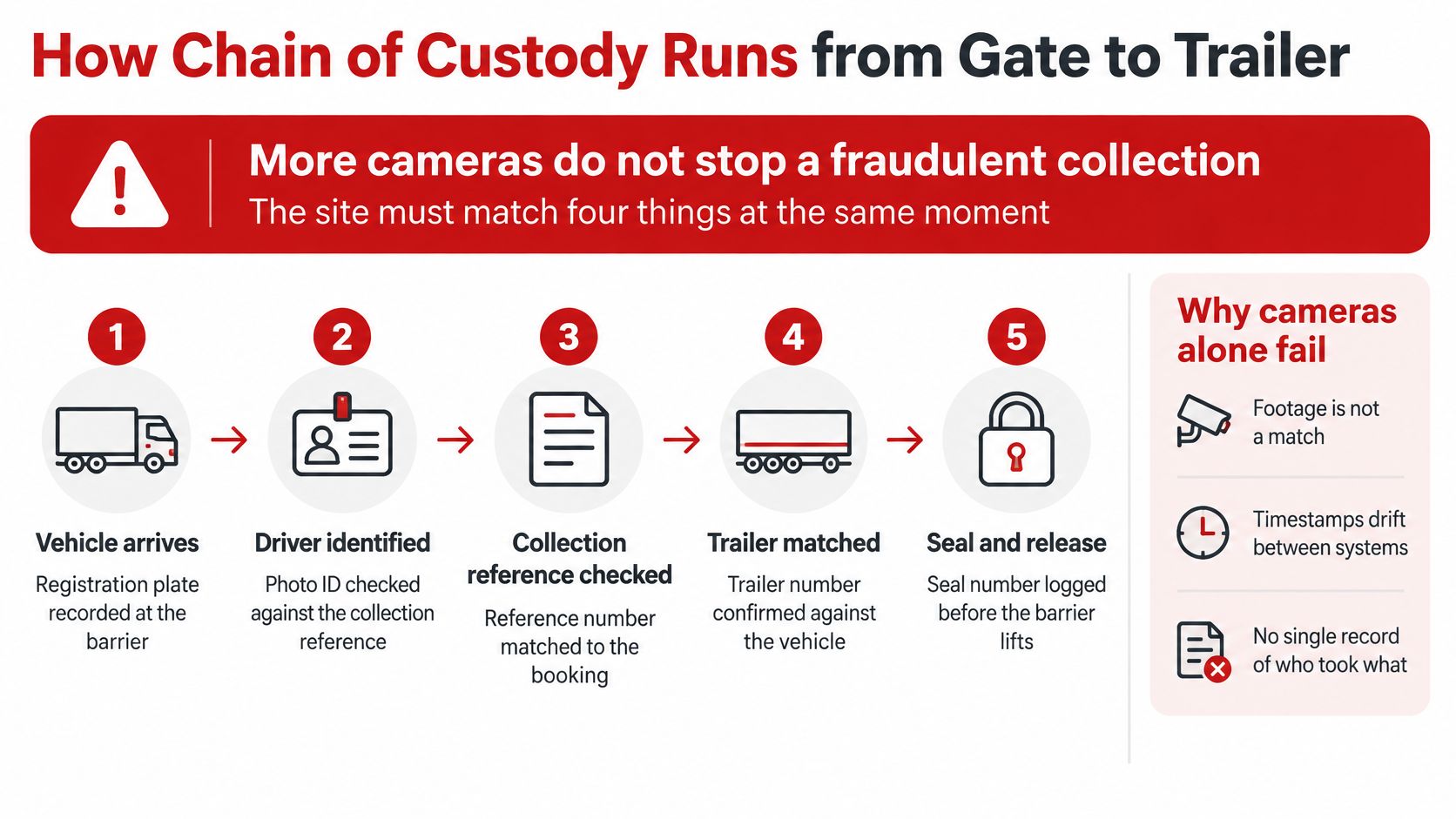
More cameras don't stop a fraudulent collection if nobody authenticates the collection. Before stock moves, the site must reconcile the driver, vehicle, collection reference and trailer, rather than approving each in isolation.
Warehouses accounted for 33% of reported cargo-theft locations in the 2025 dataset, while theft from a facility represented 30% of theft types, according to the BSI and TT Club cargo theft report. Those measures describe the report's dataset, not the probability that an individual warehouse will suffer theft.
The process diagram shows the checks that need to meet before release.
Make release a controlled decision
Validate the collection before arrival. Record the booking reference, collection window, authorised carrier and expected trailer where known. Changes must come through an established contact, not a number supplied by the arriving driver.
Check the driver's identity against the booking. A plausible explanation at the barrier isn't a substitute for authorisation, and possession of a reference doesn't establish identity.
Match the vehicle and trailer. Compare the registration and trailer identifier with the pre-advice. If the carrier substitutes equipment, verify that change independently before allowing collection.
Record the incoming seal number and condition before opening, where a sealed trailer arrives. For an outbound load, record the new seal after loading and before release. Don't treat a seal as proof of the contents.
Control access to the load. Escort visitors or supervise their movement where the goods, layout or uncertainty justify it. Keep drivers away from unrelated picking and storage areas.
Release only when the required records agree. Put any mismatch on hold for the nominated gate or bay supervisor, with a documented reason for approval or refusal.
Close the handover. Log departure time, trailer identity and seal details, then pass the completed record to transport so later discrepancies can be investigated.
A hold needs a safe waiting position and an escalation contact. Otherwise, staff under pressure to clear a queue may wave through the very exception the procedure was designed to catch.
Test the process against a fraudulent collection
Say a Friday collection arrives in convincing livery with a cloned registration and a reference that differs from the booking. The gate records the truck, dispatch recognises the carrier's branding and the loading team assumes somebody else checked the driver.
The load leaves because each team approved a fragment. A full match before release, owned by the gate or bay supervisor, changes that outcome by stopping the transaction until the discrepancy is resolved through a trusted channel.
An opportunist may exploit an open bay or an unattended pallet. An organised collection fraud requires a different response: independent verification, restricted release authority and an exception record that can't disappear during a shift change.
Use the video alongside a desk exercise in which gate, dispatch and transport staff explain who can authorise a changed collection.
Who Owns Risk Beyond the Warehouse Fence
A larger on-site guard force isn't the answer to a loaded trailer waiting somewhere the guards neither control nor observe. Warehouse managers still influence that exposure through booking decisions, loading readiness and the waiting arrangements they agree with carriers.
Assign the boundary decisions
Who owns each warehouse transport risk
Moment | Warehouse | Carrier or driver | Landlord or police | Indicator |
|---|---|---|---|---|
Before arrival | Validate booking, window and expected trailer | Share accurate collection data and route | Landlord sets estate access rules | Unbooked or early arrivals |
Driver waiting | Refuse ad-hoc yard parking of loaded trailers | Use agreed safer waiting, not a lay-by | Landlord controls estate lighting and parking where applicable | Unexplained dwell time |
At the gate | Check driver, vehicle, trailer and seal together | Present matching documents | Police if a crime is in progress | Failed identity checks |
Loading and release | Escort if justified and release only on a full match | Confirm seal and trailer identity | Landlord maintains shared access routes; police handle suspected crime | Seal discrepancies |
After dispatch | Log departure time and identifiers | Avoid predictable patterns and report exceptions | NaVCIS or police for off-site cargo crime through appropriate reporting channels | Collections outside the booked window |
Out of hours | Alarm path, patrol and no unscheduled release | No unofficial night collections | Police response to a live offence | Attempted out-of-hours collections |
This is an operational allocation, not a statement of contractual liability. Put responsibilities into the carrier agreement and site instructions, especially where a landlord controls the access road but the warehouse controls the loading appointment.
Refusing improvised parking doesn't mean sending a loaded vehicle to the nearest uncontrolled space. Agree an alternative before the driver arrives. If no suitable waiting arrangement exists, transport and warehouse managers need to resolve the appointment rather than leaving the driver to improvise.
A departure record closes the warehouse handover. It doesn't make the rest of the journey someone else's problem.
Follow the waiting decision
Say a sealed trailer leaves on schedule but then waits on an industrial estate because its onward slot isn't ready. A thief cuts the curtain while the driver is parked. Another officer inside the warehouse wouldn't have changed that exposure.
The carrier owns the vehicle's stopping decision, but the warehouse may have contributed through premature release or poor coordination. The departure record helps establish the handover; the seal record documents its condition, but doesn't prove that every part of a curtain-sided load remained inaccessible afterwards.
Avoid making security-driven timing changes that conflict with safe driving or lawful rest. The practical objective is less unnecessary loaded dwell, not unpredictable instructions that put drivers under pressure.
Review exceptions with transport managers each month. Examine unexplained waiting, failed identity checks, seal discrepancies and attempted out-of-hours collections, then assign corrective actions to the person who controls the cause. A high number of recorded challenges can mean staff are applying the procedure properly, so read the circumstances rather than treating every increase as deteriorating performance.
Keep collection information on a need-to-know basis. Staff should confirm amendments through established carrier contacts, and drivers should have a clear way to report unexpected waiting, route disruption or a suspicious approach without relying on informal messages.
How to Report and Escalate an Incident
The Health and Safety Executive's guidance on controls to prevent violence and aggression identifies CCTV, trained security personnel, body-worn cameras, alarms and building-security measures as proportionate options following risk assessment, including measures that deter offenders and support police evidence. The warehouse task is to connect those controls to a response that staff can carry out.
Position cameras to capture useful events at vehicle gates, pedestrian turnstiles, reception, loading docks, high-value cages and blind approaches. Check whether lighting, parked trailers or open doors obscure the view, rather than assuming the installation drawing proves coverage.
Use the incident flow as an induction aid, with site-specific contacts and reporting duties recorded alongside it.
Protect people before collecting evidence
Make people safe. Withdraw from threats, warn colleagues and summon emergency assistance where needed. Don't pursue an offender or block their exit if doing so increases danger.
Isolate the affected bay, cage or entrance when safe. Stop further stock movement through it without obstructing emergency escape routes or disturbing potential evidence unnecessarily.
Preserve recordings immediately. Note the camera identifier and relevant time span, retain the original export and restrict access. Save associated access and alarm logs before routine deletion or overwrite.
Record who was present, what happened and what each witness observed. Include vehicle, trailer, seal and badge identifiers, and separate direct observations from assumptions.
Escalate to the duty manager and appropriate external parties. Report an immediate threat promptly; follow the site procedure for police, insurer and other notifications. Check whether any separate workplace reporting duty applies rather than assuming every security event is reportable to the HSE.
Review the log on the next working day. Assign unresolved actions, confirm evidence is accessible and correct any procedural gap that allowed the event to progress.
Written incident response procedures should identify who answers each alarm and who takes over if that person is unavailable. A contact list without an unanswered-call route leaves the response dependent on luck.
An unwatched camera is an archive, not a live intervention.
Preserve a sequence people can reconstruct
Body-worn cameras may help document delivery disputes, but they need clear activation rules, signage, a lawful basis, retention limits and trained users. Don't issue devices without deciding who may retrieve footage and how recordings will be protected.
Test alarm-to-response arrangements on a schedule. Include an unavailable contact, a poor camera view and a failed export in the exercise, then record what needs fixing.
Say a contractor disputes a supervisor's account of an argument at a pedestrian door. There's no body-worn recording, and the access log runs on a different clock from the CCTV, making the sequence difficult to establish. The duty supervisor should own checks that logs and video remain time-synchronised and that any body-worn camera is used under the agreed rules, not activated selectively after a disagreement has escalated.
Walk the Site Before You Commission Cover
Walk the premises with the risk register and transport responsibility matrix before commissioning cover. List access points, vulnerable stock, night operations and the person who owns the carrier relationship, then follow an actual collection from appointment to departure.
Place a staffed post where a person must challenge an entry in real time. Use patrols for dispersed lock and perimeter checks, and monitored cameras where remote observation can trigger a practical response.
Buy against the operational gap
Check the scope. Include temporary storage and shared access. If you're considering flexible warehouse self storage units from Orange Box Self Storage, establish who controls entry and collection at that separate location.
Specify accountability. Require role-appropriate SIA licensing, a written escalation path and records the next shift can understand.
Keep the provision proportionate. A small office without stock, public access or out-of-hours vehicles doesn't need a warehouse-grade post.
At Solomon's Facilities Management, we assess premises, vulnerabilities, access points and operational requirements before recommending an appropriate security solution. Our guarding services are delivered by appropriately SIA-licensed personnel, with deployment arrangements agreed according to site requirements.
Solomon's Facilities Management offers guarding, mobile patrols, CCTV monitoring and alarm response for London premises, with cover shaped around the access and handover risks on site. Visit Solomon's Facilities Management to arrange a premises assessment and request a free quote before deciding which controls your warehouse needs.


Comments