
Event Security Requirements in London: A Practical Guide

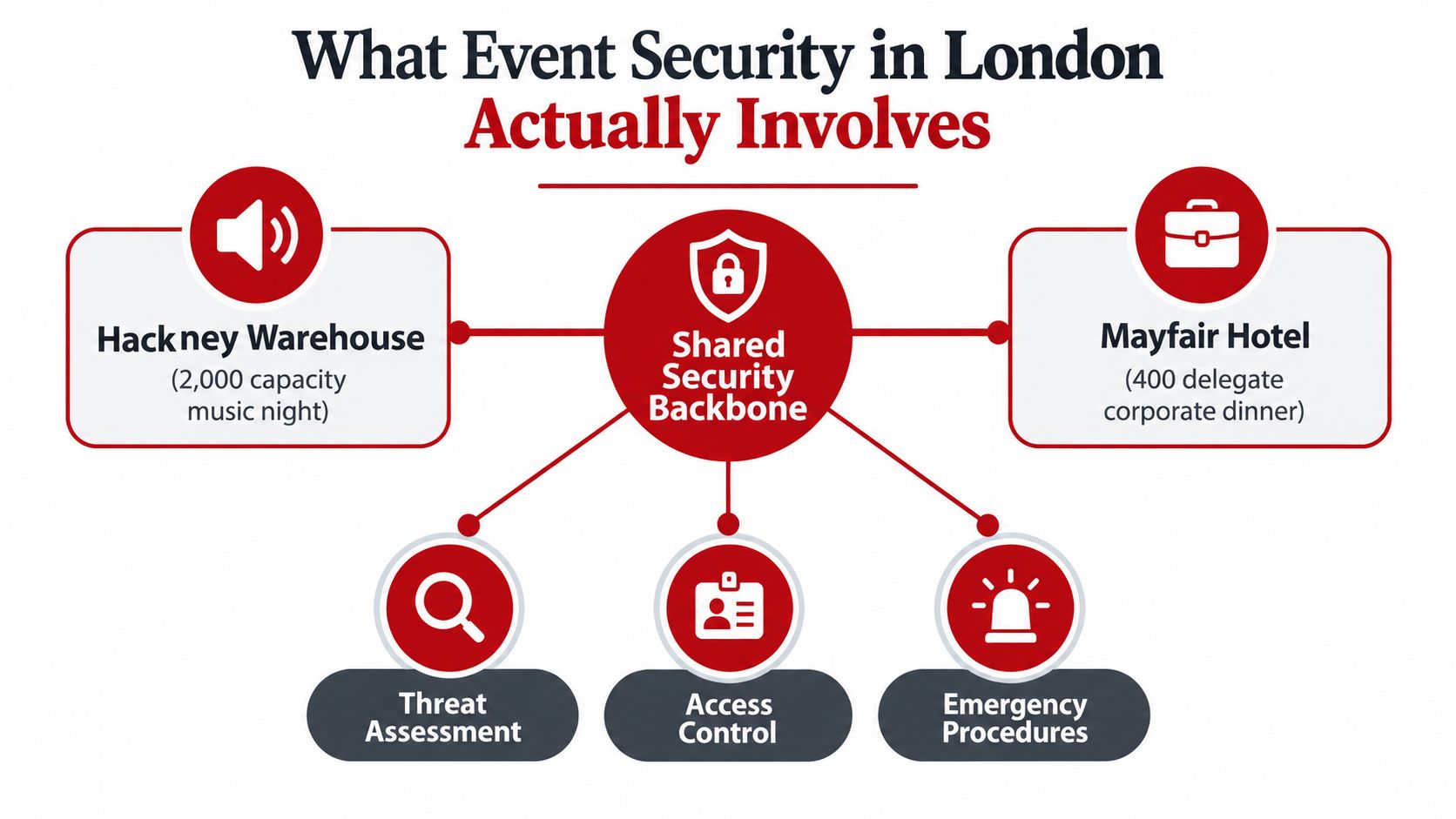
You've got a London event to deliver, a venue manager asking for the final security plan, and a budget that won't stretch to putting a guard beside every door. Perhaps it's a 2,000-capacity music night in a Hackney warehouse. Perhaps it's a 400-delegate corporate dinner in a Mayfair hotel. Both need competent security, but they don't need the same operation.
The useful question isn't “How many guards do we need?” It's “What risks must the plan control, and how will those controls work from arrival through dispersal?” London event security requirements now sit across statutory duties, licensing, crowd safety, screening, staffing, site design and emergency response. The Terrorism (Protection of Premises) Act 2025, commonly known as Martyn’s Law, will make documented preparedness still more important when its substantive duties come into force, currently expected in spring 2027.
Table of Contents
What Event Security in London Actually Involves - The same backbone, different controls
Legal and Statutory Duties Organisers Must Meet - Martyn's Law and occupancy bands
SIA Licensing, Staffing Ratios and Team Structure - Build the roster around functions
Designing Search and Screening Around the Threat - Balance detection with queue risk
Emergency Planning, Lockdown and Escalation Pathways - Set the trigger before the incident
Operational Checklist and Review Process for London Events - Before the event - At the readiness gate - After close
What Event Security in London Actually Involves
The Hackney organiser is balancing several moving parts: ticket validation, queue space, prohibited items, backstage access, transport links, alcohol-related incidents and a safe way to clear the building. The Mayfair organiser has a different profile, but still needs access control, accreditation, emergency communications, fire procedures and a response plan for anything from a medical incident to an unauthorised person entering a restricted area.
The shared backbone is a layered control plan. It begins with the event profile and threat assessment, then turns those findings into practical decisions about entrances, barriers, CCTV, search procedures, staffing, radios, control-room responsibilities and evacuation routes. Venue type and audience matter, but occupancy is also significant because UK statutory duties now use thresholds to distinguish between levels of preparedness.
The same backbone, different controls
A warehouse concert may require controlled public entry, a dedicated response team, perimeter protection, search lanes and active crowd monitoring around the stage. A hotel dinner may put more emphasis on guest accreditation, lift and floor access, discreet observation, reception screening and liaison with the venue's existing facilities team.
Neither operation should be built from a generic guard count. The organiser needs to understand:
Threats and vulnerabilities: What could happen, where could it happen and who would be affected?
Access control: Which people, vehicles, suppliers and contractors need access, and how will credentials be checked?
Crowd movement: How will people arrive, circulate, queue, reach toilets and bars, and leave without dangerous pinch points?
Emergency response: Who can order an evacuation or lockdown, who communicates it, and how do frontline teams act?
Evidence and accountability: Which documents, logs, briefings and incident reports prove that controls were planned and operated?
The working answer is a documented plan that a London security provider can staff and an event authority can understand. The controls should be proportionate, but they also need to be specific enough for a supervisor to brief a team and for an organiser to test the plan before doors open.
Legal and Statutory Duties Organisers Must Meet
UK event security requirements come from several overlapping duties rather than one event-security statute. The organiser, venue and contractors need to establish who owns each responsibility before the event enters delivery.
The Health and Safety at Work Act 1974 provides the broad duty to protect employees and visitors. That duty reaches beyond physical security. It covers safe circulation, competent staffing, emergency arrangements and the way foreseeable risks are controlled. The College of Policing national events guidance also makes clear that police attendance isn't a substitute for organiser-led safety management. Police have no general duty to preserve public safety at public events, except where there are imminent or likely threats to life.
Martyn's Law and occupancy bands
The Terrorism (Protection of Premises) Act 2025, commonly known as Martyn’s Law, received Royal Assent on 3 April 2025. Its substantive requirements are not yet in force, although implementation is currently expected in spring 2027. When commenced, qualifying premises where 200 to 799 people, including staff, may reasonably be expected at the same time will generally fall within the standard tier, while enhanced-tier premises and qualifying events generally begin at 800 or more people. The Home Office Martyn's Law factsheet gives examples such as CCTV, bag-search policies and vehicle checks where appropriate.
For smaller premises, the practical emphasis is on documented preparedness. GOV.UK guidance describes measures including evacuation routes, lockdown procedures and staff communication plans for premises accommodating 200 to 799 people. The enhanced tier for 800 or more people makes protective measures and operational evidence more demanding, but it doesn't mean every venue needs the same equipment or staffing model.
Legislation | Who it applies to | Core duty for events |
|---|---|---|
Health and Safety at Work Act 1974 | Employers, organisers and venue operators | Provide a safe environment for staff and visitors, with suitable risk controls |
Safety of Sports Grounds Act 1975 | Relevant sports stadia and grounds | Operate within safety-certificate requirements and crowd-safety conditions |
Regulatory Reform (Fire Safety) Order 2005 | Responsible persons for non-domestic premises | Complete and maintain suitable fire-risk assessments and emergency arrangements |
Licensing Act 2003 | Premises and organisers providing alcohol, late-night refreshment or regulated entertainment | Follow licence or temporary-event conditions and manage relevant premises risks |
Terrorism (Protection of Premises) Act 2025 | In-scope public premises and qualifying events | When commenced: maintain appropriate public-protection procedures, with additional protective measures for enhanced-tier premises and qualifying events. |
Paid operatives must hold the appropriate SIA licence for the work they perform. Door supervisors are relevant to licensed premises and front-of-house search duties, while other roles require the licence category that matches the activity. The venue's premises licence or temporary event notice adds another layer, and local authorities may review higher-risk plans through a Safety Advisory Group. The Metropolitan Police can also impose conditions under applicable terrorism legislation.
Practical rule: Treat the legal documents as the minimum architecture. Your operational plan must show how people, equipment and decisions work on the actual site.
Building the Risk Assessment That Drives the Plan
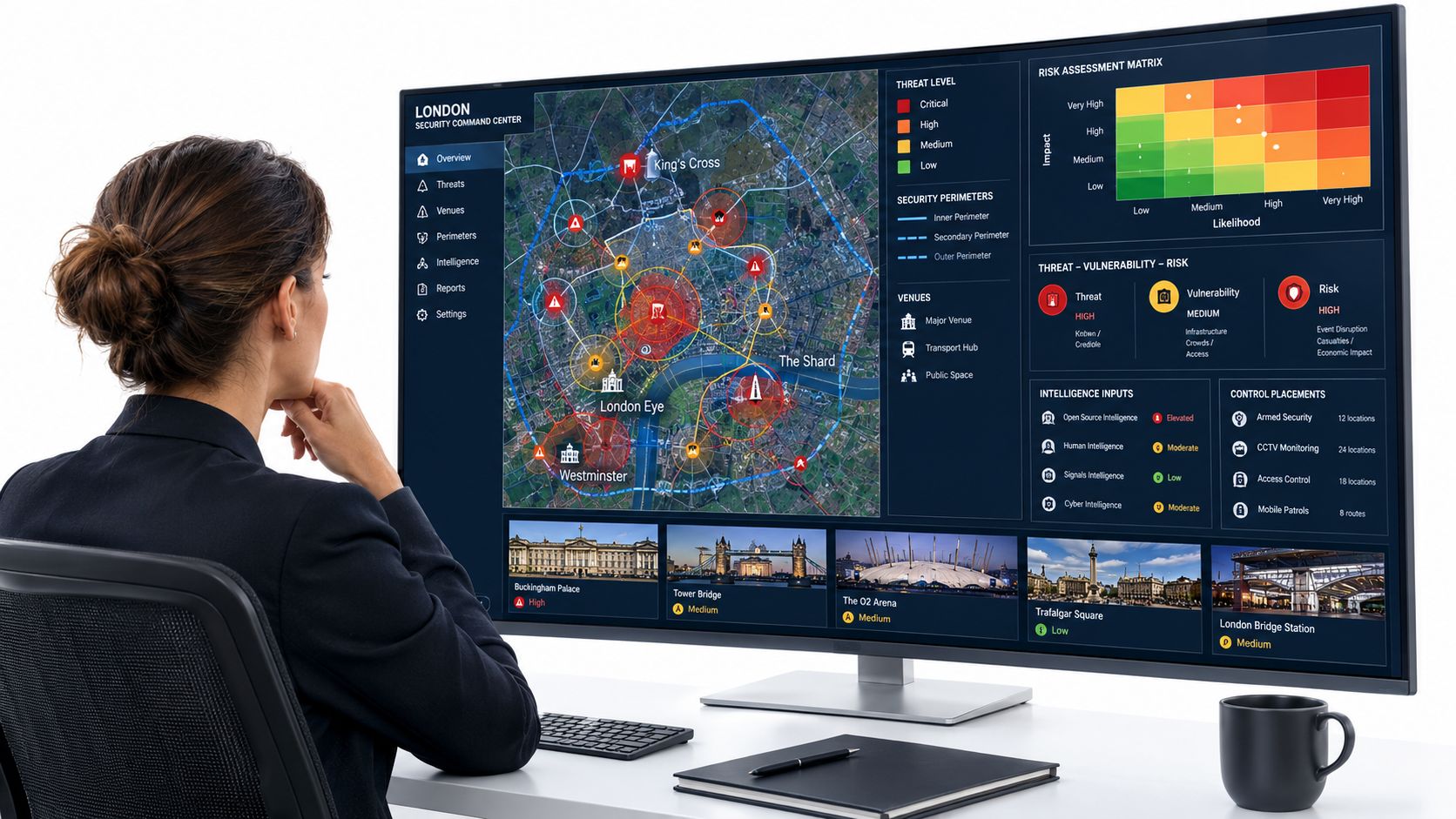
A TVRA should determine the security model before anyone discusses guard numbers. It connects the event's audience, site, activities and current threat picture to controls that can be tested, staffed and reviewed.
Begin with the operating picture. Record the venue layout, occupancy, public and service entrances, loading arrangements, neighbouring roads, transport interfaces, attendee demographics, VIP or controversial profiles, previous incidents and intelligence from appropriate authorities. The NPSA guidance for venues, events and public spaces places this assessment at the centre of decisions about protective measures.
The assessment should also consider how Martyn's Law will affect the plan once its substantive requirements come into force. Occupancy and event thresholds can change the level of preparedness required, so confirm the venue's status and duties early. The result is a tiered control plan, not a fixed checklist of gates and officers.
For each credible threat, assess likelihood in the event context, site vulnerability and potential impact. Include theft, unauthorised access, disorder, missing people, medical emergencies, hostile vehicles, suspicious items, fire and communications failure alongside terrorism.
Map each risk to a control and an accountable owner:
Physical controls: barriers, protected service entrances, lighting, doors, vehicle restrictions and CCTV coverage.
People controls: SIA-licensed officers, stewards, supervisors, search teams, control-room staff and trained venue personnel.
Procedural controls: accreditation, prohibited-item rules, contractor checks, incident reporting, evacuation and lockdown.
Response controls: escalation thresholds, police liaison, medical coordination, assembly arrangements and business continuity.
Guard numbers follow the layout and the control design. A compact venue with controlled entry may need fewer officers, but a stronger search team and clearer supervision. A dispersed event may require personnel across a wider footprint even with a smaller audience. Search dogs or hostile vehicle mitigation belong in the plan only where the assessment provides a defensible reason.
The organiser owns the risk process. The venue and security provider should test whether the proposed controls work in practice, including sightlines, breaks, equipment, access delays and response times. Share the health and safety, fire and counter-terrorism assessments early.
For exhibitions and similar events, ESSA's March 2026 eGuide states that the event health-and-safety risk assessment and event fire-risk assessment should be submitted to the venue no later than 28 days before tenancy begins.
Other venues or event types may operate different submission deadlines, so confirm these requirements early. The TVRA should support the Safety Advisory Group submission and remain the control room's working reference.
SIA Licensing, Staffing Ratios and Team Structure
A visible badge isn't enough by itself. Each operative needs the correct, current SIA licence for the role being performed, and the provider should verify identity, licence status, right to work, vetting and training records before deployment.
The role matters. A door supervisor may search attendees and manage entry to licensed premises. A security guard may cover a perimeter or restricted area. A CCTV operator needs the relevant public-space surveillance licence, while close protection is a distinct specialist function. Don't ask a team to fill a role their licence or training doesn't support.
Build the roster around functions
Start with the operating picture rather than a ratio. List every public entrance, staff entrance, production gate, vehicle route, restricted zone, control point, response position and welfare area. Then identify the periods when demand changes, such as opening, headline arrival, intermission, closing and dispersal.
Supervision levels should reflect the risk, workload and complexity of each function rather than a fixed universal ratio. Busy search and entry points may require closer supervision than static posts because queue movement, searches, refusals and incident escalation can occur simultaneously.
SIA Role | Typical Event Duties | Supervision Approach |
|---|---|---|
Door supervisor | Licensed-premises entry, searching, refusal of entry and front-of-house intervention | Closer supervision may be appropriate at busy search and entry points |
Security guard | Perimeter, restricted areas, service access and static posts | Based on site layout, post distribution and risk |
CCTV operator | Monitoring cameras, recording incidents and directing response | Based on camera coverage and control-room workload |
Close protection operative | Protection of a specific person or protected group | Determined by the protection assessment |
Steward under suitable supervision | Wayfinding, queue assistance and basic crowd support | Integrated into the event command and supervision plan |
Nominate one on-site security lead. Give that person authority to deploy resources, pause an unsafe entry process and escalate to the event control point. Name response coordinators and define who briefs search teams, who receives incidents from CCTV and who speaks to the venue duty manager.
Use a shift roster that records breaks, relief cover and handovers. Check licences before the team reaches the door, not while a queue is building. A provider such as Solomon's event security service can support crowd management, access control and incident response with SIA-licensed event personnel, but the organiser still needs to confirm that the proposed team matches the event's documented risks.
Crowd Density, Capacity and Site Flow Engineering
A venue can sell every advertised place and still fail at the doors. Arrivals concentrate at particular entrances, bars, toilets and accreditation points, while departures happen in waves. The control plan must keep those movements within safe limits without turning an external queue into a separate crowd risk.
Capacity should follow the most restrictive part of the operation. UK event-planning guidance cites 2 people per square metre for event-safety guidance, 3 people per square metre for standing-density fire-risk assessments and 7 people per square metre for open-space sports-ground guidance, as set out in Bradford Council's event-planning guidance. Those figures do not mean every usable area can be filled. Entry capacity, viewing space, audience profile and evacuation time all need testing, with the lowest safe result setting the limit.
A London site plan should show the full journey, not only the gate arrangement:
Arrival routes: ticket checks, search points, queue pens, accessible entry and staff lanes.
Internal circulation: bars, toilets, stages, seating, stairs, lifts and restricted doors.
Failure routes: blocked exits, poor visibility, lighting loss, fire alarm activation and sudden crowd surge.
Dispersal zones: release gates, transport interfaces, taxi areas and locations where stewards can prevent bottlenecks.
Entry and evacuation require separate capacity checks. Extra entry lanes may shorten the pavement queue, but each lane still needs ticket validation, screening, barriers, signs and a safe holding area. A broad concourse can absorb arrivals while a stairway, lift lobby or narrow exit remains vulnerable to pressure.
Brief stewards to report density, stalled movement and changes in queue shape through the event control point. The crowd-management guidance for events helps convert those observations into practical positions and controls. A barrier change may reduce the number of guards required. It may also create a pinch point, so test the layout against both normal arrival and emergency release before opening the gates. When London providers price the plan, ask whether the staffing figure reflects the site flow, or merely the headline capacity.
Designing Search and Screening Around the Threat
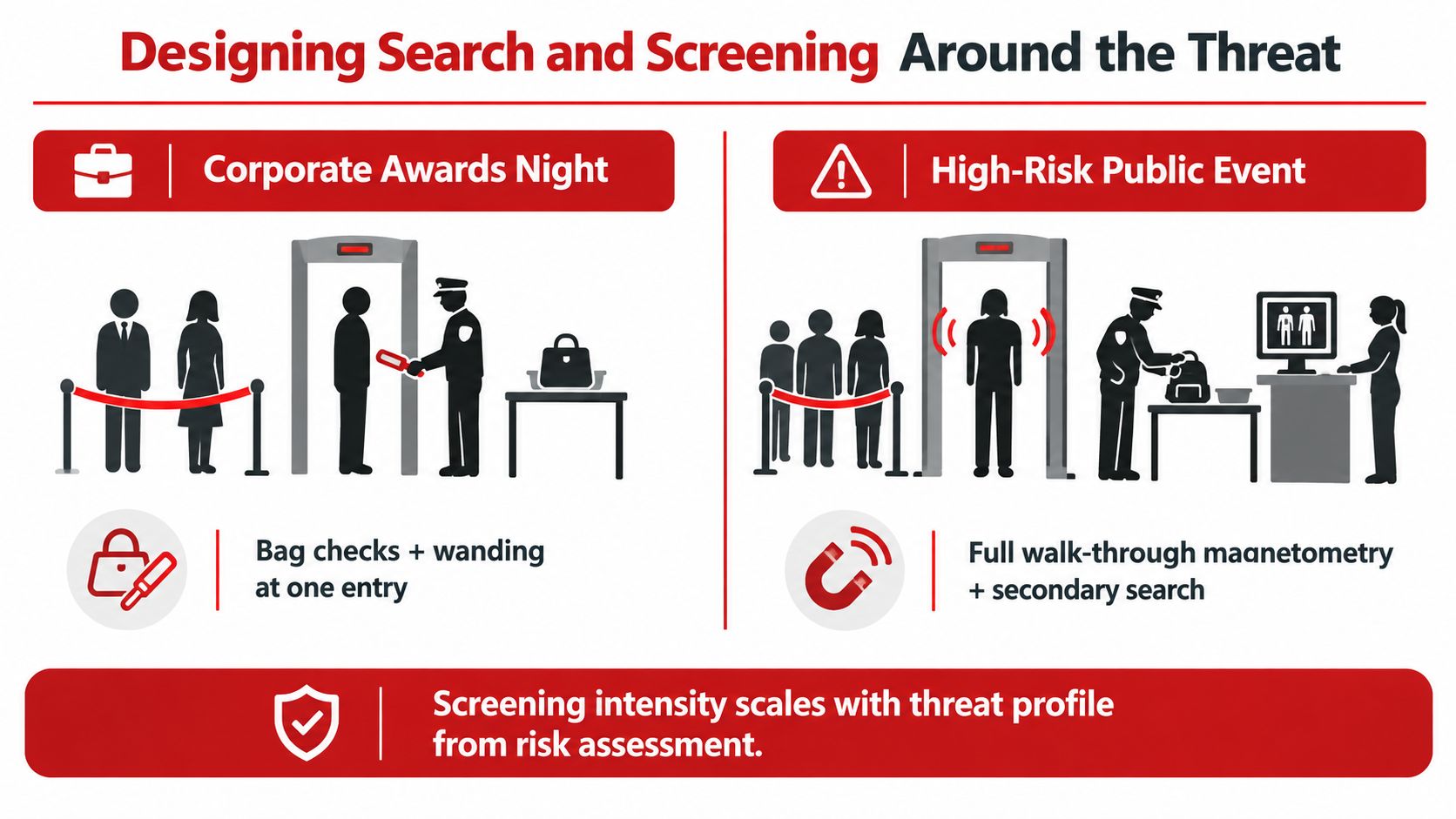
Search is a control lever, not a ceremony performed the same way at every event. The ProtectUK guidance for security managers advises organisers to define what the search is intended to detect, communicate prohibited items in advance and maintain the regime through arrival, the event and post-event egress.
For a corporate awards night, the plan might use bag checks and handheld wanding at a controlled entry. A high-profile concert or political conference may justify walk-through magnetometry, dedicated bag-search tables, secondary search space and a clear confiscation process. The choice should come from the TVRA, not from an assumption that a more intrusive search is automatically safer.
Balance detection with queue risk
Screening can reduce risk at the entrance, but a slow process can push people onto the pavement, block emergency routes or create a concentrated queue. The guidance warns that queues themselves can become a target, so the organiser needs enough throughput to maintain detection capability without allowing unmanaged accumulation.
Publish the prohibited-item list before arrival and repeat it at queue entry. Explain what happens to an item that's refused. Otherwise, staff will make inconsistent decisions, attendees will argue at the search point and abandoned property will create its own workload.
Separate public, staff, VIP and production access where the site allows. Keep screening back from the kerb line so the public queue doesn't spill into the street. Give each search team an escalation route for concealed items, suspicious behaviour, drone concerns and requests for a secondary search.
The workable screening model is the one officers can apply consistently at the pace the site requires.
Rehearse the process before opening. Test how search staff communicate, where a refused attendee goes, how a bag is isolated and how the control room receives an incident report. If the plan can't answer those questions, adding more guards won't repair the design.
Emergency Planning, Lockdown and Escalation Pathways
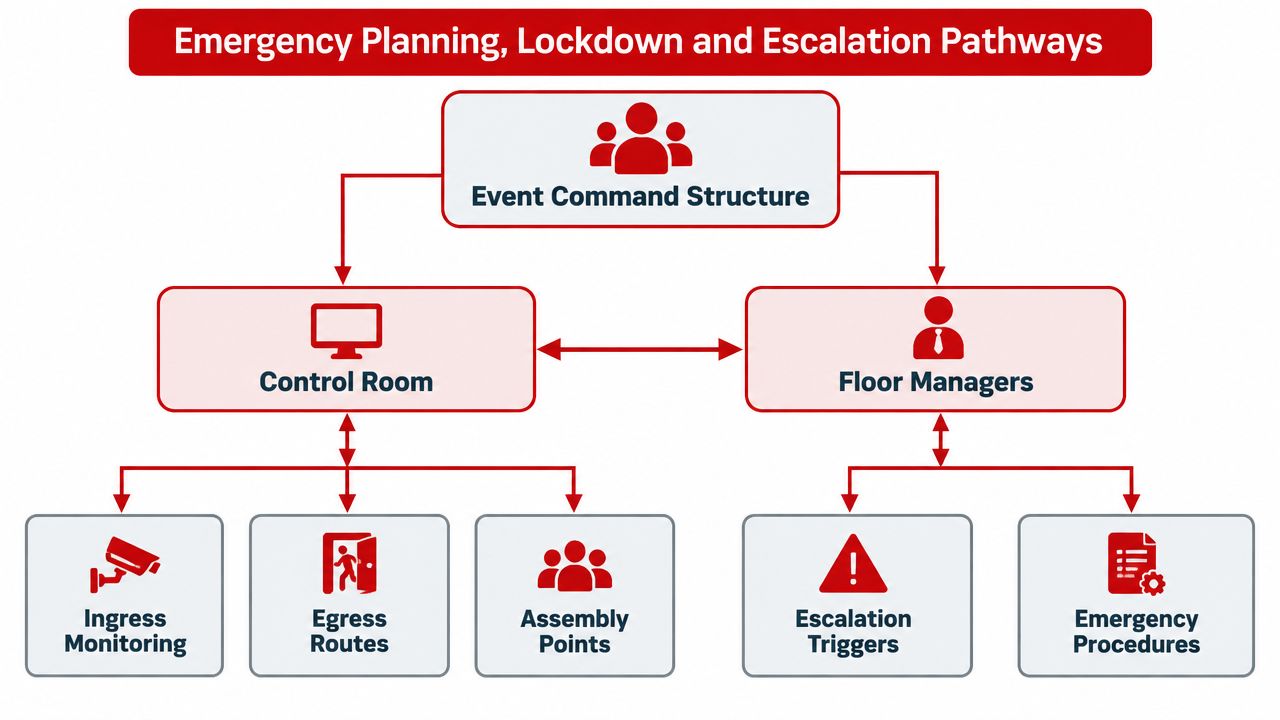
At a London venue, a blocked service door can undermine an otherwise sound evacuation plan. Emergency arrangements must therefore connect the site map, radio network and decision authority, then be tested under realistic operating conditions. The control room needs a live view of entrances, internal movement, escape routes and assembly points. Floor managers need clear thresholds for immediate action and for referral to the event lead.
Assign authority by role, not by title alone. Stewards report to SIA supervisors, supervisors to floor or zone managers, and the on-site security lead coordinates with the event control point, venue duty manager and emergency-service liaison. Larger events may use Silver, Bronze and Gold structures. The labels matter less than named responsibilities, decision rights and a communications route that still works under pressure.
Set the trigger before the incident
Evacuation moves people away from danger, including fire, structural failure or a confirmed internal hazard. Lockdown restricts movement and access where movement could expose people to greater danger, such as a suspected external threat or hostile person. The plan must identify who authorises each response, what information supports that decision and how instructions reach every zone.
Use plain-language radio call signs, agreed priority words and a fallback method. If the network fails, supervisors need a runner arrangement and a known alternative channel. The control room should record the time, location, reporting source, decision, action and outcome for each incident. Incident-response procedures guidance can help organisers structure that reporting and escalation process.
Build the overlooked details into the briefing:
Suspicious items: Keep people away, avoid unnecessary handling and escalate through the agreed route.
Missing people: Establish a welfare point, verify descriptions and control the release of personal information.
Medical incidents: Preserve responder access and prevent crowds forming around the casualty.
Communications failure: Move to the backup channel or runner system and record the service loss.
Welfare: Provide staff rest, hydration and a route for reporting fatigue or distress.
Walk evacuation and lockdown routes with the venue, police liaison, ambulance liaison and local authority representatives where appropriate. Check service doors, parked vehicles and temporary structures, because any of them can obstruct the route on event day.
Operational Checklist and Review Process for London Events
A useful checklist follows the event lifecycle. It shouldn't be a folder of generic policies that nobody opens on the day. The duty manager should be able to walk the site, ask a named person for evidence and record whether each control is ready.
Before the event
Confirm the venue capacity, licence conditions, event profile and responsible persons. Complete the TVRA, fire-risk assessment, crowd-management plan, emergency plan and screening plan. Share the relevant documents with the venue and security provider, then record comments and approvals.
Check the roster against the controls rather than attendance alone. Verify SIA licences, identity, right to work, training, relief cover and supervisor assignments. Confirm that every entrance, restricted zone, CCTV position, response point and control-room function has an owner.
At the readiness gate
Walk the site before opening and check the items that commonly fail:
Documents: The current risk assessments and site plans are available at the control point.
People: Every operative is in the correct role, briefed and assigned to a post.
Screening: Search equipment, signage, prohibited-item information and secondary-search space are ready.
Queues: Barriers and holding areas keep people away from kerbs, emergency routes and pinch points.
Communications: Radios, backup channels, call signs and escalation phrases have been tested.
Emergency routes: Exits, assembly points, responder access and lockdown arrangements remain usable.
Records: Incident logs, attendance records, handover sheets and briefing acknowledgements are prepared.
During the event, the control room should monitor queue growth, density, entry refusals, medical calls, lost people, unauthorised access and any change in threat information. The duty manager should know when a supervisor can redeploy staff and when the event lead must be contacted. Use the command structure established in the emergency plan, rather than creating an improvised chain of authority during pressure.
After close
The review starts before the last person leaves. Confirm that dispersal routes remain staffed, restricted areas are checked and incidents are logged while details are fresh. Afterward, collect the incident log, Met engagement notes, venue feedback, contractor performance comments, screening issues and any injuries or near misses.
A credible debrief asks what the plan predicted, what happened and which control should change next time. Feed those findings into the next TVRA. That loop is what turns event security requirements from a compliance exercise into an operating system that becomes more accurate with every delivery.
Solomon's Facilities Management provides London event security with SIA-licensed personnel for crowd management, access control, search and screening, perimeter control and incident response. If you're planning an event and need a staffing and control plan built around the venue, occupancy and threat profile, visit Solomon's Facilities Management to discuss the requirement.

Comments