
Event Security Guard Roles and Planning Guide

At 6:30 p.m., a 1,200-capacity London venue can look deceptively calm. The queue is forming, the doors are due to open, and the organiser is watching the ticket scanners. Meanwhile, the event security guard team should already have checked radios, studied the risk assessment, confirmed evacuation routes, identified the incident rendezvous point, and agreed who makes decisions when the plan meets real crowd behaviour.
Effective event security isn't a line of people standing at entrances. It's an operating system linking licensed personnel, controlled access, crowd movement, emergency readiness, incident reporting and reliable staffing. A guard who spots a blocked fire lane before it becomes a problem is doing just as important a job as the officer who handles a confrontation at the door.
Table of Contents
What an Event Security Guard Actually Does - Prevention starts with movement - Response must remain accountable
Licensing and Core Responsibilities - The job in practical terms
Planning Event Security Staffing Levels - Two events, different deployment logic
Managing Entry, Searches and Crowds - Searches should support flow - Egress needs its own plan
Designing Accreditation and Access Zones - Match the credential to the zone
Securing Reliable Event Security Cover - Verify the supply, not just the promise
Pre-Event Readiness and Final Checks - Planning checks before the event - The final 24-hour pass
What an Event Security Guard Actually Does
The first guest may not arrive until the evening, but the security operation starts much earlier. The supervisor checks the venue layout, confirms posts and role cards, and turns the event risk assessment into instructions that officers can use under pressure. Radios need to work, call signs need to be understood, and every member of the team should know the rendezvous point, emergency exits, welfare facilities and escalation route.
At the entrance, the visible duties are familiar. Guards check tickets or credentials, direct people towards the correct queue, identify prohibited items, and help prevent unauthorised access. The stronger teams also watch how the queue is behaving. A narrowing barrier line, a guest repeatedly trying to bypass screening, or a group showing signs of intoxication can indicate a developing problem before anyone raises their voice.
Prevention starts with movement
Crowd safety depends on keeping people moving without creating pressure at pinch points. An event security guard may reposition a queue, ask a steward to keep a fire route clear, or hold entry briefly while an internal corridor is cleared. These are small decisions, but they protect the wider flow of the venue.
The role also includes customer service. Guests may need directions, assistance with accessibility arrangements, help locating lost property, or a calm explanation of an entry condition. A refusal of entry should be lawful, proportionate and recorded, not delivered as an argument.
Response must remain accountable
If a disturbance begins, the first objective is usually separation and de-escalation. Officers communicate clearly, create space, protect uninvolved guests and call for the appropriate support rather than turning a minor disagreement into a public confrontation. Afterward, the team records what happened, who was involved, what action was taken and whether a follow-up is required.
That combination of prevention, service and accountability is why event security personnel need practical training as well as a uniform and licence. Guidance on security personnel training is useful because the quality of decisions at the gate, in the queue and around the venue often determines whether an incident remains manageable.
Licensing and Core Responsibilities
In the UK, whether an event security role requires an SIA licence depends on both the activity being carried out and the setting. At licensed premises — for example, venues supplying alcohol or regulated entertainment — a Door Supervisor licence is required where someone provides a physical presence to guard against damage, theft, unauthorised access or disorder while the premises are open to the public. At other premises, a Security Guard licence may be appropriate for equivalent guarding duties.
Licensing point: The SIA licence confirms that the person is authorised for the relevant regulated activity. It doesn't replace a venue briefing, an event risk assessment or assignment-specific competence.
The distinction should be settled before officers arrive. The contractor and organiser should identify the activity required at each post and confirm that the officer holds the appropriate SIA licence. A Door Supervisor licence also allows the holder to work as a security guard, but the reverse does not apply where door supervision licensing is required.
The job in practical terms
Access control means checking that the person has the right ticket, pass, identification or authorisation for that location and event. Searching must follow the agreed policy, be carried out respectfully and remain proportionate to the assessed risk. Where entry is refused, the guard should explain the relevant reason where appropriate, avoid unnecessary confrontation and ensure the decision is logged through the event procedure.
Conflict management is more than physical intervention. It includes recognising agitation early, using clear language, calling a supervisor, separating people and protecting bystanders. Physical intervention standards must reflect the officer's training, the assignment and the law.
Emergency-route protection is a core responsibility, not a secondary task. Guards need to keep exits, corridors, fire lanes and emergency access points usable, report obstructions and support the venue's emergency plan. They may also guide guests, provide information to emergency services and preserve a clear route for responders.
The SIA's regulatory scale shows why these duties sit within a formal national system. Its annual report recorded 486,308 active licences in 2023-24 and 507,300 in 2024-25, with inspection activity covering people, providers and venues across Britain. The report also recorded 5,283 licence revocations in 2023-24 and 7,343 in 2024-25, reinforcing the importance of checking licence status and right to work rather than relying on a contractor's verbal assurance. SIA annual reporting provides the regulatory context.
Planning Event Security Staffing Levels
Headcount should follow the risk assessment, not replace it. Attendance matters, but it doesn't explain whether people arrive gradually or in a surge, whether the venue has one controlled entrance or several exposed approaches, or whether the audience will be seated, standing, drinking, moving between zones or travelling through a constrained transport interchange.
A London organiser should test the operating conditions before requesting a quotation. The relevant inputs include:
Audience profile: Consider age range, expected behaviour, accessibility needs and whether a particular artist, speaker or fixture is likely to create a concentrated arrival.
Venue design: Map entrances, exits, stairs, balconies, bars, toilets, backstage areas, loading points and emergency routes.
Activity and service: Alcohol, cash handling, late finishes, stage-front pressure and multiple programme areas can change the deployment.
Local context: Review previous incidents, nearby transport, public approaches, taxi locations and areas where crowds may gather after departure.
Management structure: Allow for supervisors, relief cover, radio coordination and the time needed to brief staff properly.
The SGSA event safety management guidance and related HSE principles support a risk-based approach in which queues, searches, barriers, signage, phased movement and clear emergency paths work together.
Organisers should also be aware of the Terrorism (Protection of Premises) Act 2025, commonly known as Martyn's Law. Although its substantive requirements are not yet in force, qualifying events where 800 or more people may be present at the same time can fall within its scope. Current Home Office guidance is intended to help organisers prepare for the new protective-security requirements.
Two events, different deployment logic
A seated corporate conference with bar service may have a predictable arrival, controlled registration and limited movement during presentations. Its pressure points are likely to be the registration desk, loading entrance, VIP route, bar and post-event departure.
A standing general-admission concert creates a different problem. The team may need to manage queue build-up, ticket and search lanes, prohibited items, internal circulation, stage-front pressure, alcohol-related incidents, backstage boundaries and egress. The same attendance figure would not justify copying the conference plan.
Event Profile | Key Risk Drivers | Indicative Guard Range |
|---|---|---|
Seated conference | Registration, credential control, VIP movement, bar service and timed departure | Set through the risk assessment, with emphasis on access points and roaming supervision |
Standing concert | Surge arrivals, searches, alcohol, stage-front density, perimeter and egress | Set through the risk assessment, with dedicated posts for entry, internal crowd areas and exits |
Outdoor public event | Open approaches, transport links, multiple zones, weather and dispersed crowds | Set through the risk assessment, with geographic coverage and communications resilience |
Managing Entry, Searches and Crowds
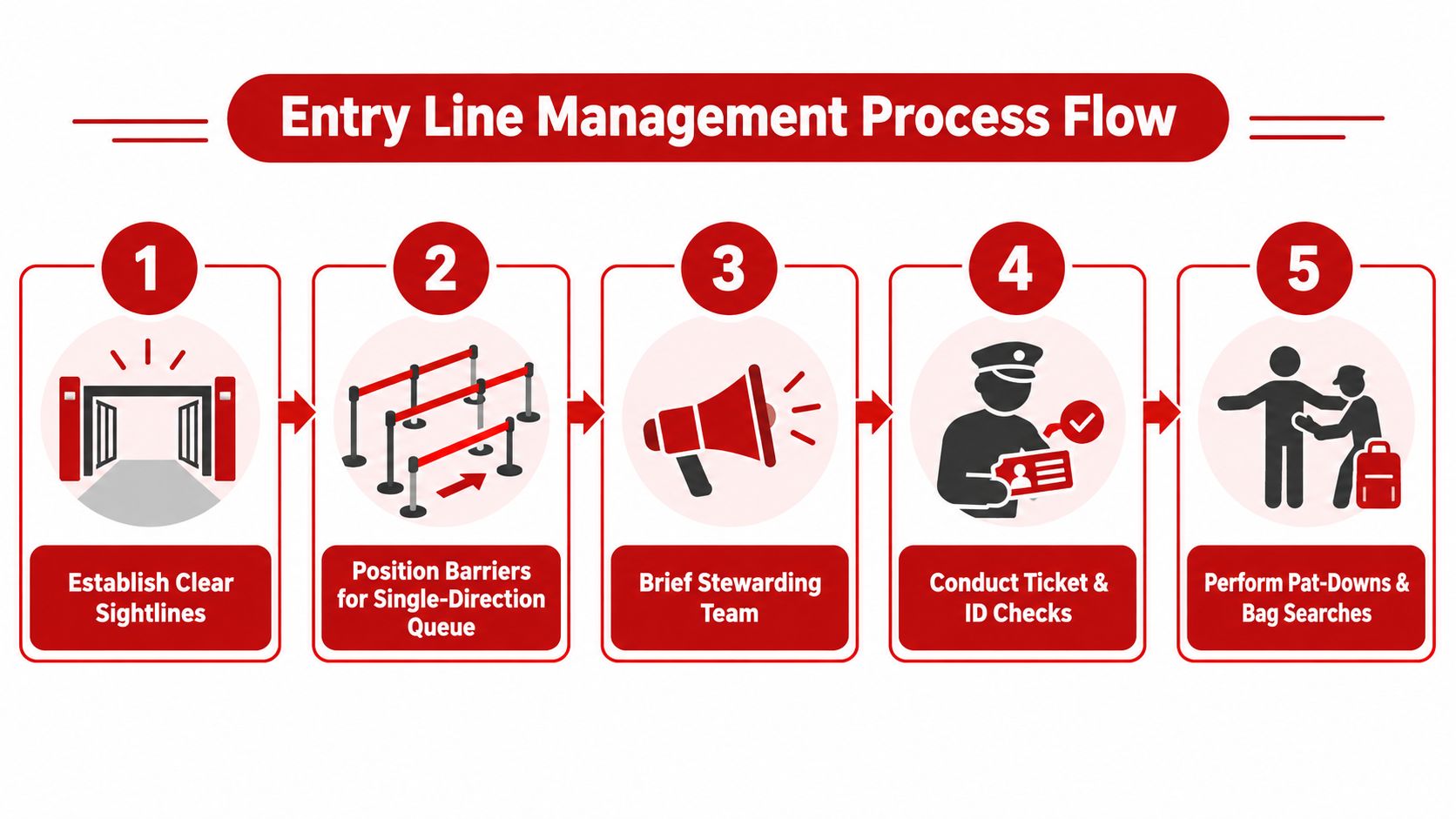
Entry works best when the gate line is designed as a movement system rather than a row of guards. Before opening, the supervisor should walk the approach from the guest's perspective, check sightlines, remove avoidable obstructions and make sure the queue can't spill into a fire route, road or competing pedestrian flow.
Barriers should create a clear, single-direction route with enough room for staff to intervene without trapping guests. Signs need to explain where to queue, what to have ready and which items aren't permitted. Stewarding staff should understand the search policy, ticketing exceptions, accessibility arrangements and the person who authorises a decision when a guest disputes the process.
Searches should support flow
Uniform searching can sound fair, but a rigid process may create unnecessary delay and crowd pressure. The event policy should define what is searched, who conducts it, how privacy and dignity are protected, and what happens when a prohibited item is found. Officers need a consistent decision path, while supervisors need visibility of refusals, confiscations and incidents.
Queue density changes quickly. Rain can drive guests under a narrow canopy, a delayed headline act can produce a sudden arrival wave, and a bar opening can alter movement inside the venue. Staff should monitor the queue as a live condition, not wait for a complaint before adjusting barriers or opening another controlled lane.
The crowd management guidance for events should sit alongside the venue plan, not in a separate folder. It needs to account for phased entry, holding areas, welfare points, accessible routes and the route guests will take after screening.
Egress needs its own plan
Departure often gets less attention because the ticket check is over. That is a mistake. Guests leave together after the final song, result or speech, and the security team may need to protect emergency access, prevent counter-flow, direct people towards transport and keep restricted areas closed.
Use radios for short, specific messages. A useful call identifies the location, the condition observed, the immediate action and the support required. The team should know when to pause admission, when to request a supervisor and when to contact venue management or emergency services.
A short practical demonstration before opening can expose problems that a written procedure won't. The video below can support a briefing discussion, but it shouldn't replace a site-specific walk-through.
Designing Accreditation and Access Zones
Admission proves that someone may enter the event. Accreditation proves where that person may go and what they are authorised to do.
Consider a conference with a keynote auditorium, an expo floor and a back-of-house production area. Registration data produces badges for delegates, exhibitors, press, speakers, contractors and venue staff. The badge or pass then becomes useful only when every category maps to a physical control point and the officer checking it understands the access decision.
Match the credential to the zone
A colour-coded lanyard can work for visible categories, while wristbands may suit temporary event access and RFID passes may support controlled doors where the venue has compatible readers. The technology isn't the control by itself. A guard still needs to recognise a mismatched credential, a badge being used by another person or a pass that doesn't apply after a shift changes.
Access zone | Credential type | Control point |
|---|---|---|
Delegate areas | Delegate badge or lanyard | Registration and internal zone entrance |
Exhibitor floor | Exhibitor credential | Expo entrance and service access |
Press area | Press pass | Media desk or controlled press entrance |
Back of house | Staff or contractor pass | Staff entrance and production corridor |
VIP area | VIP credential | Dedicated access point with supervisor oversight |
Supervisors should reconcile the guest list with the access zones before opening. If a speaker's assistant has a delegate badge but needs backstage access, the answer isn't to ignore the mismatch. Issue the correct authorisation, record it and brief the relevant post.
Securing Reliable Event Security Cover
A large licensed workforce doesn't guarantee that the right people will attend your event. The SIA reported over 446,000 individual licence holders across the UK holding more than 500,000 licences by February 2025, while its 2025-26 business plan forecast around 182,000 licence applications would be processed in that year. Those figures show the scale of the system, not the availability of experienced officers for a particular London shift. The SIA business plan also records that 60% of respondents in its 2023-24 survey felt safer with a private security presence across settings including concerts and sporting events.
The resilience question becomes sharper when event-specific availability is considered.
The SIA's 2026–29 strategic plan records more than 458,000 licensed individuals holding over 517,000 SIA licences across the UK.
However, among the 12,000 first-time applicants who responded to its 2025 survey, only 15% intended to work at events. These figures don't tell an organiser how many experienced officers are available for a specific date, but they show why total licence numbers should not be treated as a measure of event-security availability.
The SIA strategic plan is relevant context for workforce planning.
Verify the supply, not just the promise
Ask the provider to confirm:
Licence fit: Does every post require a Door Supervisor licence or a Security Officer licence?
Identity and eligibility: How will licence validity and right-to-work documents be checked before deployment?
Comparable experience: Have the proposed supervisors managed a similar crowd, venue layout and access model?
Dropout cover: Who replaces an officer at short notice, and how quickly can the provider make that decision?
Accountability: Are subcontractors involved, and who remains responsible for briefing, conduct and incident reporting?
The event security company selection guidance can help organisers frame those questions before comparing prices. Look for a named account manager, a confirmed deployment list, a documented induction period and an escalation route that works outside office hours.
Pre-Event Readiness and Final Checks
Readiness is a series of verifiable checks, not a feeling that the supplier has everything under control. The organiser, venue manager, security supervisor, fire-safety lead, first-aid provider and stewarding lead should work from one integrated plan, so that an instruction about an exit, welfare point or incident escalation doesn't change between briefings.
Start with the contract scope. Confirm the posts, operating hours, breaks, relief arrangements, search responsibilities, accreditation duties, perimeter coverage and reporting requirements against the current risk assessment. Then verify the people, not just the rota. Each deployed officer's SIA licence should match the assigned activity, and the provider should complete the required identity and right-to-work checks.
Planning checks before the event
Confirm responsibilities: Name the organiser, venue contact, security supervisor, emergency liaison and person who can authorise late changes.
Check equipment: Test radios, spare batteries, barriers, torches, signage, search tables, sealable evidence or property bags and any approved screening equipment.
Walk the site: Visit entrances, emergency routes, staff areas, accreditation points, welfare locations, loading areas and the rendezvous point.
Align partners: Bring security, fire safety, first aid, venue operations and stewarding into the same operational briefing.
Test decisions: Use short scenarios covering a blocked exit, lost badge, prohibited item, aggressive guest, missing child or radio failure.
The pre-event security checklist gives the team a visual prompt for procurement and event-day routines.
The final 24-hour pass
Recheck the weather plan, queue shelter, ground conditions, lighting and any transport disruption that could alter arrival patterns. Confirm where lost property goes, who records refusals and incidents, how urgent information reaches venue management, and who can approve a change when the original plan no longer fits.
On the day, the supervisor should conduct a physical walkthrough, test radio communications and assign posts by name. The briefing should explain not just where each officer stands, but what they watch for, what they can decide independently and when they must escalate.
Solomon's Facilities Management provides SIA-licensed event officers for crowd safety, access control, search and screening, perimeter control, accreditation checks and incident response, with integrated security and facilities support available across London. To discuss a deployment built around your venue risk assessment and staffing requirements, visit Solomon's Facilities Management.

Comments