
Facilities Management vs Property Management in London

Most advice on facilities management vs property management starts with job descriptions. That's the wrong place to start. In a London building, the meaningful question isn't whether you appoint a facilities manager or a property manager. It's who carries contractual accountability when the lift fails at night, a statutory inspection is overdue, a tenant challenges a charge, or three suppliers give you three different explanations.
Facilities management keeps the building operating. Property management protects the asset, manages leases, and represents the landlord's interests. Those descriptions are useful, but they don't tell you who owns the outcome. A contract can assign responsibility clearly, or it can create a chain of handoffs between a managing agent, an M&E contractor, a cleaning supplier, and a security company.
The UK market is large enough for this distinction to matter commercially. The Institute of Workplace and Facilities Management's 2025 Market Outlook valued the wider workplace and facilities management sector at £102 billion to the UK economy and around 1.2 million jobs. Different market studies use different definitions of facilities management, so individual market-size estimates vary significantly. For example, Mordor Intelligence's UK facility management market overview values the UK facilities management market at USD 81.09 billion in 2025 and reports that outsourced services accounted for 63.85% of the market.
My procurement rule: if nobody can explain who owns the result, you haven't bought accountability. You've bought a collection of services.
Table of Contents
Why the Real Question Is Contractual Accountability - What the contract must answer
Defining Facilities Management and Property Management in the UK - Where the functions overlap
Scope, Responsibilities, and Reporting Compared - The reporting mismatch
London Use Cases and How the Split Plays Out - The decision at each site
Procurement Models and Cost Drivers for London Sites - What changes the price
When Single-Supplier FM Beats Split Property and FM Contracts - Where the model fails
Choosing the Right Setup for Your Building - Three practical profiles
Why the Real Question Is Contractual Accountability
The popular advice says property managers look after the building while facilities managers look after the people inside it. That's broadly right, but it's not enough to sign a safe London contract.
A property manager may control the budget and appoint contractors, while an FM provider runs the helpdesk, engineering response, security, cleaning, reception, and compliance records. In another building, the property manager may also coordinate daily services through several subcontractors. The labels change. The exposure doesn't.
Consider a failed air-conditioning system on a summer evening. The tenant calls reception. Reception calls the helpdesk. The helpdesk calls the M&E contractor. The contractor says the managing agent must approve the works. The managing agent asks whether the fault is a landlord repair or a tenant responsibility. By the time the decision reaches the engineer, the operational problem has become a contractual argument.
That is the failure mode: fragmented handoffs with no single point of accountability. The same pattern appears when a fire door inspection is missed, a visitor-control procedure isn't followed, or a cleaning complaint sits between the occupier, agent, and supplier.
What the contract must answer
Before choosing a model, put these questions in writing:
Who receives the first call? The answer must be a named function, not “the management team”.
Who can authorise urgent work? A response target is useless if approval sits elsewhere.
Who proves compliance? Certificates, inspection records, actions, and close-out evidence need one accountable owner.
Who reports the outcome? A supplier shouldn't be able to declare success without evidence accepted by the client.
Who carries the service failure? Credits, abatements, remediation, and escalation must be contractual.
London landlords and occupiers often need both disciplines. The procurement decision should therefore reflect building type, operational intensity, compliance exposure, and cost risk, rather than an argument about which job title sounds more senior.
The distinction becomes clearer once the UK definitions are separated.
Defining Facilities Management and Property Management in the UK
Facilities management is the operational control layer. It coordinates the hard and soft services that keep a workplace, estate, or mixed-use site safe, functional, presentable, and available to its users. That can include M&E maintenance, planned preventive maintenance, cleaning, security, reception, concierge, waste, helpdesk administration, access control, energy monitoring, and compliance evidence.
For public-sector estates, GovS 004 Property on GOV.UK places facilities management standards inside a wider property-management framework. The standard is mandatory for relevant central government bodies with property responsibilities and acts as a benchmark for good FM practice. That distinction is practical: FM is assessed through service delivery, operational control, assurance, and measurable outcomes.
The Institute of Workplace and Facilities Management, formerly BIFM, also treats FM as a broad professional discipline covering people, place, process, technology, procurement, risk, and service performance. You don't need to reproduce every competency framework in a contract, but you do need to specify the services and outcomes that matter at your site.
Property management sits closer to ownership and asset stewardship. It normally covers lease administration, rent collection, tenant and landlord communication, service-charge administration, budgets, insurance coordination, repairs that affect the asset, contractor appointments from the owner's perspective, and long-term value protection.
Property managers also operate within legal and professional frameworks that an FM supplier cannot absorb. Service-charge decisions may engage the Landlord and Tenant Act 1985, while residential management practice may be governed by relevant RICS standards and codes. Higher-risk residential buildings bring additional duties under the Building Safety Act 2022, including the landlord-side accountable-person framework.
Where the functions overlap
On one London site, a managing agent might administer the service charge, handle lease queries, and communicate with the freeholder. An FM supplier might run the engineering helpdesk, security, cleaning, reception, and plant maintenance. Both parties may touch compliance, contractor performance, budgets, and occupier complaints.
That overlap is acceptable only when the contract defines the boundary. Property management usually owns asset administration, lease obligations, landlord governance, and financial allocation. FM owns daily execution, service coordination, response, operational records, and front-line performance.
Dimension | Facilities Management | Property Management |
|---|---|---|
Primary focus | Day-to-day operation of buildings and estates | Asset stewardship, leases, tenants, and landlord obligations |
Typical services | M&E, cleaning, security, reception, concierge, helpdesk, maintenance coordination | Rent, leases, service charges, budgets, tenant relations, owner reporting |
Main customer | Occupants, users, operational leadership, and the client organisation | Landlord, investor, freeholder, residents, and tenants |
Performance lens | Service quality, response, compliance evidence, uptime, and satisfaction | Financial control, lease compliance, asset condition, and occupier governance |
UK anchor | GovS 004 and FM service standards | Landlord and Tenant legislation, RICS practice, and ownership duties |
Scope, Responsibilities, and Reporting Compared
The cleanest way to compare the two functions is to follow a building issue from detection to closure.
FM normally receives the operational request, triages its urgency, allocates the engineer or supplier, and records the outcome. A London office might require a defined reactive M&E response target, a helpdesk record for every request, and monthly reporting that shows open tasks, response performance, planned maintenance, incidents, and recurring defects.
Property management usually enters when the issue affects landlord responsibility, lease interpretation, service-charge recovery, capital expenditure, insurance, tenant communication, or the asset plan. A managing agent may need to confirm whether a repair is recoverable, whether consultation is required, and whether the expenditure belongs in the service charge or the landlord's budget.
The reporting mismatch
Most contract disputes start because the parties measure different things. FM reports work orders, response times, maintenance completion, incidents, defects, and satisfaction. Property management reports budgets, rent, arrears, service-charge spend, variance, lease events, and owner decisions.
A monthly FM report can show that an engineer attended quickly, but it may not show whether the repair was allocated correctly under a lease. A property report can show that expenditure remained within budget, but it may not show that tenants waited too long for a resolution.
Use one operating dashboard with separate views. The client should be able to see the service event, the contractual responsibility, the cost decision, and the final evidence without reconstructing the story from different suppliers. For a practical explanation of the service categories that commonly sit inside FM, see Solomon's guide to facilities management soft services.
Criterion | Facilities Management | Property Management |
|---|---|---|
Scope | Hard and soft services, work orders, site teams, helpdesk, operational compliance | Leases, rent, service charges, landlord obligations, budgets, owner reporting |
Daily duties | Coordinate cleaning, security, reception, maintenance, inspections, incidents, and access | Manage tenant communication, approvals, accounts, lease matters, and contractor governance |
Compliance ownership | Maintain operational evidence, schedules, certificates, actions, and service assurance | Retain landlord, lease, statutory governance, consultation, and asset-level obligations |
Contract structure | Often service-led, with SLAs, KPIs, mobilisation, and escalation provisions | Often management-led, with authority limits, reporting obligations, and owner instructions |
Reporting cadence | Monthly operational reporting, with service reviews and periodic KPI meetings | Regular financial and management reporting, service-charge accounts, reconciliations, and owner reports |
Typical KPI set | Reactive response and resolution, planned maintenance completion, compliance evidence, satisfaction | Service-charge variance, budget control, arrears, lease events, complaints, and asset actions |
Escalation point | Operational failure, safety risk, service interruption, or missed task | Legal responsibility, cost allocation, lease dispute, capital decision, or owner risk |
The decision is rarely “one or the other”. It's usually about whether the two contracts are joined by a usable responsibility matrix and a single point of accountability for the building outcome.
London Use Cases and How the Split Plays Out
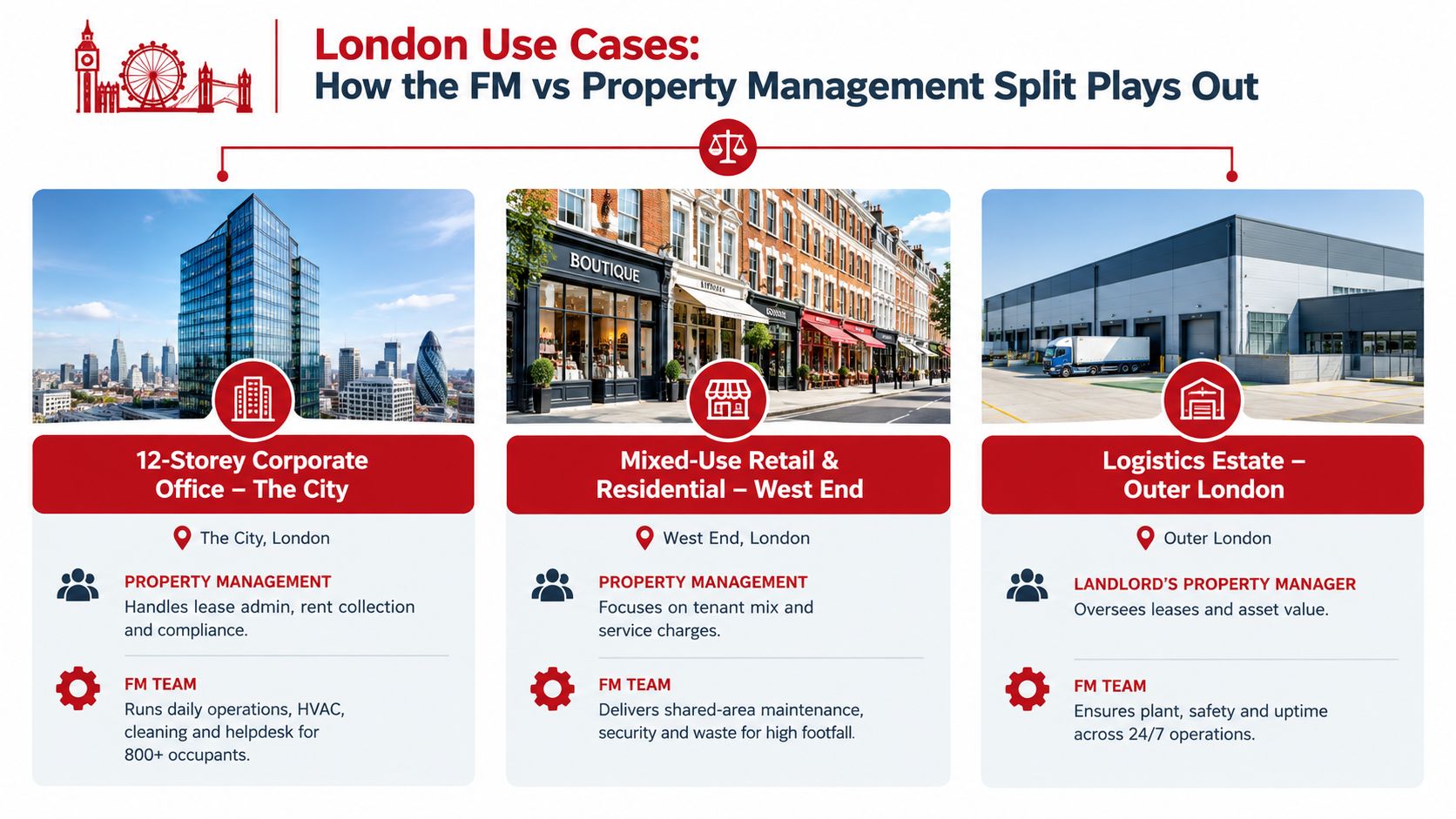
A 12-storey corporate office in the City usually needs a managing agent and an operational FM function. The managing agent handles leases, rent interfaces, service-charge administration, landlord approvals, and owner reporting. An integrated FM contractor runs M&E coordination, reception, security, cleaning, helpdesk activity, contractor access, and daily site presentation.
The handover risk sits between the two. If a tenant reports poor air quality, the FM team can investigate the plant and operating conditions, but the property manager may need to approve remedial expenditure or determine whether the issue relates to a landlord obligation. The contract should name the decision-maker, not merely list both suppliers.
A residential block in Canary Wharf or Nine Elms creates a sharper legal boundary. The landlord-side property-management function may handle leaseholder communication, building governance and service charges, while duties under the Building Safety Act remain with the relevant Accountable Person or Principal Accountable Person.
The FM supplier may deliver cleaning, concierge, security, CCTV monitoring, plant maintenance, waste and resident-facing helpdesk services, but holding an operational contract does not transfer the statutory responsibilities of the relevant accountable parties to the FM supplier.
A mixed-use retail and office scheme on the Strand is harder again. Shared M&E, loading arrangements, waste routes, security, access control, energy allocation, and public-facing areas create operational dependencies across different occupiers. Property management may control tenant mix, leases, service charges, and landlord strategy. FM must keep shared areas operating during trading and office hours, coordinate contractors, and manage incidents without forcing every decision back through the agent.
The decision at each site
City office: appoint a property manager for ownership and lease matters, then give one FM supplier control of daily operations.
Residential block: keep landlord and statutory building-safety accountability with the relevant landlord-side accountable parties, with property management handling its defined governance role and FM responsible for clearly defined physical and resident-facing services.
Mixed-use scheme: consolidate shared-area operations under one accountable FM lead, while retaining property management for leases, budgets, and landlord governance.
A useful test is simple. Ask who reports the issue to the board, who can spend money during an incident, and who closes the action with evidence. If the answer changes depending on the supplier involved, the building has a handoff problem.
Procurement Models and Cost Drivers for London Sites
London buyers usually choose between three operating models.
Multi-vendor procurement separates cleaning, security, M&E, reception, and property management. It can create competitive tension and preserve specialist suppliers, but the client or managing agent becomes the integrator. That internal coordination has a cost, even when it doesn't appear as a line item.
Single-supplier integrated FM places multiple hard and soft services under one contract. The supplier can coordinate shifts, escalation, reporting, mobilisation, and service recovery through one management structure. This model is particularly useful where reception, security, cleaning, concierge, and engineering affect the same occupied environment.
In-house delivery gives the landlord or occupier direct control over staff and daily decisions. It can work where the estate has enough operational scale to support supervision, absence cover, compliance management, procurement, and technical expertise. Smaller or less predictable sites often need specialist subcontractors anyway.
What changes the price
London cost comparisons need more than a headline management fee. TUPE exposure can affect mobilisation when staff transfer during a retender. Wage obligations, including annual changes to the London Living Wage for accredited employers, influence labour-intensive services. Out-of-hours engineering in Zone 1 carries a different commercial profile from planned daytime attendance.
Older EPC C or D stock may also require building management system work, controls optimisation, plant replacement, or energy-related capital expenditure. These are not always FM operating costs, and a supplier should separate routine service delivery from lifecycle investment.
Residential schemes face another pressure. Service-charge scrutiny, consultation requirements, and leaseholder challenge can make a low bid expensive if the scope, exclusions, and approval route aren't explicit. Solomon's guidance on reducing operational costs is relevant here because cost control depends on scope, scheduling, supplier governance, and evidence, not just rate reduction.
Cost Driver | Multi-Vendor | Single-Supplier FM | In-House Team |
Supplier management | Client or agent coordinates several contracts | One commercial relationship, though subcontractors still need control | Internal managers coordinate staff and specialists |
Labour exposure | Separate wage and mobilisation positions across suppliers | Consolidated staffing model, with transfer and subcontracting risks | Direct employment, absence, training, and supervision costs |
Out-of-hours response | Often priced separately by discipline | Can be packaged into one escalation model | Requires rota coverage or specialist call-outs |
Compliance evidence | Records may sit in different systems | One dashboard is possible if the contract requires it | Client owns systems, records, and audit discipline |
Capital and lifecycle work | Often split between property and technical vendors | Must be separated from operational scope in the pricing schedule | Client carries planning and delivery responsibility |
Management overhead | Highest for the client or agent | Lower handoff burden, but stronger supplier governance is essential | Highest internal ownership burden |
Main commercial risk | Gaps between contracts | Overreliance on one supplier or vague exclusions | Under-resourcing and loss of specialist capability |
Don't accept invented benchmark ranges when the tender doesn't provide verified comparables. Ask suppliers to price the same asset register, service schedule, staffing assumptions, response model, exclusions, mobilisation tasks, and lifecycle responsibilities. A cheaper line item can be an unpriced obligation waiting to return as a variation.
When Single-Supplier FM Beats Split Property and FM Contracts
Single-supplier FM beats a fragmented model when the building is service-heavy and the client needs one operator to own the daily result. Cleaning, security, reception, concierge, CCTV monitoring, visitor management, and engineering don't operate in separate lanes. A reception team may identify an access issue. Security may escalate it. Engineering may need to secure plant space. Cleaning may require a temporary change to access routes. One operating structure can resolve that faster than four disconnected contracts.
For a large office or mixed-use estate, the benefit isn't the label “total FM”. The benefit is one accountable KPI dashboard, one escalation route, one mobilisation plan, and one service-recovery process. The managing agent can remain responsible for lease and owner matters, while the FM supplier controls the physical services that occupiers experience every day.
The contract still needs discipline. Integrated FM doesn't remove risk. It can hide risk if the scope says “all associated services” without listing assets, frequencies, response categories, exclusions, subcontracting rules, reporting requirements, and approval limits. Solomon's explanation of integrated facilities management illustrates the model's core idea, consolidating multiple facilities functions under one coordinated arrangement.
Where the model fails
Single-supplier FM is the wrong primary contract for a residential block if it tries to absorb landlord duties, lease enforcement, service-charge governance, or tribunal exposure. Those responsibilities belong with the owner and the appointed property-management function. An FM provider can maintain plant, manage cleaning, run concierge, monitor CCTV, record incidents, and coordinate repairs. It shouldn't be presented as the party responsible for every legal or ownership decision.
The strongest arrangement is often a property manager plus integrated FM supplier, joined by a single SLA and a shared responsibility matrix. The property manager owns the legal, financial, and lease interface. The FM supplier owns service delivery. Both parties use the same incident, compliance, cost, and action records.
Contract position: one supplier should own the operational outcome, but that doesn't mean one supplier should inherit duties the landlord cannot outsource.
Use single-supplier FM when the building's users experience a connected service environment. Keep property management visibly separate where ownership, lease interpretation, service-charge accountability, and statutory landlord duties drive the risk.
Choosing the Right Setup for Your Building
Start with service intensity, not floor area alone. A small building with critical plant and high visitor traffic may need stronger FM governance than a larger, quiet single-let property. The contract should reflect how quickly a failure affects people, income, compliance, reputation, and the landlord's obligations.
Three practical profiles
Low-intensity buildings include a straightforward single-let site with limited footfall and uncomplicated plant. A traditional property manager with carefully separated FM suppliers can work, provided someone coordinates access, maintenance evidence, cleaning standards, and emergency escalation.
Medium-intensity buildings have mixed tenancy, multiple floors, frequent contractor activity, and plant that needs active management. An integrated FM supplier usually earns its place here because reception, maintenance, security, cleaning, and helpdesk records need to connect.
High-intensity buildings include 24/7 environments, retail frontages, regulated operations, complex mixed-use schemes, or sites where service failure creates immediate safety and continuity risk. These may justify an in-house operational lead supported by specialist subcontractors, or a fully integrated FM contract with strong client-side technical oversight.
Track five KPIs regardless of model:
Reactive resolution: measure mean time to resolve, not only time to acknowledge.
Compliance evidence: track the cycle from inspection or test through action close-out and document acceptance.
Planned maintenance: report completion against the agreed programme, with reasons for deferral.
Building data: monitor energy and BMS data uptime so decisions rely on usable information.
Occupier experience: use a tenant satisfaction score and investigate recurring themes rather than chasing a single headline result.
Building Profile | Recommended Setup | Primary KPIs to Track | Non-Negotiable Contract Clauses |
Low intensity, single let, low footfall | Property manager with selected FM vendors | Resolution time, compliance evidence, cleaning quality, maintenance completion, tenant satisfaction | Scope matrix, approval limits, escalation route, evidence standard, exit support |
Medium intensity, mixed tenancy, plant-heavy | Single-supplier integrated FM with property-manager interface | Reactive resolution, planned maintenance, helpdesk closure, BMS data, satisfaction | Single point of accountability, KPI dashboard, subcontractor controls, open-book costs, service credits |
High intensity, 24/7 or compliance-heavy | In-house operational lead with specialists, or tightly governed integrated FM | Uptime, incident response, statutory close-out, maintenance completion, stakeholder satisfaction | Defined command structure, emergency authority, audit rights, performance abatements, exit assistance |
Insist on a defined scope matrix, a named single point of accountability, performance credits or abatements, transparent open-book cost reporting, and exit assistance. Include the asset register, service frequencies, response categories, exclusions, subcontractor approval, data ownership, mobilisation duties, and handback requirements.
Finally, don't assume outsourcing removes landlord obligations. Section 20 of the Landlord and Tenant Act 1985 can still affect consultation for qualifying works and qualifying long-term agreements, even when an external supplier delivers the service.
Your property manager, FM provider, and legal advisers need a process that identifies consultation requirements before commitments are made.
Further viewing: This discussion explores how property management and facilities management work together in practice.
Solomon's Facilities Management provides integrated security, cleaning, reception, concierge, CCTV monitoring, and visitor-management services under one accountable London contract. If you're deciding between fragmented suppliers and a joined-up FM model, visit Solomon's Facilities Management to discuss a service scope and accountability structure suited to your building.

Comments