
Shopping Centre Facilities Management: A London Guide

Shopping centre facilities management in the UK is shaped by vacancy as much as by footfall. Savills reported shopping centre vacancy at 16.1% in Q2 2026, down from 16.9% in Q1, as occupational conditions improved following a temporary rise in vacancies earlier in the year. Savills' retail market research captures the operating contradiction clearly.
A busy shopping centre is not automatically an easy one to run. An estate with vacant units needs more patrols, tighter access control, better presentation of dead zones, careful maintenance of unused plant and faster support for incoming tenants. The FM team is maintaining a trading environment, but it's also defending a partially empty asset against vandalism, anti-social behaviour, poor customer perception and inconsistent service.
The practical answer is an operating model that joins security, cleaning, engineering, tenant services and compliance around one set of priorities. The sections below take the perspective of a London facilities lead making decisions on a live retail estate, where a missed patrol, blocked waste route or unresolved leak can affect tenants, visitors and the landlord's letting strategy at the same time.
Table of Contents
What Shopping Centre Facilities Management Means in 2026 - Start with the operating condition
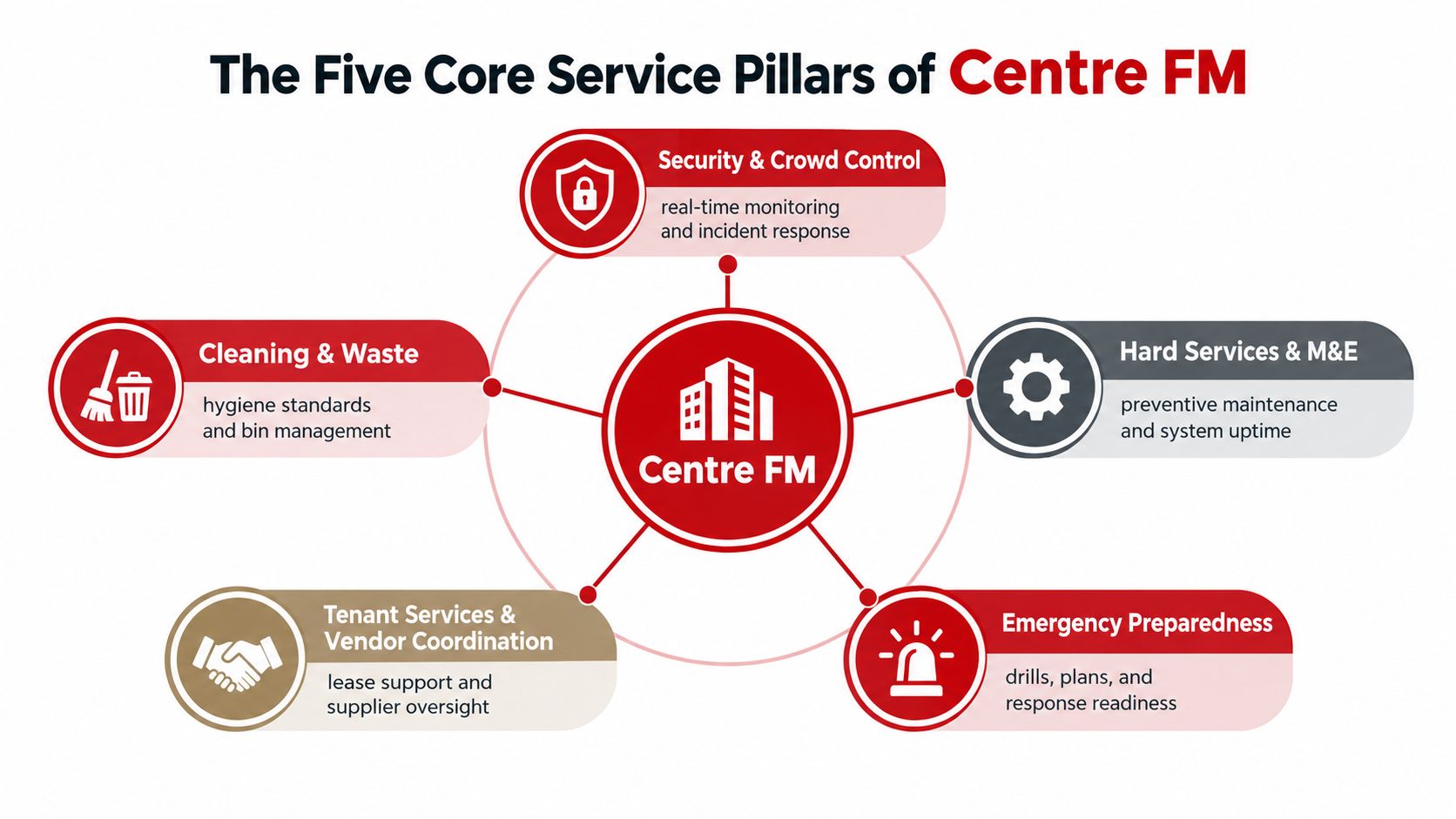
The Five Core Service Pillars of Centre FM - Security and crowd control - Cleaning, hygiene and waste - Hard services and M&E - Tenant services and vendor coordination - Emergency preparedness
Security and Crowd Control on a Live Estate - How the layers work together
Tenant Services, Vendor Coordination, and Emergency Response - The day-to-day coordination layer
Performance Metrics That Actually Matter - Trading performance - Safety and compliance
Choosing the Right FM Model for a London Centre - Check the vacancy profile - Check the trading pattern - Check compliance and service-charge visibility - Check the repositioning timeline
What Shopping Centre Facilities Management Means in 2026
Shopping centre facilities management is the discipline that keeps a retail estate safe, operational, welcoming and commercially usable throughout the trading day and beyond it. That includes the obvious work, such as cleaning mall floors, maintaining lifts and managing security officers. It also includes the less visible work that becomes critical when units are empty, including securing vacant premises, controlling contractor access, maintaining lighting in underused areas and keeping back-of-house routes ready for new occupiers.
The historical direction of travel is clear. Cushman & Wakefield reported that vacancy in institutionally held shopping centres fell to 11.1% of floorspace in 2024, while many best-in-class schemes were operating with less than 3% vacancy. Its prime shopping centre index rose from 85 in Q4 2023 to 89 in Q4 2024, a movement associated with stronger occupier performance and more disciplined asset management. The UK retail market report from Cushman & Wakefield illustrates why FM is now part of asset performance rather than a back-office cost line.
Start with the operating condition
Before writing a specification, map the estate in four layers:
Occupied areas, where presentation, customer flow and tenant response times affect daily trading.
Vacant units, where security, inspection, lighting, damp prevention and access control matter more than customer service.
Shared infrastructure, including roofs, risers, plant rooms, service yards, lifts, escalators and fire systems.
External interfaces, such as car parks, public footways, delivery routes, local authority boundaries and event spaces.
That map tells you where the same service needs different treatment. A washroom beside a food court needs visible daytime attention, while a vacant unit may need planned inspections and alarm verification. A loading bay needs controlled access and safe vehicle movement, whereas an atrium needs crowd observation and rapid spill response.
Asset type | Vacancy position | FM implication |
|---|---|---|
Shopping centres | Higher structural vacancy pressure, with the Q2 2026 position reported above | Maintain occupied areas and present, secure and inspect vacant space |
Retail parks | Lower vacancy pressure than shopping centres in the cited UK outlook | Focus on traffic movement, external areas, parking and tenant access |
Prime high streets | Lower vacancy pressure than shopping centres in the cited UK outlook | Prioritise public realm, frontage presentation and street-facing access |
An integrated operating model is useful because the estate doesn't experience incidents in departmental categories. A leak can become a cleaning issue, a slip risk, a tenant complaint and an insurance matter within minutes. Managers responsible for facilities management for large UK venues will recognise the same principle: the customer sees one venue, so the operating team needs a joined-up view of performance.
The Five Core Service Pillars of Centre FM
A London centre FM contract should be built around five connected service pillars. Each pillar has a distinct supervisor, competence profile and set of procedures, but the centre manager should still be able to see one operating picture rather than five disconnected supplier reports.
Security and crowd control
Security covers perimeter checks, service-yard access, CCTV monitoring, on-floor presence, incident response, lost children procedures and support during events. On a high-vacancy estate, officers also provide reassurance around empty units and underused routes. The work is not only about deterring theft. It's about keeping people moving safely and giving tenants confidence that the whole centre is being watched.
Cleaning, hygiene and waste
Cleaning has to follow trading patterns, not a fixed weekly rota. The scope normally includes mall floors, escalators, lifts, washrooms, parent rooms, food and beverage areas, car parks, service yards, bin stores and vacant units where dust, pests or leaks can quickly become visible defects. Waste handling belongs in the same pillar because poor segregation can create odour, pest pressure and blocked collection routes.
Hard services and M&E
Hard services keep electrical systems, HVAC, plumbing, lifts, escalators, fire protection and building management systems available and compliant. Preventive maintenance is particularly important in vacant space, where faults can develop without a tenant reporting them. A digital task system can help technical teams schedule planned work, record defects and show whether a fault has been acknowledged, attended and closed.
Tenant services and vendor coordination
The tenant services function handles fit-out access, signage requests, delivery queries, utilities, pest reports, waste arrangements and day-to-day complaints. It also coordinates vendors who may otherwise arrive without the right permits, escorts or information. One accountable helpdesk is more useful than a collection of informal messages because every request has an owner, a timestamp and an escalation route.
Emergency preparedness
Emergency planning brings the pillars together. The centre needs current contact lists, tested evacuation arrangements, clear radio protocols, contractor call-out procedures and a control-room process for logging decisions. UK counter-terror guidance also emphasises practical housekeeping, clean communal areas, reduced hiding places and CCTV coverage of entrances, exits and critical areas. Those measures are ordinary FM work, but they support resilience as well as appearance.
Shopping centre operators should also be preparing for Martyn’s Law, which introduces requirements for qualifying premises to improve preparedness for terrorist attacks and, for larger premises, take additional measures to reduce vulnerability.
Practical rule: Write the contract around shared outcomes. A security team that identifies a damaged shutter, a cleaner who reports a leak and an engineer who closes the defect should be working through the same escalation process.
The operating advantage of integration is speed from observation to action. Atlas describes live notifications, digital issue reporting, planned task scheduling, inspections and compliance checks as part of specialist retail FM delivery. Its retail facilities management operating approach reflects what works on complex estates: the reporting mechanism must be as live as the operation.
Security and Crowd Control on a Live Estate
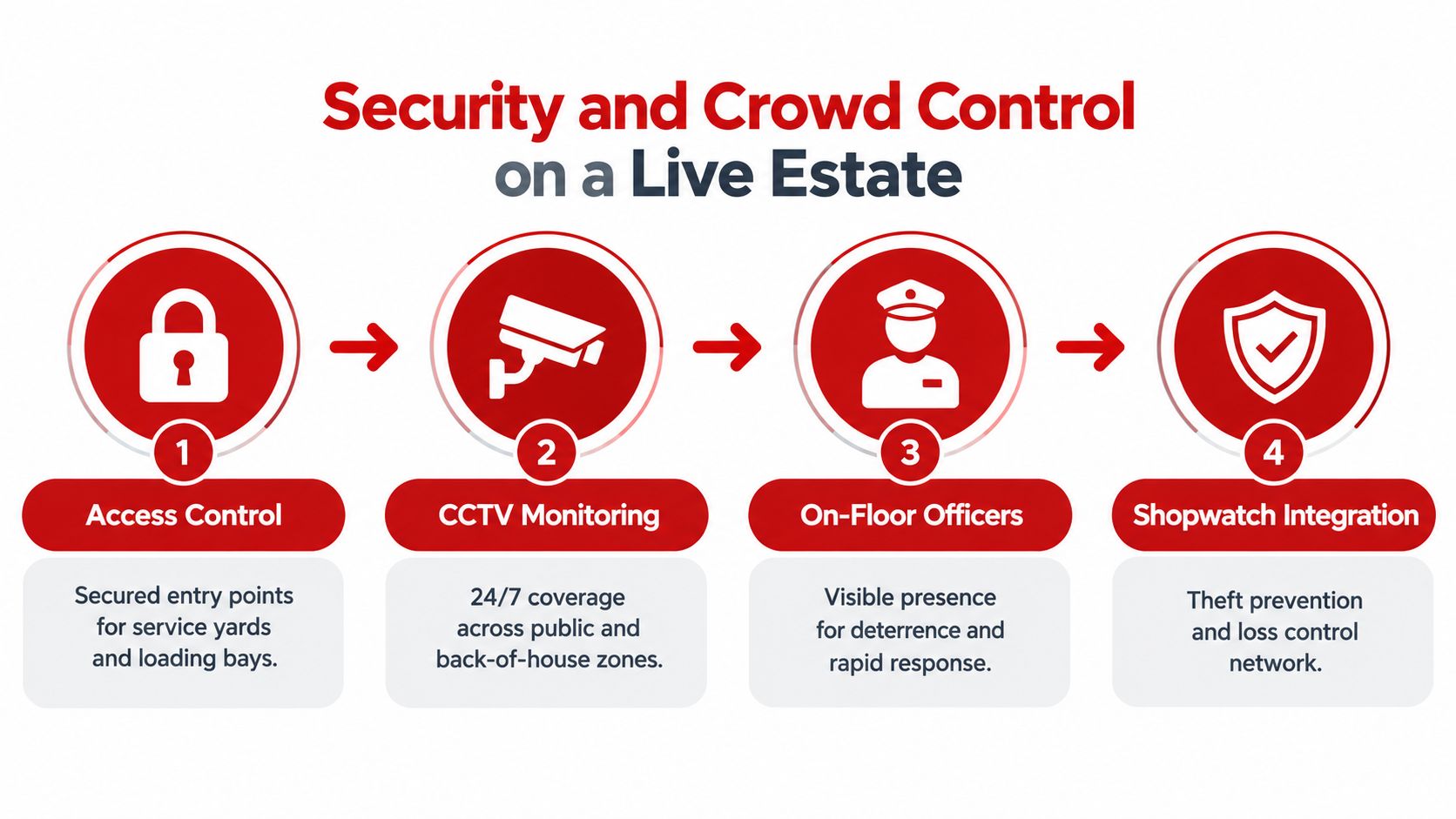
Security starts before a visitor reaches the mall. Service yards, loading bays, contractor entrances and car-park routes need defined access permissions, visitor records and escalation procedures. The public areas then require a combination of monitored CCTV, visible officers, radio discipline and clear ownership of incidents.
CCTV is valuable when it leads to a decision. A control-room operator should know which officer is nearest, which exit can be secured, which tenant needs notification and when the police should be contacted. Cameras without trained review, reliable recording and an agreed response process create an archive, not a security system.
How the layers work together
Consider a representative coordinated theft attempt during a busy trading period:
A retailer reports suspicious behaviour, and the control room checks nearby CCTV.
Officers on the floor receive a description and position update rather than a vague instruction to “keep an eye out”.
A Shopwatch-style network shares relevant information with participating retailers, the centre team and police contacts.
Security checks service routes and back-of-house exits so suspects cannot move unnoticed between public and restricted areas.
The incident is logged with time, location, actions and outcome, allowing the centre to identify repeat patterns.
Workman's analysis of 20 managed centres found that prolific offenders accounted for more than half of incidents in 60% of centres, while 75% had more than 10 known individuals under active monitoring. The figures support an intelligence-led model, not a simple instruction to add more guards. Workman's retail crime analysis also reports that four in five centres operate Shopwatch, while one in five use WhatsApp groups for live information sharing between retailers.
For system selection, the Wisenet Security Ltd retail security guide is a useful reference when comparing CCTV, monitoring and access-control requirements. The important commissioning question is not how many devices appear on the proposal. It's whether the technology gives officers reliable information quickly enough to protect people and property.
Crowd control is a separate operational responsibility. During Black Friday, Boxing Day sales or late-night events, the FM team must manage queues, barriers, signage, emergency routes, steward positions, loading restrictions and cleaning recovery. Event plans should be tested against a full centre evacuation, not just the expected customer journey. Guidance on crowd management for events can help centre managers structure that planning.
A high-vacancy centre also needs regular checks of empty zones, temporary hoardings, lighting and shutter condition. Those checks reassure occupiers and help the letting team present the asset properly. Security therefore protects both the immediate trading environment and the credibility of the wider estate.
Cleaning, Hygiene, and Waste Across a Centre
Cleaning should be managed as a scheduled operational system, not as proof that people are present. Day teams deal with spills, washrooms, bins, touchpoints and customer-facing defects while the centre is open. Night teams can carry out machine scrubbing, high-level work, back-of-house servicing and detailed cleaning when shops are closed.
Footfall should determine deployment. A food court, main entrance and escalator bank need different attention from a quiet corridor beside vacant units. If supervisors only measure attendance or hours, they can miss the actual issue, which is whether the right areas were cleaned at the right time.
Zone | Daytime during trading | Evening after closure | Deep-clean frequency |
|---|---|---|---|
Main mall and entrances | Spill response, litter removal, touchpoint checks and visible patrols | Machine cleaning, edge work and detailed inspection | Adjust to footfall, weather and event activity |
Food court and F&B routes | Continuous table, floor, bin and washroom response | Degreasing, extraction and back-of-house servicing | Increase when food production or events create additional load |
Washrooms and parent rooms | Replenishment, hygiene checks and rapid response | Full sanitary clean, consumables review and defect reporting | Triggered by condition data and recurring defects |
Escalators, lifts and quiet corridors | Spot cleaning, safety checks and obstruction reporting | Detailed floor, balustrade and threshold cleaning | Planned around condition, access and asset use |
Car parks, service yards and vacant units | Litter, access and hazard checks | Pressure washing, waste-area work and unit inspections | Scheduled by condition, weather and letting activity |
Waste streams should be agreed with tenants before the contract starts. General waste, mixed recycling, food waste, cardboard, confidential waste, WEEE and hazardous items need clear routes, responsibilities and records. Tenants should know what can enter the centre compactor, what must be stored separately and who approves exceptional collections.
High-level cleaning belongs in the same scope as routine cleaning because visual standards and safety conditions overlap. Waste throughput affects hygiene, pest pressure and service-yard congestion, while poor bin-store discipline can undermine an otherwise clean mall. The integrated FM benchmark described in this shopping-centre facilities management contract example includes cleaning, high-level cleaning, waste, recycling, pest control and hygiene under one accountable structure.
Use washroom inspections, complaint patterns and supervisor audits to trigger deeper work rather than relying on opinion. Visible rosters and clear cleaning responses also help tenants understand what the service charge supports. A practical commercial cleaning contract structure should define the areas, frequencies, response categories and evidence required for each task.
Tenant Services, Vendor Coordination, and Emergency Response
At 15:00 on a Saturday, a fault in a vacant unit can become a centre-wide problem. The response depends less on heroic intervention than on having one person who can make decisions and a contractor network that knows what happens next.
Take a representative scenario involving smoke from an electrical cupboard in an empty unit. The centre manager becomes the single point of contact, while security establishes the immediate cordon and protects the public route. The M&E engineer isolates the relevant panel, checks connected systems and assesses whether the fault has affected a riser or neighbouring unit.
The response should run through a defined sequence:
Detect and verify: The control room receives an alarm or report and confirms the location.
Protect people: Security redirects visitors and prevents unauthorised access.
Escalate: The centre manager contacts emergency services and the landlord's nominated contacts.
Coordinate tenants: A short message goes to affected occupiers through the agreed channel.
Mobilise contractors: Engineering, cleaning and specialist recovery resources are called using pre-agreed rates.
Close the incident: The team records the cause, actions, follow-up work and risk-register changes.
The communication must be proportionate and fast. In this scenario, the centre could use a brief SMS to affected tenants, a noticeboard update and direct security contact with stores near the route. The manager should avoid broadcasting uncertain information, but silence creates rumours and can lead tenants to make their own unsafe decisions.
The day-to-day coordination layer
Emergency response exposes weaknesses that already exist in normal tenant services. Fit-out approvals, signage requests, utilities queries, pest reports and waste collections should pass through a shared helpdesk, not disappear into informal group chats. Each request needs a named owner, a target response and a record of closure.
Contractor records should include competence documents, access requirements, emergency contacts and agreed call-out terms. The centre also needs a shared radio protocol, a current key register, an accessible asset list and a clear handover between day and night teams. After the incident, the statutory fire log and internal risk register should be updated, and the centre manager should lead a short debrief while the facts are fresh.
The point is not to eliminate every fault. It's to prevent a local defect in an empty unit from becoming an unmanaged disruption across occupied stores, customers and essential services.
Integrated vs Fragmented FM Contracts
Fragmented contracting can appear cheaper because each service is procured separately. In practice, the centre manager may be coordinating separate agreements for security, cleaning, M&E, waste, pest control and landscaping, each with its own account manager, KPI set, invoice and escalation route.
An integrated contract places those services under one operating structure. That can shorten the fault-to-action path because the cleaning supervisor, security lead and engineer work from the same helpdesk and management chain. It also makes accountability clearer, although the contract must be written carefully enough to prevent one provider from hiding behind internal subcontractors.
Factor | Fragmented contracts | Integrated contract |
|---|---|---|
Accountability | Multiple suppliers can create handover disputes | One primary provider owns coordination |
Response | Delays can arise between disciplines | Shared reporting can speed escalation |
Reporting | Separate dashboards and invoice trails | One operating pack and one service view |
Specialist expertise | Direct access to niche providers | Specialist capability must be protected in the specification |
Commercial risk | Failure is spread across suppliers | Underperformance can affect the whole estate |
Management effort | Centre team carries more coordination | Provider carries more coordination responsibility |
Resilience | One supplier may fail without affecting all services | Concentration creates a wider contingency requirement |
The commercial trade-off is concentration of risk. If an integrated provider underperforms, the centre can be exposed across several services at once. Protect against that with clear SLAs, service credits, audit rights, mobilisation gates, performance security where appropriate and exit provisions linked to persistent KPI failure.
Keep specialist arrangements where the technical risk justifies them, particularly for systems such as lifts, fire suppression or highly regulated equipment. Integration doesn't mean every task must be delivered by the same operative. It means one operating structure must coordinate the work and accept responsibility for the result.
The integrated facilities management model is most useful when the centre's vacancy, tenant mix and service complexity create a genuine coordination burden. A fully let, simple asset may tolerate more direct supplier management. A partially empty estate with frequent access requests and changing occupiers usually benefits more from a single control point.
Performance Metrics That Actually Matter
A centre FM dashboard should show whether operations are protecting trading, safety and tenant confidence. It shouldn't just prove that staff completed activities. Raw cleaning hours, patrol counts and closed work orders can look positive while customers still encounter dirty washrooms, unresolved defects or intimidating empty areas.
Trading performance
Track indicators that connect the built environment with commercial use:
Footfall and movement quality: Review changes in visitor flow, dwell patterns and underused areas rather than relying on a single headline count.
Tenant occupancy: Monitor occupied and vacant space alongside the condition and readiness of empty units.
Customer environment: Combine observations, complaints and event feedback to identify where presentation is affecting the visitor journey.
Event readiness: Record whether planned activations opened with safe routes, working amenities, suitable cleaning cover and adequate security.
Safety and compliance
The compliance pack should give centre management a reliable view of risk:
Incident response time: Measure how quickly the right team acknowledges and attends incidents.
Near-miss reporting: Encourage useful reporting and track whether corrective actions are closed.
Audit outcomes: Record findings, owners and due dates rather than presenting a pass or fail without context.
Statutory maintenance: Maintain evidence for inspections, tests, servicing and remedial actions across the asset register.
Tenant satisfaction needs operational measures too. Helpdesk first-time resolution, request cycle time, contractor attendance against SLA and structured tenant feedback reveal whether the service works from the occupier's perspective.
Outcome group | Example KPI | Reporting cadence |
|---|---|---|
Trading performance | Footfall quality, tenant occupancy and readiness of vacant units | Monthly operations pack, with event reviews when required |
Safety and compliance | Incident response, near misses, audit actions and statutory maintenance status | Weekly exception review and monthly management report |
Tenant satisfaction | First-time fix rate, request cycle time and structured tenant feedback | Monthly trend report and quarterly owner review |
Service delivery | Planned-task completion, defect ageing and contractor attendance | Daily exceptions, weekly supervisor review and monthly summary |
Use red, amber and green thresholds that reflect the contract, risk profile and service-charge budget. The threshold itself should be agreed during mobilisation, not invented after a poor result.
A useful worked example is a decline in the quality of footfall through a quiet zone. Before tenants complain, the FM lead checks lighting, cleaning frequency, security presence, temperature, wayfinding and nearby vacant-unit presentation. If the issue is operational, the team can adjust deployment and inspect the result. If it's structural, the evidence gives the asset manager a stronger basis for investment or repositioning.
Choosing the Right FM Model for a London Centre
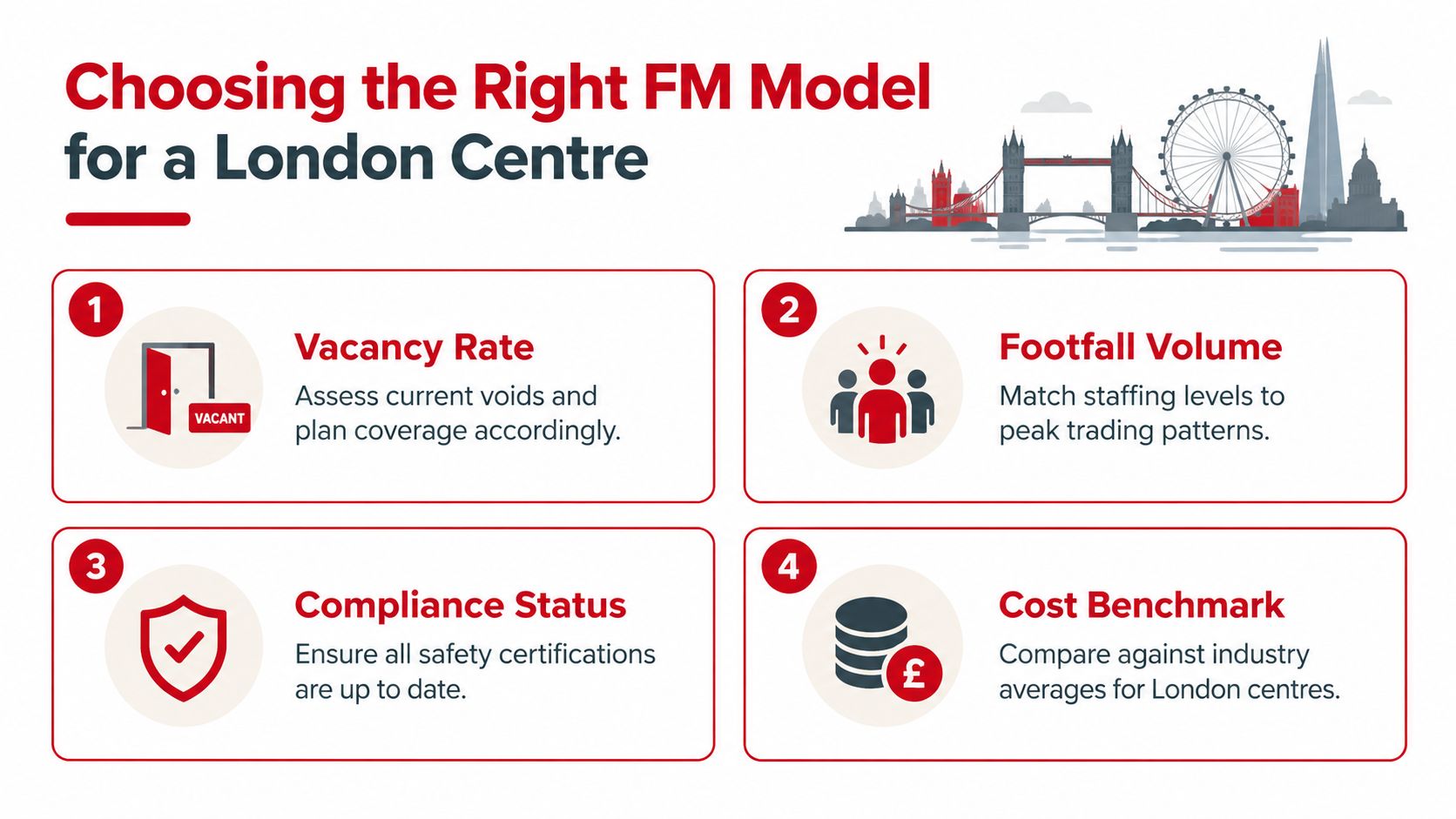
The right model starts with the asset, not the supplier's preferred organisation chart. A London centre manager reviewing an FM contract should make four checks.
Check the vacancy profile
Ask whether vacant space requires regular security inspections, lighting checks, leak detection, cleaning or tenant-readiness work. The higher the operational burden of the empty shell, the stronger the case for joined-up control.
Check the trading pattern
Match staffing to entrances, food areas, events, weekend peaks, delivery periods and seasonal activity. A fixed headcount that ignores volatility can be wasteful in quiet periods and inadequate when demand rises.
Check compliance and service-charge visibility
Specify who owns statutory records, tenant communications, audits, remedial actions and invoice evidence. Tenants need to understand the service outputs they're paying for, while asset owners need a clear view of risk and lifecycle work.
Check the repositioning timeline
A centre preparing for refurbishment, re-letting or a major event may need a mobilisation plan that is more detailed than the eventual steady-state operation. Don't choose a contract solely on headline cost per square foot. Test mobilisation, TUPE planning, data handover, vacant-unit inspections, emergency cover and the provider's ability to work around construction.
For a cautious transition, pilot an integrated arrangement around two connected pillars, such as security and cleaning, or tenant services and maintenance. Establish the KPI pack first, capture the starting position, review the operational evidence and expand only when the provider has demonstrated control. That approach limits concentration risk while testing whether the contract improves coordination on a live estate.
The core decision is simple. Shopping centre facilities management must protect occupied trading space and actively defend the value of vacant space. Choose the model that gives people, systems and suppliers one accountable operating rhythm.
Solomon's Facilities Management provides integrated security, cleaning, reception and concierge support for retail sites across London, with 24/7 cover, SIA-licensed personnel, digital patrol reporting and a single point of contact. If your centre needs a joined-up approach to security, presentation and tenant support, visit Solomon's Facilities Management to discuss the operating model for your estate.

Comments