
Facility Management Hard Services: A London Guide

At 9:02 on a Monday morning, the facilities desk is already making decisions. A tenant reports that the goods lift has stopped between the fourth and fifth floors. The lobby BMS is showing an AHU fault. The quarterly emergency lighting test is overdue, and a letting agent wants a quote for an electric vehicle charger before the next viewing.
That isn't a disaster scenario. It's a normal London building morning.
Every call belongs to a hard service discipline, but the risks overlap. The lift may need an electrical investigation. The AHU fault may affect comfort, energy use and tenant complaints. The overdue test is a compliance exposure, not an administrative inconvenience. The EV charger request touches electrical capacity, fire strategy, landlord approvals and future maintenance.
The question isn't whether the building needs maintenance. It's how the disciplines are organised, how evidence is controlled, and who owns the risk when systems fail together.
Table of Contents
What Facility Management Hard Services Actually Cover - A practical categorisation test
The Core Hard Service Disciplines in a London Building - HVAC - Electrical - Plumbing and water hygiene - Fire safety - Lifts - Building fabric
Maintenance Models and the Real Cost of Reactive Work - Compare the models before choosing one
Retrofit, Compliance and Keeping the Building Live - Establish the baseline first - Protect the tenancy
A Practical Checklist for Integrating Hard Services - Check competence before signing - Build one compliance calendar - Route requests through one helpdesk - Write SLAs around consequences - Keep responsibility clear
The Monday Morning That Shows Why Hard Services Matter
A lift contractor confirms the unit is safe, then asks an electrician to check the supply. The electrician finds the distribution board healthy and sends the fault back to the lift controls. Meanwhile, a fifth-floor tenant wants to know why staff and deliveries are using a service stair.
That morning tests the operating model. A contractor list does not create accountability. One person must coordinate diagnosis, protect access routes, update occupiers and decide whether the remedy is an urgent repair or planned work. In an occupied London building, keeping the tenancy moving is part of the engineering response.
The lobby BMS is also reporting an AHU fault. An alarm identifies the affected asset, not necessarily the cause. The fault could sit with a sensor, actuator, air-handling component, control sequence or power interruption. The engineer needs plant history, the controls strategy and authority to test connected systems, rather than close the alarm.
Practical rule: Treat every critical fault as a building-system problem first, and an individual contractor problem second.
The overdue emergency lighting test creates a different exposure. No tenant may have complained, but the responsible person still needs a reliable inspection record and evidence that defects were corrected. UK Government facilities management standards require an estate compliance plan, defined inspection frequencies, validation of subcontracted compliance work and legally competent duty holders. Weak statutory control produces remedial work and urgent interventions that disrupt the building. The Government's facilities management standard sets that control clearly.
The EV charger request needs the same joined-up assessment. A hardware-only quote is inadequate if the landlord supply, distribution capacity, fire arrangements, access controls and tenant billing model remain unchecked.
Use Monday's problems as an operating test. Require technical competence, one visible audit trail and a clear escalation route. A single supplier can provide that coordination, but do not consolidate specialist work for administrative convenience. Keep disciplines together where interfaces create risk, and retain specialist expertise where the asset or statutory duty demands it.
What Facility Management Hard Services Actually Cover
Facility management hard services are the physical and statutory services that keep a building safe, operational and compliant. They cover fixed assets and systems such as boilers, roofs, fixed wiring, gas installations, asbestos controls and water hygiene. The UK Government's facilities management standard is a sound reference because it links maintenance with inspection, evidence and clear duty-holder control. The Government's facilities management standard
Use one test when the boundary is unclear: does the work maintain a fixed building system, physical asset or statutory control? If so, put it in hard services. Work that supports people, presentation or daily experience without maintaining the building fabric or engineering systems normally belongs to soft services.
Hard services are the building's structure, machinery and fixed connections. They keep the property standing, powered, ventilated and safe. Soft services cover the people-facing work, including cleaning, reception, security and occupier support. Good presentation cannot compensate for a failed plant system, unsafe wiring or a leaking roof.
A practical categorisation test
Start with the asset, not the job title. A plumber repairing a fixed water main is delivering a hard service. A cleaner removing water after that repair is delivering a soft service. A security officer controlling access to a plant room supports hard-services work, but security remains a soft service.
Grey areas need a written scope and a named owner. Building fabric repairs sit with hard services. Cyclical decoration can sit either way. Treat decoration as technical building maintenance when it protects substrates, repairs damaged surfaces or manages asbestos risk. Put it with soft services when the work is primarily visual presentation.
Discipline | Hard Service | Soft Service |
|---|---|---|
Building fabric | Roof, cladding, windows and fixed structural repairs | Presentation checks and reporting of visible defects |
Engineering | HVAC, electrical, plumbing, controls and lifts | Helpdesk logging and occupier communication |
Life safety | Fire alarms, emergency lighting and fixed fire systems | Evacuation support and front-of-house assistance |
Water systems | Plant, pipework, tanks and water hygiene controls | Cleaning and washroom replenishment |
Energy infrastructure | Meters, distribution, BMS and EV charging equipment | Tenant guidance on operational use |
Workplace support | Technical maintenance of fixed assets | Cleaning, reception, security and concierge |
Assign responsibility for each interface, define who attends first, and require the helpdesk to record the complete chain from report to diagnosis, repair and supporting evidence. That structure matters when one supplier coordinates several trades, and it also shows which work should remain with a specialist contractor rather than being bundled for convenience.
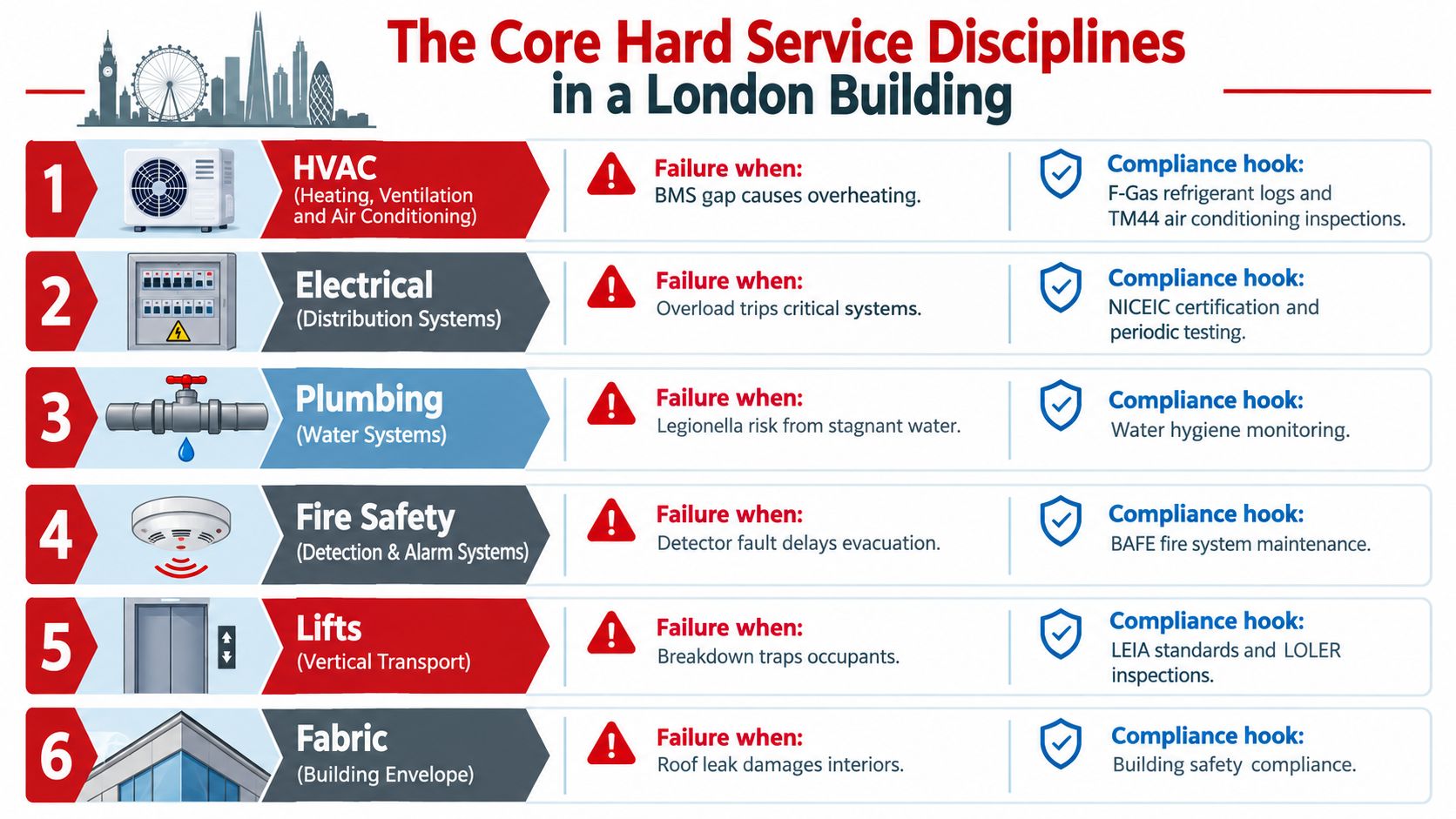
The Core Hard Service Disciplines in a London Building
London buildings rarely fail in neat categories. An AHU fault can be electrical, mechanical or controls-related. A water leak can damage fabric, interrupt a tenant and create a hygiene concern. Your contract must recognise those connections.
HVAC
Heating, ventilation and air conditioning failures usually appear first as comfort complaints, overheating or poor air movement. The technical risk sits deeper. Controls drift, sensors fail and BMS points stop reflecting the plant's actual condition.
Refrigerant records, F-Gas obligations and TM44 air-conditioning inspections need proper ownership. A contractor who only resets alarms isn't managing the system. Require trend review, plant-room checks and clear reporting when the BMS no longer provides reliable control.
Electrical
Electrical maintenance covers landlord supplies, distribution boards, emergency power, fixed wiring and the boundary between base building systems and tenant fit-outs. A trip may shut down lighting, access control, lifts or critical communications, so fault response needs a proper isolation and escalation process.
Periodic inspection and testing must be evidenced, and remedial works need their own records. Don't assume the tenant's electrical contractor owns the landlord installation, or that a landlord contractor can alter a tenant fit-out without approval.
Plumbing and water hygiene
Leaks are the obvious failure. Stagnation is the quieter one, particularly in void floors, disconnected appliances and dead legs left after refurbishment.
Water hygiene management needs risk assessment, monitoring, flushing arrangements and commissioning records. A building manager should know which outlets are active, which are isolated and who verifies the system after a change in occupancy or layout.
Fire safety
Fire safety is a duty-holder discipline, not merely a maintenance line item. Fire alarm servicing, emergency lighting, fire doors, smoke control and fire-stopping all need coordinated records, with actions from the fire risk assessment tracked through to closure.
The Responsible Person retains the legal duty under the Regulatory Reform (Fire Safety) Order. Tasks can be delegated, but responsibility can't be passed to a contractor. For a practical view of how monitoring fits into the wider arrangement, see fire alarm monitoring services.
Lifts
A lift service visit isn't the same as a repair, and neither is the same as a statutory thorough examination. LOLER examinations, maintenance records, breakdown response and entrapment procedures should sit in one visible asset record.
The failure mode is obvious, but the interface often isn't. If the lift stops because of a supply problem, someone must coordinate the lift specialist and electrician without leaving the building manager to run the investigation manually.
Building fabric
Roofs, façades, windows, cladding, drainage, asbestos and internal finishes protect the building and its occupants. Water ingress can turn a minor roof defect into damaged ceilings, electrical risk, tenant disruption and an insurance conversation.
Plan surveys, asbestos re-inspections, roof maintenance and cyclical decoration together. Every discipline has an inspection cycle that must be evidenced, whether the requirement comes from legislation, a lease, a manufacturer or the building's risk assessment.
Maintenance Models and the Real Cost of Reactive Work
There are three maintenance models in most estates, although contracts often blur their boundaries.
Planned preventative maintenance, or PPM, schedules inspection, servicing and replacement before failure. It protects asset condition and gives the team a predictable workload. The price is administrative discipline. Your CAFM or CMMS data must identify the asset, task, frequency, competence requirement and evidence standard.
Reactive break-fix responds after a fault occurs. It has a place, particularly for minor defects and unpredictable failures. It becomes expensive when the building team uses it as the default because emergency call-outs, tenant disruption and temporary measures quickly outweigh the apparent simplicity.
Statutory compliance work is separate. Fire systems, fixed wiring, water hygiene, lifts, gas, asbestos and other regulated areas need ring-fenced planning and evidence. You can't trade a statutory inspection against a PPM saving because the budget is tight.
The UK market illustrates the scale of the problem. Hard services accounted for 60.12% of the UK facilities management market in 2025, with demand supported by essential systems and the NHS's £11.6 billion maintenance backlog, according to Mordor Intelligence's UK facilities management market estimate. The backlog is a warning about deferred maintenance, not a justification for panic spending. When planned work is repeatedly delayed, the estate accumulates defects, capital interventions become more urgent and teams lose the ability to choose the right time for repairs.
Compare the models before choosing one
Model | Annual Cost Profile | Risk Profile | Typical Failure Mode |
|---|---|---|---|
Preventative PPM | Planned and easier to forecast | Lower failure risk when the schedule and asset data are sound | Tasks are marked complete without meaningful inspection |
Reactive break-fix | Unpredictable, with premium costs during emergencies | Higher disruption and uncertain asset condition | A minor defect becomes an outage or urgent capital repair |
Statutory inspection | Non-negotiable planned expenditure | Legal, life-safety and audit exposure if missed | Certificates exist, but remedial actions remain open |
Sequence the budget plainly: statutory first, PPM second, controlled reactive work third. Set a reactive allowance that finance can monitor, but don't disguise planned replacement as reactive maintenance because the PPM budget has been exhausted.
The 2025 UK hard FM market was estimated at £18.2 billion in annual contract value, projected to reach about £19.3 billion by 2028, implying a 1.97% CAGR, in the UK FM Market Summary Report. That institutional demand includes regulated assets such as hospitals, schools and prisons. The lesson for commercial property is straightforward: build the maintenance plan around asset criticality and compliance, not around whichever contractor happens to be available after a failure.
In-House Teams Versus Outsourced Versus Single-Supplier FM
The right model depends on the building's complexity, not on ideology. A capable in-house engineer may solve everyday faults faster than a national supplier, but no small team can hold deep expertise across lifts, high-voltage systems, BMS commissioning, fire engineering and specialist fabric work.
An outsourced multi-contract model gives you specialist access. It's familiar across London estates, but it creates handoffs. The lift contractor blames the electrical contractor. The electrical contractor points to controls. The property manager coordinates both and carries the tenant pressure.
A single-supplier model removes some of those interfaces. It can provide one helpdesk, one CAFM record, one escalation path and one party responsible for coordinating subcontractors. It only works if the lead supplier has genuine technical competence and audited specialists behind it. If the integrator is just a contract layer, you've added administration without removing risk.
Model | Strengths | Weaknesses | Best Fit |
|---|---|---|---|
In-house team | Fast local response, strong tenant knowledge and direct control | Limited specialist depth and expensive cover for rare skills | Complex sites with enough recurring work to support technical staffing |
Multiple outsourced contractors | Deep discipline expertise and competitive specialist pricing | Interface gaps, duplicated reporting and heavy client coordination | Single-discipline requirements or estates with strong client-side engineering management |
Integrated single-supplier FM | One accountable route, shared data and coordinated response | Can conceal subcontractor margins and weaken niche expertise | Mixed-use estates where engineering systems interact frequently |
The contract must state which work remains specialist. Keep heritage lift refurbishment, complex BMS commissioning, high-voltage operations and unusual fire engineering under named competent specialists where necessary. Integration should improve coordination, not force a generalist to perform work beyond its competence.
Don't confuse hard and soft integration either. Cleaning, security, reception and concierge can sit alongside engineering services in an integrated facilities model, but each service still needs its own competence, SLA and reporting logic. The difference between the two categories is set out clearly in this guide to facilities management soft services.
For public estates, governance also matters. Government FM controls require approval for new, irregularly extended or materially varied FM contracts, including major variations above £20 million, while contracts under £500,000 in the approved pipeline receive lighter assurance, as described in the Government FM controls guidance. The practical principle applies more broadly: tie procurement to an auditable business case and a controlled pipeline.
Retrofit, Compliance and Keeping the Building Live
Retrofit, compliance and tenancy continuity are not separate workstreams in an occupied London building. They share the same risers, plant rooms, electrical infrastructure, access windows and tenant communications.
A heat pump installation may require electrical upgrades. A BMS project may change control sequences across occupied floors. LED replacement can affect emergency lighting records. Fabric improvements may disturb asbestos-containing materials or alter fire and smoke performance. Treating each project as an isolated package creates rework and service interruptions.
Establish the baseline first
Complete statutory inspections and review open remedial actions before designing the retrofit sequence. The baseline should include electrical condition, lift status, fire risk actions, asbestos information, water hygiene controls, HVAC performance and BMS reliability.
Then phase the work around plant-room shutdown windows and controlled isolations. Don't schedule a BMS upgrade before you know which AHU points are trustworthy, and don't close a riser without confirming access, fire-stopping requirements and tenant dependencies.
Protect the tenancy
Issue tenant communications before access dates are fixed, not after the contractor has booked labour. State the affected area, expected interruption, temporary arrangements, contact route and reinstatement test.
Industry reporting identifies hard FM contracts with explicit energy-performance, carbon-reporting or renewable-energy requirements as representing roughly £2.2 billion to £2.6 billion of annual spend, while low-carbon retrofit and asset optimisation could reach £2.8 billion to £3.3 billion by 2028, according to the UK hard FM services market report. The same source points to BEMS, IoT, heat pumps, solar and EV infrastructure as increasingly important operational considerations, alongside labour shortages and planning delays linked to Building Safety Act complexity.
The commercial case is strong, but the execution risk is real. MEES requirements and the movement towards higher EPC standards make delay harder to defend, yet a retrofit that disrupts occupiers can damage retention and income.
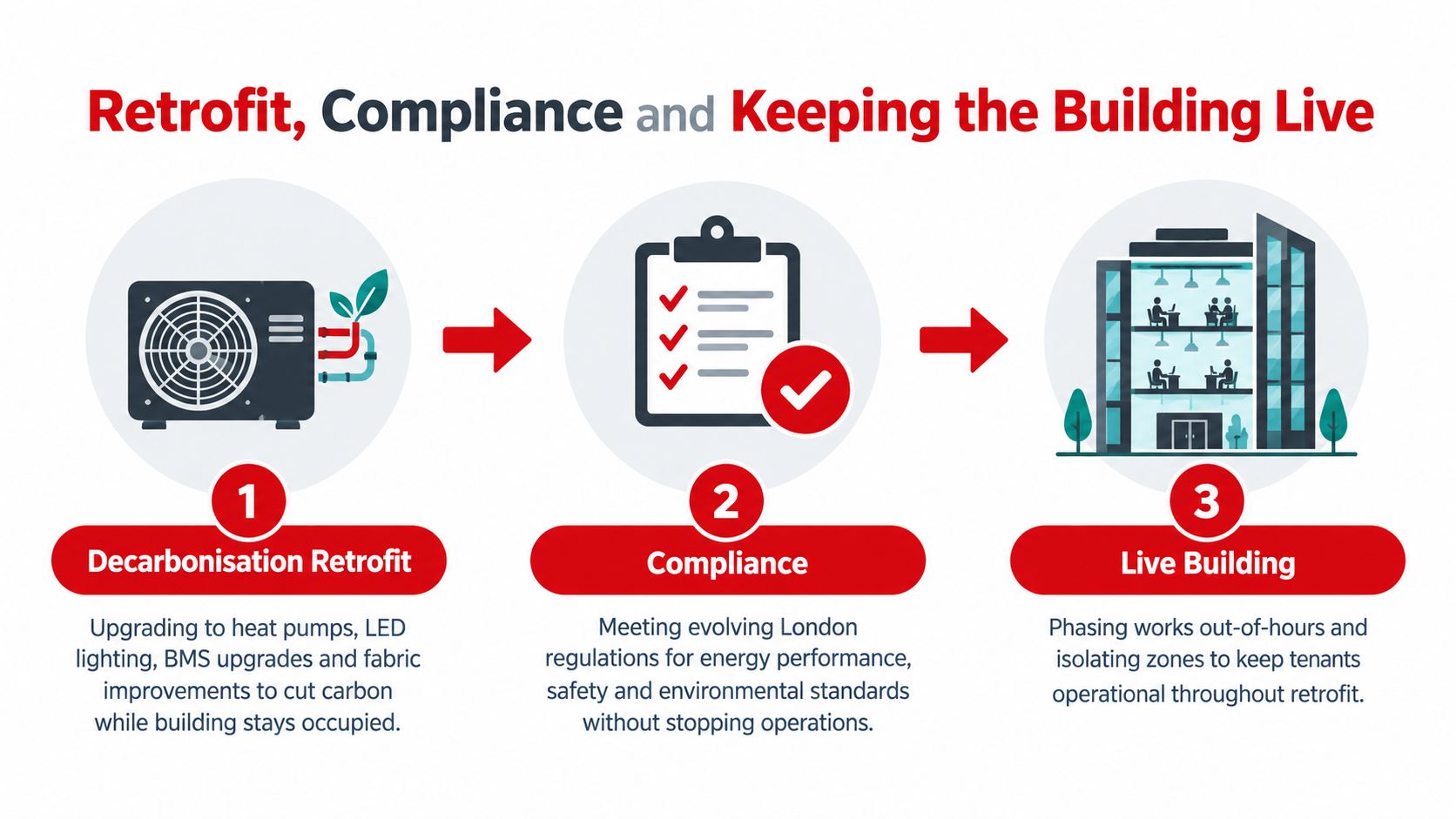
The sequencing rule is simple: inspect first, establish the condition baseline, phase engineering works around controlled shutdowns, and secure tenant agreement before interrupting a service. Retrofit only earns its place when the building remains safe, compliant and usable throughout.
A Practical Checklist for Integrating Hard Services
Integration succeeds or fails during mobilisation. A polished proposal won't protect the building if the supplier can't evidence competence, understand the asset register or coordinate out-of-hours work.
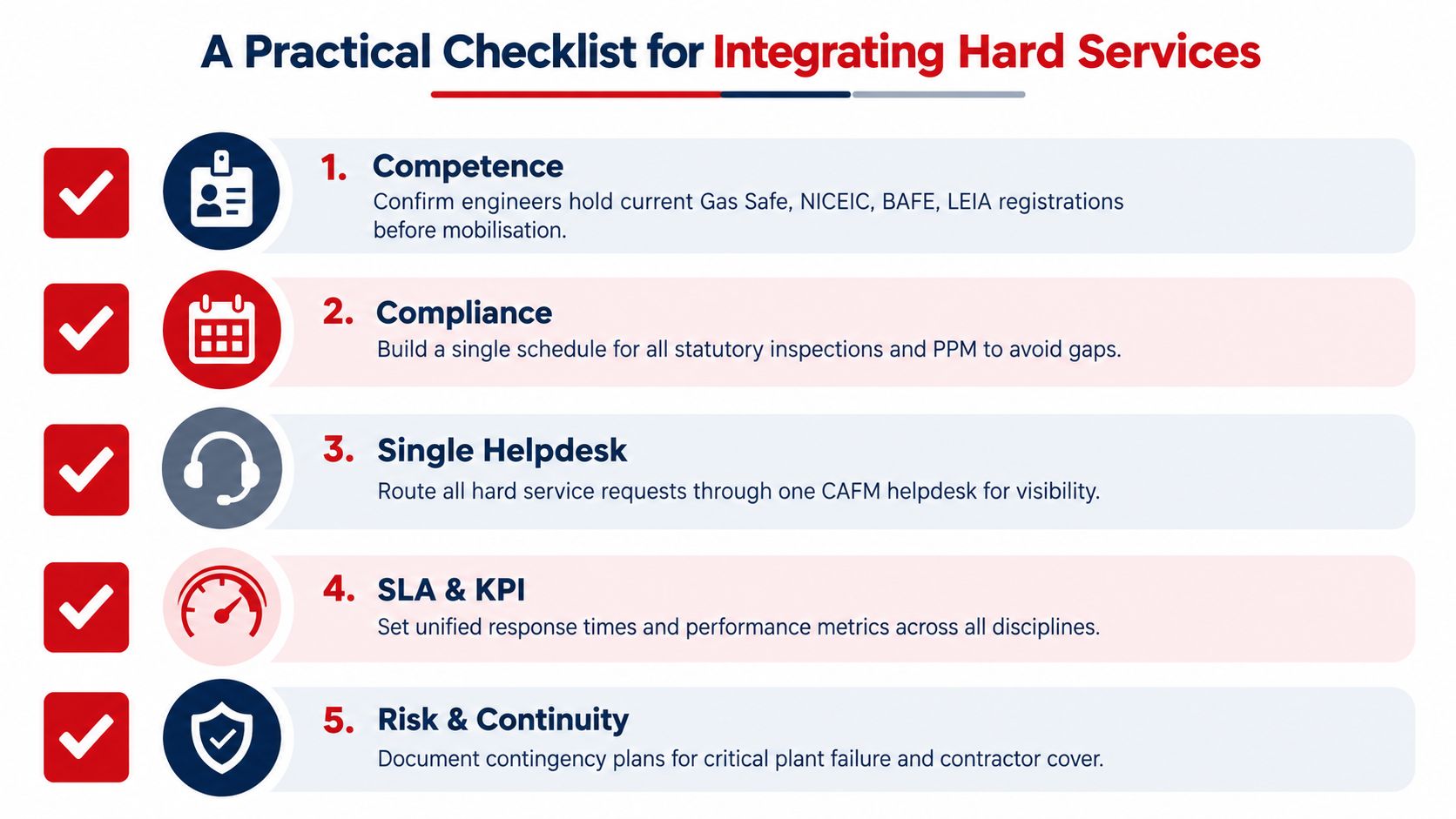
Check competence before signing
Ask for current evidence, not a list of logos. Confirm that the people and organisations assigned to the site hold the relevant qualifications, registrations, certifications and memberships, such as Gas Safe, NICEIC, BAFE or LEIA where applicable.Check subcontractor control, engineer cover, escalation arrangements and the limits of the supplier's own technical capability.
Build one compliance calendar
Put statutory inspections and PPM tasks into one schedule, with asset references, due dates, responsible engineers, certificates, defects and closure evidence. A CAFM system should make overdue work visible rather than allowing separate contractor spreadsheets to hide gaps.
Route requests through one helpdesk
One point of entry gives the property manager a complete history of tenant reports, diagnosis, attendance, parts, isolation and reinstatement. It also exposes repeated failures that individual contractors may otherwise treat as unrelated call-outs.
Write SLAs around consequences
A lift entrapment, fire alarm isolation and loss of cooling don't have the same operational impact. Set response, attendance, diagnosis and rectification expectations by discipline and criticality. Measure fix quality and restored service, not just arrival time.
Keep responsibility clear
The Responsible Person under the Regulatory Reform (Fire Safety) Order can delegate tasks, but not the underlying responsibility. Name the client-side duty holder, contractor account director and escalation contacts. Include permit-to-work controls, tenant notice periods, contingency arrangements and an exclusions schedule for work that must remain with a specialist.
Contract test: If you can't see the asset, the duty holder, the due date, the evidence and the escalation route in one report, the service isn't integrated yet.
When Consolidated Hard Services FM Is the Right Call
Consolidated hard services FM earns its keep on a mixed-use London estate where lifts, HVAC, electrical systems, fire safety and tenant access interact every day. It suits owners who want one accountable party, one CAFM dataset and one coordinated route through compliance.
It's the wrong answer for a simple single-tenant office, a heritage building that needs conservation specialists or an estate where one trusted lift or BMS contractor is central to performance. Use integrated facilities management as a coordination model, not an excuse to remove specialist competence.
Watch the contract closely. Open-book pricing must be open, exclusions must remain controlled, KPIs should measure restored service rather than attendance, and the agreement needs an exit plan that returns complete asset and compliance data. Size the contract to the building, not the sales presentation.
Solomon's Facilities Management helps London property managers coordinate building support through a single accountable service model, with experienced teams, clear reporting and responsive escalation. If you're reviewing hard services interfaces, occupied-building continuity or a wider integrated FM arrangement, visit Solomon's Facilities Management to discuss the practical requirements of your estate.

Comments