
Festival Crowd Safety: A Guide for London Venues

Festival crowd safety starts with active control of arrivals, movement, density, communication and emergency intervention, not a plan filed away before gates open. The Hillsborough disaster on 15 April 1989, which ultimately claimed 97 lives, remains a stark reminder that crowd safety depends on effective planning, communication and active management.
If you're looking at the site plan while radio checks are under way, the test isn't whether every box is ticked. It's whether the people on the ground can see a queue building, report a pinch point and get a timely decision before movement becomes restricted. A duty manager may be watching arrivals while a supervisor flags slow circulation by a bar; that is the moment a plan has to work.
Festival crowd safety is a live operating discipline. Organisers, venue teams, security staff, police, ambulance services and local authorities need clear responsibilities and a shared picture of what is happening. Flow, density, access and response are the practical signals: they tell the team whether the site is operating within its limits.
Accessibility belongs in that operating picture, too. A route that works for most attendees but blocks a wheelchair user, narrows an evacuation path or sends a queue into a shared pavement isn't a safe route. For London venues, the useful question is not only whether the plan exists, but whether staff can recognise changing conditions and act on them.
Table of Contents
What Festival Crowd Safety Really Means for a London Venue - Treat safety as a live measure
Running the Risk Assessment Before the Event - Forecast flows through the day - Make the assessment usable under pressure
Choosing the Right SIA-Licensed Team for Each Zone - Assign posts around the crowd's movement
Designing the Site for Safe Movement - Read the plan as a series of flows - Keep facilities out of circulation space
Search, Screening and Access Control Without Blocking the Gate - Protect throughput and fair access
Communications, Control Point and Emergency Response - Build a common operating picture - Rehearse the escalation, not just the radio check
Accessibility, Welfare and the Post-Event Review - Test access arrangements with the people who use them - Plan welfare capacity alongside emergency response
What Festival Crowd Safety Really Means for a London Venue
The duty manager is watching the entrance queue lengthen. Radios crackle with updates from the perimeter; a supervisor reports that people near the bar are moving slowly, and the flow behind them is beginning to bunch. Nothing may have become an emergency, but the team needs to know who can assess the area, what signal requires action and who can authorise a change.
That is crowd safety in practice. It connects people's behaviour, the shape of the site and the decisions staff make as conditions change. A risk assessment matters, but it can't substitute for active observation, workable communication and staff with authority to intervene.
The history is sobering. A parliamentary record summarising Lord Justice Taylor's inquiry into Hillsborough states that the disaster's main cause was a failure of police control, while the inquiry also examined stadium design, crowd management and emergency response failures (parliamentary record on the Hillsborough disaster). Its lessons reach beyond football: crowds at festivals, concerts and street events can also experience dangerous pressure when ingress, circulation, communication or intervention fails.
Treat safety as a live measure
A headcount tells you how many people are inside, not where pressure is building. Watch the signals that help staff make decisions: queue length, movement speed, crowd density at pinch points, blocked routes, welfare contacts and reports from stewards. Set out who records each observation, how often it is passed to control, and what response follows.
The Health and Safety Executive's crowd-management guidance calls for organisers and venue managers to anticipate likely behaviour, review previous safety records, assess risks, inspect arrangements, set trigger points and liaise with police and emergency services. That translates into operating instructions staff can use, not just paperwork that satisfies a planning process.
On-site test: If a steward identifies a growing queue, can they name the radio channel, report its location clearly and reach someone empowered to change the layout or pause admissions?
That test should include accessible movement. Check whether people can travel through entrances, barriers, toilets, viewing areas and exits without being diverted into pressure points. Accessibility is part of crowd control because safe circulation has to work for the whole audience, including people who need step-free routes, extra space or assistance during an evacuation.
Running the Risk Assessment Before the Event
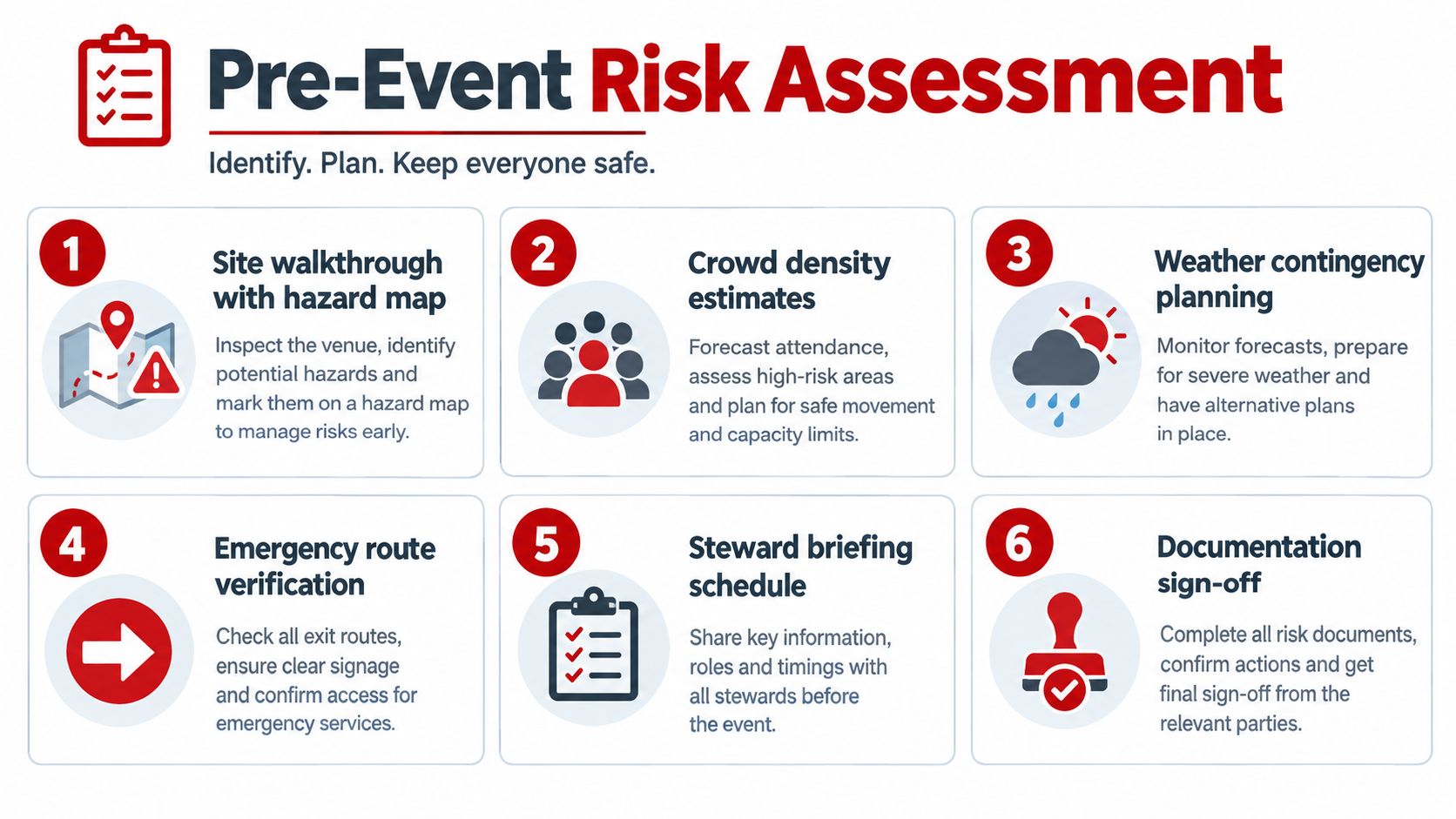
A useful risk assessment turns hazards into decisions. Start with who could be affected: attendees, staff, contractors, performers, neighbours and emergency responders. Then work through the site-specific hazards, covering crowding, fire, severe weather, alcohol, protest activity, structural problems and security threats.
A hazard list is the starting point. Each entry then needs a consequence, a control, an owner and a trigger. Compare "monitor the entrance" with "the gate supervisor reports queue growth to control and requests another lane when the agreed operating limit is reached". The second version gives staff something they can do, and it gives control a measurable signal to watch.
Forecast flows through the day
Total attendance is only one input. Estimate when people are likely to arrive, how quickly the gates can process them, where they will move between stages and facilities, and when routes will hit peak demand. Then stress-test those assumptions against different operating conditions: a delayed opening, a popular performance ending, poor weather pushing the crowd onto different routes, or a service-area queue spilling into circulation space.
Research into crowd dynamics at Notting Hill Carnival found that attendance figures and visitor itineraries were not captured, even when the route area was holding very large crowds during the peak afternoon hour. Treat time and location as safety information in their own right. The control team needs a live picture of where people are concentrating and how movement is changing, and a forecast built on flows gives them that picture.
Make the assessment usable under pressure
Give the control point a concise operational summary showing the hazard, the zone, the responsible lead, the signal to watch and the action to take. The fuller assessment stays with planning and review; on shift, supervisors need the critical instructions where they can find them fast.
Before opening, walk the route with the people who will operate it. Ask where they would stand, what they could see, how they would report a blocked path and which manager decides to pause an admission flow. On larger sites, each zone lead should confirm their trigger points during the pre-event walkthrough. This helps identify gaps in communication and responsibilities before the event begins.
Choosing the Right SIA-Licensed Team for Each Zone
A security team is not a single interchangeable resource. Each post needs a defined role, an appropriate licence where required, a supervisor and a clear operating brief. Match deployment to the work: access control at an entrance differs from monitoring a fixed perimeter, and neither is the same as stewarding movement or watching CCTV.
Festival post | Recommended SIA role | Why it fits |
|---|---|---|
Search and access-control lane | Door supervisor | Supports entry procedures, screening and refusal handling. |
Fixed perimeter or back-of-house post | Security guard | Maintains access control and reports unauthorised entry or hazards. |
CCTV monitoring position | CCTV operator with the appropriate licence | Observes assigned areas and passes relevant information to control. |
Crowd-direction point | Steward, with security support where needed | Guides movement and flags changing conditions to a supervisor. |
Welfare or lost-child point | Trained welfare staff, with security escalation available | Provides a calm contact point and a clear route for escalating safety concerns. |
Accessible viewing platform | Assigned steward or security officer, briefed for the post | Monitors access, supports safe movement and reports blocked routes. |
SIA licensing requirements depend on the specific duties performed and the type of venue. Some event stewarding activities do not require an SIA licence, while security guarding, door supervision and certain CCTV activities do. Organisers should confirm the appropriate licensing requirements for each position.
Every team member should know the zone they cover, who leads it, the radio channel, how to request support and what they must log. Staff should know the zone they cover, who leads it, the radio channel, how to request support and what they must log. Briefings should also cover refusals, lost children, medical incidents, emergency language and relief arrangements for breaks.
Assign posts around the crowd's movement
Start with the operating map: entrances, stage approaches, bars, family areas, exits, welfare points, accessible platforms and back-of-house boundaries. Assign staff to those locations and account for the periods when people move between them. A plan that covers gates but leaves a stage exit or accessible route without an identified lead has a gap, even if the overall staffing number looks substantial.
Solomon's Facilities Management provides professional security services across London, including security guarding, access control and site security support. For event organisers, selecting appropriately trained personnel and establishing clear responsibilities are important parts of effective crowd management. (Solomon's Facilities Management).
For event organisers comparing providers, continuity can help staff learn a site's access points and reporting routines.
Designing the Site for Safe Movement
A route can look clear on a drawing and still fail once people arrive. Mark where the crowd enters, where it changes direction, where it slows, and where opposing flows might meet. Then test whether barriers, queues, vendor lines and temporary structures leave enough room for both ordinary movement and emergency access.
Read the plan as a series of flows
Trace arrival from public transport and drop-off areas to the entrance. Follow the path through screening, circulation routes, food and drink queues, performance areas and exits. For each point, ask what happens if movement slows or reverses. A route should not rely on a single narrow passage if a nearby queue, barrier or parked vehicle could block it.
London sites need local checks as well as a general crowd plan. A park may have gradients or uneven ground; a street event may share pavements with residents, cyclists or regular traffic. Identify ambulance access and keep it clear in practice, not only on the drawing. Check that stewards can reach decision points and that attendees can leave an area without being directed into an incoming flow.
Keep facilities out of circulation space
Place toilets, water, food and welfare where people can reach them without queues backing into main routes. If a service point attracts a line, give it a defined queue footprint and a supervisor who can report when that space is nearing its limit. Move the service point, open another option or redirect people before the queue obstructs through-movement.
Barrier layouts need the same scrutiny. Barriers can shape queues and separate conflicting flows, but they can also create a pinch point or close off an accessible route. Walk the site at ground level, check sightlines from steward positions and confirm that emergency routes remain clear when temporary fencing, vehicles and operational equipment are in place.
Practical rule: Mark every pinch point, decision point and refuge area on the working plan, then ask the zone supervisor to explain what they would do if movement stopped there.
Treat density as a changing condition, not as a single number that guarantees safety. UK crowd research notes that densities above the often-cited 5 people per square metre can occur without an incident, while still posing a serious crush risk when movement is restricted (UK Events Research Programme study). The operational question is whether people can move freely, whether pressure is increasing and whether staff can relieve it. Monitor the condition of the crowd and the route together.
Search, Screening and Access Control Without Blocking the Gate
Screening protects the event, but every check takes space and time. The right method depends on the threat assessment, event profile, prohibited-items policy and the ability to process arrivals without creating a queue that blocks public routes or emergency access.
Method | Useful for | Operational trade-off |
|---|---|---|
Visual check | A first look at bags, clothing or event credentials | Quick, but depends on clear instructions and staff attention. |
Bag search | Checking contents against the prohibited-items policy | More thorough, but needs a clear surface, a defined process and room to move concerns aside. |
Hand-held wand | Secondary screening when a concern needs checking | Can support targeted checks, but requires trained staff and a private, consistent process. |
Pat-down | A more direct personal search where justified by policy and procedure | Requires careful briefing, respectful handling and appropriate safeguards; it can slow entry if applied indiscriminately. |
Protect throughput and fair access
Lay out distinct lanes for general admission, accessible entry, families and crew where the event needs them. Signage should tell attendees what to prepare before reaching the search point. Provide a clear place to resolve ticket or bag problems away from the active lane, and explain how prohibited items will be handled so staff aren't improvising at the gate.
Screeners need a consistent procedure for refusals, confiscations and secondary checks. Keep a record without turning the live queue into a paperwork station: capture the essential information, then pass the operational detail to the relevant supervisor or control point. If one lane begins to slow, staff should know whether to open another lane, redirect arrivals or pause admissions.
Visitor procedures should connect accreditation, screening and access permissions. Solomon's visitor-management service describes processes for check-in, accreditation checks and site procedures, which can be considered alongside the event's own entry plan (visitor management services). Whatever system is used, test it with staff before opening: they should be able to answer who can enter each zone, what happens when credentials don't match and how a person requiring an accessible route can avoid being funnelled into a congested lane.
Communications, Control Point and Emergency Response
When a gate lane stalls and the queue starts to bend back toward the road, the control point has minutes to show whether the plan is alive. It needs a named lead, live access to the right CCTV views, a current site plan, a radio channel map and direct routes to police, ambulance and venue management. Each zone supervisor should know what to report, where to report it, who can authorise an intervention and which signals matter: density at pinch points, queue length, search refusal rate, welfare referrals and the time taken to verify a call.
Build a common operating picture
Give each zone a clear radio channel or a defined procedure for using a shared channel. Confirm staff can reach control from their posts, urgent calls take priority and key terms mean the same thing across SIA staff, stewards, medical and venue ops. Control should keep a simple log of significant reports and decisions: time, location, person responsible, action taken and the signal that triggered it.
CCTV helps operators verify what a radio report describes, but the camera view is only one input. Combine it with steward observations, queue conditions, welfare information and reports from emergency services. Solomon's CCTV monitoring service describes remote monitoring, alerts and escalation; any provider or in-house team should be briefed on the camera map, incident categories, handover process and how long verification should take before a supervisor is sent.
Rehearse the escalation, not just the radio check
Before gates open, walk through a blocked route, an urgent medical call, a separated child and a missing person. For each one, fix who contacts emergency services, who keeps routes open, who meets responders, who updates the event lead and what the crowd should be told. Staff should use agreed language and keep sensitive personal details off open channels.
Clear roles, multi-agency planning and effective communication are essential during an emergency. Event organisers should ensure that security personnel, stewards, medical teams and emergency services understand their responsibilities, escalation procedures and evacuation arrangements before the event begins.
A control-room radio-protocol walkthrough for escalation calls and responder handovers.
Accessibility, Welfare and the Post-Event Review
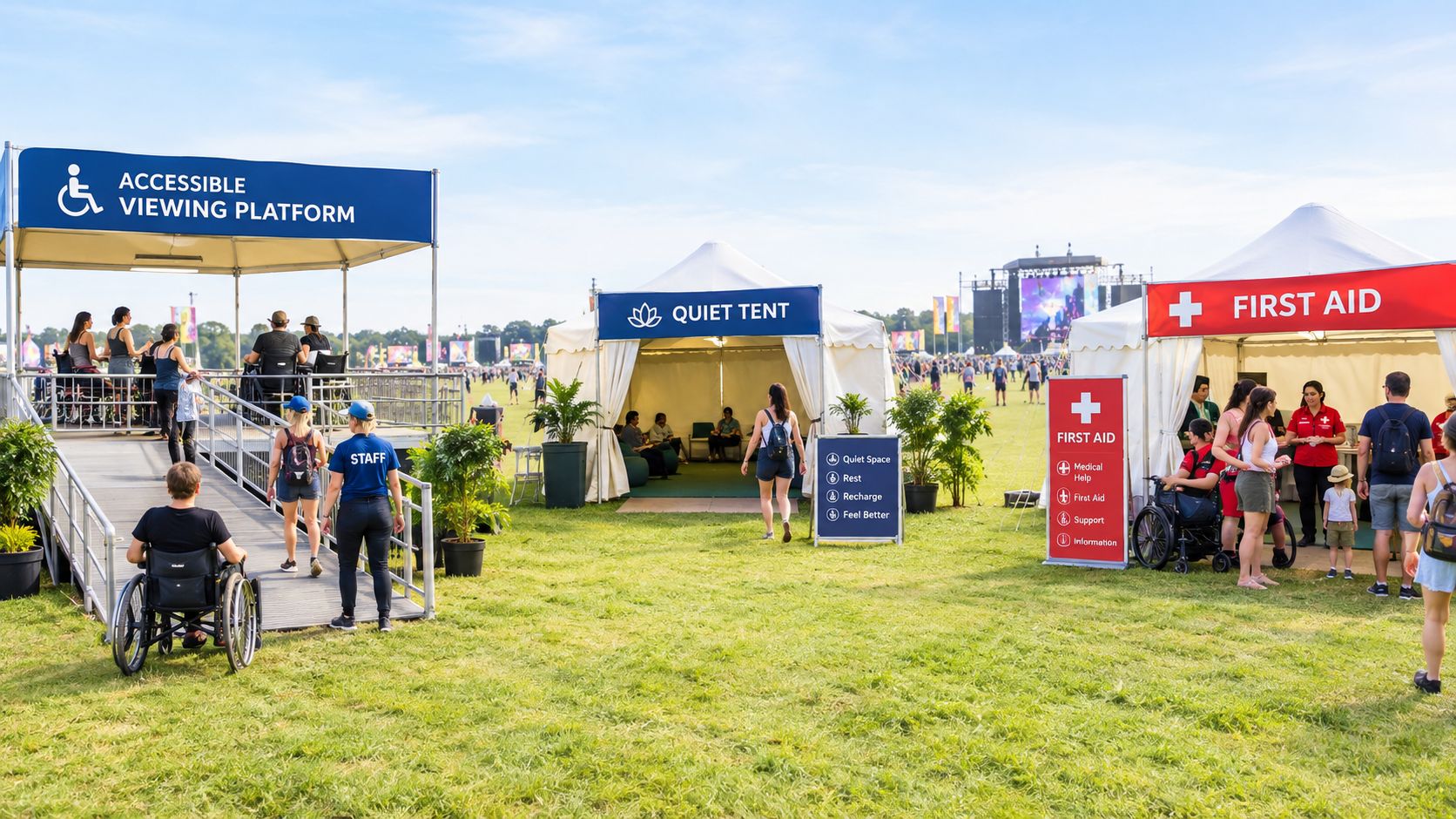
Accessibility failures can create crowd hazards, not just a poor attendee experience. A survey of more than 1,000 disabled people and family members found that 54% identified overcrowding as a barrier, 32% had difficulty entering or exiting venues, and approximately 61% said transport links weren't adequately equipped for accessibility needs (survey findings on disabled people's experience at concert venues). Treat those findings as operating signals: if step-free routes narrow, accessible viewing fills early, or transport arrivals surge after curfew, the plan is showing strain before an incident log does.
Test access arrangements with the people who use them
Walk the full journey from arrival point to entrance, toilets, viewing areas, welfare spaces and exit. Check that temporary security measures do not obstruct step-free routes, refuge areas or circulation space. Make sure staff know where evacuation assistance is available, how to reach someone who needs it and how to keep an accessible route clear when a queue shifts.
Vehicle-security barriers placed for hostile-vehicle mitigation can still pinch pedestrian movement if the layout ignores gate flow. Joint NPSA and SGSA guidance stresses that protective measures must not compromise ingress, egress, accessibility or circulation. Test layouts with disabled attendees before opening where possible, and check barriers, queue plans, steward posts and evacuation routes together. Watch live density at each pinch point during ingress; if a protective measure pushes queues into a refuge area or across an accessible lane, redesign it rather than leaving stewards to manage around it.
Plan welfare capacity alongside emergency response
Medical provision has to handle routine demand as well as major incidents. The London Ambulance Service reported more than 9,700 alcohol-related calls and over 4,700 drug-overdose calls in London between June and August 2024, around 150 calls per day during that summer period; for June and July 2025, it recorded 6,569 alcohol-related calls and 3,060 drug-overdose calls (London Ambulance Service summer safety update). Glastonbury 2025 is a useful example of sustained multi-day pressure, where welfare, hydration, medical and quiet-space provision has to keep working after the first-night peak has passed.
Bring first aid, welfare staff, ambulance liaison, hydration and cooling points, CCTV and incident logging into the same operating picture. After the event, compare forecast with observed attendance and peak locations; review queues, blocked routes, medical and welfare contacts, complaints, reporting rates and near misses. Record what changed, who made the decision and whether the intervention worked. Feed those findings into the next site walk and risk assessment, so the plan reflects what staff and attendees experienced and gives you earlier signals to act on.
Solomon's Facilities Management provides SIA-licensed security, event support, visitor management and CCTV monitoring for London sites.

Comments