
Front of House Reception: A Complete Guide for London

At 07:30 on a London weekday, a reception desk can become the busiest control point in the building before the first meeting starts. Contractors arrive while cleaners are finishing, a courier presents a manifest, a tenant swipes through the access gates, the building manager calls about a fire drill, and two unregistered visitors wait for help. The receptionist has to welcome people professionally while deciding who can enter, what must be logged, which delivery needs special handling, and when an issue needs escalation.
That combination is why front of house reception should be managed as an operational service, not treated as a decorative desk. It connects visitor experience with access control, contractor oversight, tenant support, emergency procedures, and personal-data handling. The following guide sets out what the role involves, how to staff it, which controls matter, and how a facilities manager can measure whether a provider is delivering properly.
Table of Contents
What Front of House Reception Actually Looks Like in a London Building
The Full Scope of a Front of House Reception Role
- The visible guest-facing layer
Shift Patterns, Cover, and Continuity Between Handovers
What Front of House Reception Actually Looks Like in a London Building
A typical Tuesday morning in a City of London office starts before the lobby feels ready for visitors. The duty receptionist checks the desk, opens the visitor-management tablet, reviews the expected arrivals, and confirms that the access-control system is behaving normally. The uniform and presentation matter, but so does the quiet preparation behind them.
The first contractor arrives with tools and a booking that doesn't quite match the building record. A courier needs a signature for a time-sensitive delivery. A tenant's guest has been waiting for four minutes, while another visitor has no pre-registration at all. At the same moment, a building manager asks the desk to support a fire-drill briefing, and the turnstiles beep as employees enter.
The receptionist can't deal with each person in arrival order. They have to prioritise risk without making legitimate visitors feel challenged or ignored. A good response might involve acknowledging everyone, completing the contractor check against the approved booking, notifying the host about the unregistered guest, and directing the courier to the correct receipt process.
One desk, several operating systems
Front of house reception sits where several workflows meet:
Visitors and hosts: The receptionist confirms the purpose of the visit, contacts the host, manages passes, and records departure.
Access and security: The desk monitors unusual access behaviour, challenges attempts to bypass procedure, and escalates alarms or suspicious activity.
Deliveries and post: Items are accepted, recorded, sorted, and passed to the right recipient without allowing the post function to overwhelm the visitor welcome.
Building operations: Contractors, meeting rooms, announcements, fire procedures, and tenant enquiries all pass through the same point.
Service recovery: Delays, complaints, inaccessible routes, missing hosts, and confused visitors need practical resolution rather than a scripted apology.
That pressure is normal in London commercial, residential, and mixed-use buildings. The question isn't whether the desk gets busy. It's whether the operating model keeps the welcome professional while preserving a reliable control record.
The Full Scope of a Front of House Reception Role
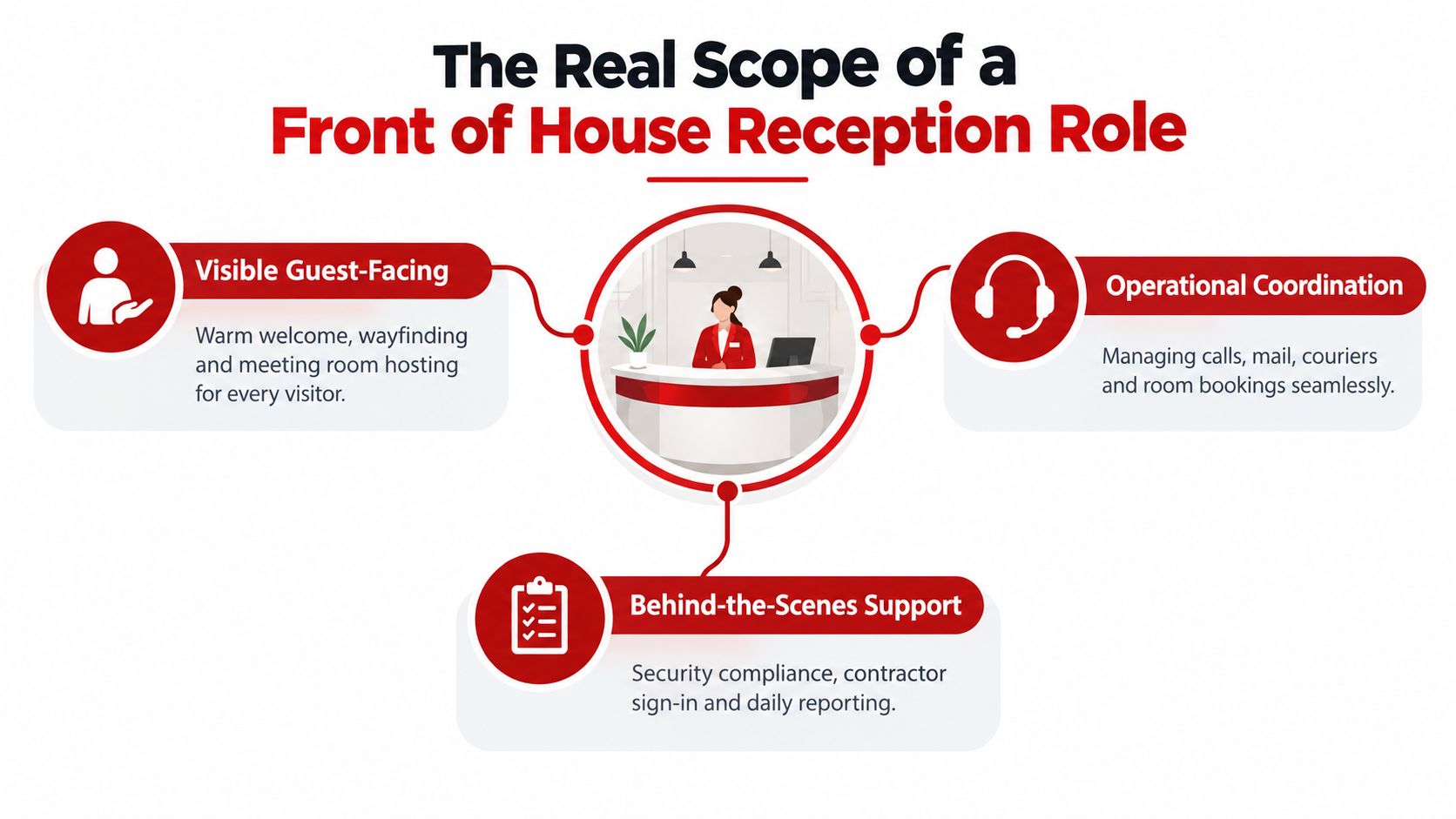
A front of house contract covers three connected layers. If the specification addresses only the visible welcome, it leaves coordination, security, and data control to chance.
The visible guest-facing layer
Visitors notice the greeting first. The role includes wayfinding, call handling, meeting-room arrivals, enquiries, accessibility routes, host contact, taxi arrangements, and event support. Consistent presentation matters because reception shapes how people judge both the occupier and the property.
Service quality still depends on procedure. A receptionist can welcome every visitor promptly while failing to confirm identity or host approval. That creates a pleasant arrival for an unauthorised person, so providers should define and measure both welcome standards and verification steps.
The operational coordination layer
The desk also coordinates work that visitors may never see. This can include post and parcels, courier collections, contractor bookings, meeting-room readiness, tenant communications, visitor lists, and building-wide messages. In a multi-tenant property, reception is often the route through which information reaches occupiers.
The service specification must set priorities. If one person is expected to prepare rooms, receive deliveries, issue passes, monitor doors, answer calls, and support tenants, it should state what happens when a queue forms or an incident occurs. Clear ownership reduces improvisation and makes performance comparable between shifts.
The control layer
The least visible duties often carry the greatest operational consequence. They include identity checks, visitor screening, access-control monitoring, contractor sign-in, pass recovery, incident logging, evacuation support, and UK GDPR-aware handling of visitor information.
Secure-site guidance recommends pre-registration, identity verification, identifiable passes or temporary credentials, and confirmation of departure so access can be disabled promptly. The visitor registration workflow guidance for secure sites also identifies useful management measures, including unregistered arrivals, check-in time, overdue visitors, unreturned passes, rejected access attempts, and pre-approved visits.
Reception is therefore a security and data control point dressed up as a meet-and-greet desk. The visible layer serves visitors, the coordination layer keeps the building moving, and the control layer creates evidence for facilities teams, auditors, insurers, and responsible building personnel.
Property requirements vary, and the training section's comparison table sets out the differences between corporate, residential, and mixed-use environments.
Core Duties That Make Up a Front of House Shift
A competent receptionist should be able to explain not only what they did, but why the action mattered. The daily occurrence log should make that visible.
Visitor management
The process starts before arrival, with pre-registration and host information. At the desk, staff verify identity according to site policy, confirm the host, issue the correct pass, explain escort requirements, and record departure. An unannounced visitor shouldn't be waved through because the lobby is busy. The receptionist should acknowledge them, contact the relevant host or building contact, and record the decision.
Post, parcels, and couriers
Signed-for items need evidence of receipt. Perishable, medical, confidential, or high-value deliveries need a defined route rather than casual storage behind the desk. Misdelivered mail should be identified and transferred through an agreed process, while courier collections should leave a clear record of what was handed over and to whom.
Contractor control
Contractors should be checked against the booking, the site rules, and any required permit or RAMS documentation. Staff need to record arrival and departure, confirm where the contractor is going, control keys or temporary credentials, and escalate discrepancies. A contractor who signs in but can't be located later represents a control failure, not merely an untidy logbook.
Access control
Reception may monitor turnstiles, doors, intercoms, and alarms. Tailgating, door-forced alerts, repeated rejected access attempts, and attempts to borrow credentials require consistent responses. The receptionist doesn't need to investigate beyond their authority, but they must know how to challenge safely and when to call the security control room or building management.
Calls and tenant enquiries
Switchboard handling should route callers accurately, capture messages completely, and record complaints in a way that allows follow-up. Intercom calls in residential buildings need the same discipline as telephone calls. A visitor or resident shouldn't have to repeat the problem to several shifts because the first interaction wasn't recorded.
Incident logging
A useful incident record includes the date, time, location, people involved, action taken, witnesses, and escalation route. Where relevant, the log should identify CCTV references or access-control events without copying unnecessary personal information into open notes. Facilities managers should be able to audit whether the record is complete and whether follow-up occurred.
Fire and evacuation support
Reception supports the building's emergency process by providing visitor and contractor information, liaising with wardens, directing people towards the assembly point, and helping identify anyone who may still be inside. The desk shouldn't become a bottleneck during an evacuation. Roles, backup arrangements, and access to current visitor information must be rehearsed.
Duty | What Good Looks Like | Outcome Supported |
|---|---|---|
Visitor management | Host confirmation, identity check, pass issue, and departure record | Controlled access and a smoother arrival |
Post and parcels | Secure receipt, accurate distribution, and evidence of handover | Reduced loss, delay, and dispute |
Contractor control | Booking verification, site-rule confirmation, and sign-in/out | Better accountability for people working on site |
Access control | Consistent challenge and escalation for abnormal events | Stronger protection against unauthorised entry |
Calls and enquiries | Accurate routing, complete messages, and complaint capture | Faster tenant and visitor support |
Incident logging | Timely, factual records with relevant references | Auditability and effective follow-up |
Fire support | Current lists, warden liaison, and clear evacuation assistance | Better emergency coordination |
Shift Patterns, Cover, and Continuity Between Handovers
Reception cover should match the building's risk, occupancy, and activity profile. A single-tenant office may need early, core, and late shifts around employee and visitor peaks. A multi-tenant building usually needs overlap for contractor arrivals, deliveries, and tenant changeovers. A residential lobby operating around the clock requires continuous cover, relief staff, clear night procedures, and a defined route to security or management support.
Two-shift cover is easy to administer, but it can leave weak points during overlap and late-day activity. Three staggered shifts give better control when demand changes through the day. A continental pattern can work for continuous residential operations, provided the contract controls fatigue, relief cover, and handovers.
Practical rule: A reception post is only as reliable as the information passed between shifts.
What a proper handover contains
Before leaving, the outgoing receptionist should update the written handover log and the live system of record. The incoming colleague needs a short face-to-face briefing on expected visitors, contractors still on site, unreturned passes, unresolved complaints, access problems, deliveries awaiting collection, incidents, and building-management instructions.
The record must support both action and audit. It should show what happened, who owns the follow-up, and when the matter was closed, without placing unnecessary personal information into open notes. Facilities managers can then test whether the provider is meeting response and escalation requirements rather than relying on verbal reassurance.
The escalation list should identify who handles access-control faults, fire alarms, tenant emergencies, suspicious behaviour, lost keys, and welfare concerns. A night receptionist should not have to search an outdated folder while an alarm is sounding. Facilities managers can use this guidance on continuity of service when checking cover through leave, sickness, weekends, and out-of-hours periods.
Weekly continuity audit
Check that:
Every shift is covered: The rota names trained relief staff, not placeholders.
Logs are current: The next team can identify open issues without reconstructing events from access-control records.
Systems are accessible: Staff have working credentials for visitor management, telephones, radios, and relevant building systems.
Weekend cover is competent: Relief staff know site rules, emergency contacts, and escalation thresholds.
Friday-to-Monday continuity exists: Outstanding visitors, incidents, parcels, and contractor matters are handed over explicitly.
Training Front of House Staff to a Consistent Standard
A busy reception can expose a weak training programme within one shift. A visitor arrives while a contractor disputes access, a parcel requires a signature, and an alarm notification appears on the desk system. The receptionist must protect information, control movement, and record decisions without losing service discipline. Training should therefore be a controlled progression, with competence demonstrated before independent cover begins.
The baseline should cover site-specific fire safety and evacuation responsibilities, first aid at work awareness, GDPR and visitor-data handling, access-control operation, evacuation arrangements, and safeguarding basics where residents use the post. Requirements depend on the building and role. The manager should still keep an auditable record of each person's training, completion date, observed practice, and approval to work alone.
From induction to independent cover
Induction should explain occupiers, systems, uniform standards, emergency routes, restricted areas, and escalation contacts. Shadow shifts then expose the new colleague to arrivals, contractor checks, calls, deliveries, access refusals, and incidents as they happen. A supervisor should observe key tasks, test judgement, and sign off competence. Attendance alone proves very little.
Role-specific training should include:
Visitor and VIP protocols: Discreet host contact, privacy, escort requirements, identity checks, and refusal of access.
Mail and parcel security: Signed-for items, sensitive deliveries, secure storage, collection records, and handover evidence.
Conflict de-escalation: Calm language, safe positioning, clear boundaries, and timely escalation.
Suspicious behaviour: Unattended items, inconsistent explanations, attempted tailgating, access-control anomalies, and emergency contacts.
Accessibility and inclusion: Clear directions, practical assistance, and support for visitors who may find an unfamiliar building difficult to move through.
Reception is part of the building journey, not a decorative front desk. The Government Property Agency design guidance supports considering how visitors receive information and practical help as they move through a site.
Training Module | Corporate Office | Residential Lobby | Mixed-Use Building |
|---|---|---|---|
Visitor and host procedures | Client, interview, and meeting protocols | Resident guest and delivery rules | Separate routes for offices, homes, and retail |
Access control | Turnstiles, passes, and staff access | Intercoms, resident credentials, and contractor access | Multiple zones and different permission levels |
Emergency response | Warden liaison and office evacuation | Resident welfare and out-of-hours escalation | Coordinated response across shared areas |
Data handling | Visitor records, host details, and confidentiality | Resident information and parcel records | Data separation between occupiers and user groups |
Conflict and safeguarding | Professional boundary setting | De-escalation and safeguarding awareness | Managing competing demands at one desk |
Mail and parcels | Corporate post room and couriers | Resident deliveries and secure storage | Distinct recipient and handover processes |
Training must continue after onboarding. Supervisors should sample logs, observe live interactions, test emergency knowledge, and refresh procedures after changes to the building, software, access rules, or tenant profile. The audit should connect each duty to evidence, such as accurate visitor records, documented access decisions, secure parcel handovers, and completed escalation records. Managers can use front of house training guidance to structure that review and keep provider performance tied to agreed service levels.
Service Levels and Metrics Worth Measuring
A reception provider should be judged through evidence collected during live operations, not broad descriptions such as “professional” or “excellent”. The contract needs to state what staff must do, which records they maintain, the service level expected, and the action required when performance falls short. This gives facilities managers something specific to test during reviews.
Guest experience measures
Track visitor wait time, completed check-ins, satisfaction feedback, complaints, and response times for calls and intercoms. Segment the results where it helps explain the cause. A host who fails to answer creates a different problem from a desk that cannot keep pace with arrivals, and each requires a different corrective action.
The same approach applies to resident, tenant, and contractor interactions. Review whether staff gave clear directions, followed the agreed reception procedure, and recorded exceptions accurately. A quick interaction is not a successful one if it creates an access or data-control risk.
Operational and security measures
Operational reporting should cover mail and parcel throughput, room readiness, access-control accuracy, incident-log completeness, unreturned passes, and unresolved handover items. Visitor workflow reporting can also examine unregistered arrivals, overdue visitors, rejected access attempts, and the proportion of visits approved in advance through visitor-management workflow measures.
Security measures need context. A rise in recorded tailgating events may reflect worse behaviour, or it may show that reception staff have started logging incidents consistently. The service review should examine the original records, corrective actions, repeat issues, and whether every escalation was closed properly.
Data quality deserves its own check. Review missing host details, unexplained access decisions, duplicate records, and retention against the agreed procedure. These failures can expose occupier information and make an incident harder to investigate.
Review the measures with the provider, assign owners, agree deadlines, and check the next reporting cycle for evidence that actions worked. Persistent patterns should lead to changes in staffing, training, procedures, or technology. That is how a reception contract becomes measurable control of the front desk, building access, and visitor information.
How Technology Is Changing Front of House Reception
A visitor arrives before the host has approved the meeting. The receptionist must check identity, confirm access, protect the visitor record, and keep the entrance moving. Paper sign-in books and phone-only alerts make those controls harder to evidence.
Digital visitor-management platforms such as Proxyclick, SwipedOn, and Envoy can support pre-registration, identity capture, badge printing, host alerts, automatic sign-out, and reporting. Costs vary according to the hardware, number of sites, integrations and subscription model. The UK visitor-management systems overview also identifies stronger audit trails, reliable evacuation lists and access-control integration as potential benefits.
Technology handles repeatable steps well. It can send pre-arrival notifications, record visitor details, print a pass, and flag an exception for the receptionist. Human judgement remains necessary when a visitor is distressed, a VIP makes an unusual request, an access permission is unclear, or someone needs practical help inside the building.
The practical result is a hybrid role. The receptionist coordinates the desk, building systems, calls, mail, and visitor flow, while checking that automation has not created a new control failure. Cloud platforms also require supplier checks, permission management, retention rules, privacy notices, and clear limits on who can view visitor data. A visitor-management systems guide provides a useful framework for reviewing those workflows.
The role is being upgraded, not erased. UK commentary cites the CIPD's 2025 Good Work Index as finding that 16% of UK employees had tasks automated using AI, with 85% of those employees saying performance improved, as reported by UK commentary on the evolving receptionist role. The sensible division is automation for transactional work, with trained staff handling exceptions, accessibility, relationships, and security decisions.
Putting It Together and Choosing a Reception Provider
Choose a provider against the building's operating risks, not a polished tender document. Look for trained staff, appropriate licensing where required, dependable shift cover, auditable training records, named account management, clear escalation routes, and service levels supported by daily records.
Ask the provider to explain its response to an unregistered visitor, forced-door alert, unattended item, missing contractor, distressed resident, and fire evacuation. Request the handover process, reporting format, relief arrangements, supervision model, and evidence that the proposed team understands the different demands of a corporate office, residential lobby, and mixed-use entrance. These scenarios show whether reception controls access and information properly during a busy shift.
Questions that expose weak delivery
Team stability: How long do colleagues stay on comparable sites, and how are replacements trained?
Incident control: Who receives an escalation at night, and how is the record preserved?
Continuity: What happens when the named receptionist is absent, and how quickly can trained cover arrive?
Data protection: Where are visitor records held, who can access them, and how are retention rules applied?
Performance management: Which measures appear in service reviews, and what corrective action follows a missed standard?
Solomon's Facilities Management provides reception, visitor-management, concierge, security, switchboard, and related facilities services for London commercial, residential, retail, and event environments. Its single-contract model supports clients seeking coordinated responsibility across functions.
Solomon's Facilities Management can help design and operate front of house reception around visitor control, access procedures, tenant support, handovers, and measurable service levels. Visit Solomon's Facilities Management to discuss a reception and facilities model suited to your London building.

Comments