
Phone Call Answering Services in London: A Practical Guide

A reliable phone call answering service in London helps businesses manage incoming calls when reception staff are busy, unavailable or off duty. For commercial offices, managed properties and other business premises, professional call handling helps ensure enquiries, maintenance requests and security concerns reach the right people. The key is not simply answering calls, but making sure important information is recorded, routed and acted upon.
Table of Contents
What a Phone Call Answering Service Does for London Sites
An answering service gives callers a route into a site when the reception team is occupied or unavailable. For a facilities manager, the useful measure is not just whether someone picks up. It is whether the operator captures enough detail to create a reliable incident record and sends it to the right person.
A phone call answering service places a trained operator, or a managed system with a person available behind it, between the caller and your site team. The operator follows your instructions, records the caller's details and reason for calling, then routes the message or call. The service does not automatically resolve a maintenance fault or dispatch a patrol. Your facilities team, security team or contractor must act on the information.
Reception cover works like a second front desk. If your receptionist is speaking with a guest, issuing a pass or helping someone in person, an answering operator can handle the phone and keep the request moving. That only helps if the operator knows which calls to transfer, which details to record and who to contact when the usual route fails.
London sites hear from tenants, residents, visitors, couriers, contractors and event attendees, as well as people reporting security concerns. Treat each answered call as the start of a record: note the caller, location, time, issue and action agreed. For security-related calls, your procedure should say when to notify the control room, check CCTV or escalate to a duty manager. A generic message alone can leave staff without enough information to respond.
Automation can collect routine details, but a scripted menu may miss urgency, distress or an access risk. Set a clear human handoff for urgent or unclear calls, and test it using realistic scenarios. Ask providers how they assess call handling and handovers, not just answer rates. A useful starting point is these key metrics for inbound call centers.
Before agreeing cover, map the call path from first answer to the person who acts. Confirm what the operator records, how the information reaches your FM or security log, and who owns follow-up. The right setup depends on the site, coverage hours and escalation duties.
Live, Overflow and Out-of-Hours Cover Compared
Service type | Who answers | Hours covered | Best fit | Main risk |
|---|---|---|---|---|
Live reception | Trained operator, same team each time | Your opening hours | Busy offices with steady tenant and visitor calls | Fixed cost even on quiet days |
Overflow | Operator answers only when your reception line is busy or unattended | Peaks, lunch hours and absences | Lobbies with predictable peaks | Callers handled differently depending on overflow rules |
Out-of-hours | Operator answers after close, at weekends and overnight | Evenings, weekends or 24/7 | Residential buildings, venues and sites with overnight access | Escalation rules must name who is called and when |
AI-assisted triage | Automated first answer, then handoff to a person | Any hours | High-volume routine enquiries | Urgent calls misunderstood if handoff is weak |
Voicemail only | Nobody; callback later | Any hours | Very low call volume | Urgent callers hang up and go elsewhere |
Live reception makes sense when callers need a consistent point of contact throughout the working day. A serviced office with one receptionist, for instance, may use a remote operator to keep the phone covered while the receptionist helps a tenant or takes a break. A fixed fee buys continuity, but it can feel wasteful during quiet periods.
Overflow cover only takes calls when your own line is busy or unattended. That can suit a lobby with predictable lunchtime visitor peaks: reception handles calls as usual, and the answering operator steps in when the line can't be picked up. The trade-off is that callers may get a different experience depending on how the overflow is configured. Check whether the operator uses the same script and can see the same escalation instructions.
Out-of-hours cover is useful when calls don't stop at closing time. In a residential block, a resident may call about a parcel or a failed access system late in the evening. The provider needs a current contact list and clear instructions for what can wait, what requires an on-call response and who answers when the first contact is unavailable. For sites that need separate arrangements for on-call staff, see the guidance on on-call services.
AI-assisted triage can direct routine enquiries or gather basic details, but it isn't a safe substitute for a person on every call. If a caller mentions a medical problem, a safety concern or failed access, they should reach a trained person, with their location and a verified callback number captured.
Where a caller reports an immediate threat to life or a serious emergency, operators should follow the site's emergency procedures, including contacting the appropriate emergency services where necessary. Internal escalation must not delay an emergency response.
Voicemail-only cover costs less, but an urgent caller gets no live response. A short guide to call forwarding options can help you understand the routing setup, but forwarding alone doesn't establish who will take responsibility for the call.
Many sites use a hybrid: people handle incidents and sensitive visitor calls, while automation supports routine enquiries. Ask every provider the same question: which calls can be automated, and which must transfer immediately to a trained person?
Features That Separate a Real Service From a Message Pad
A provider can promise to take messages and still leave your team with unusable information. Set requirements in three areas, then test them using a sample call.
Call handling rules
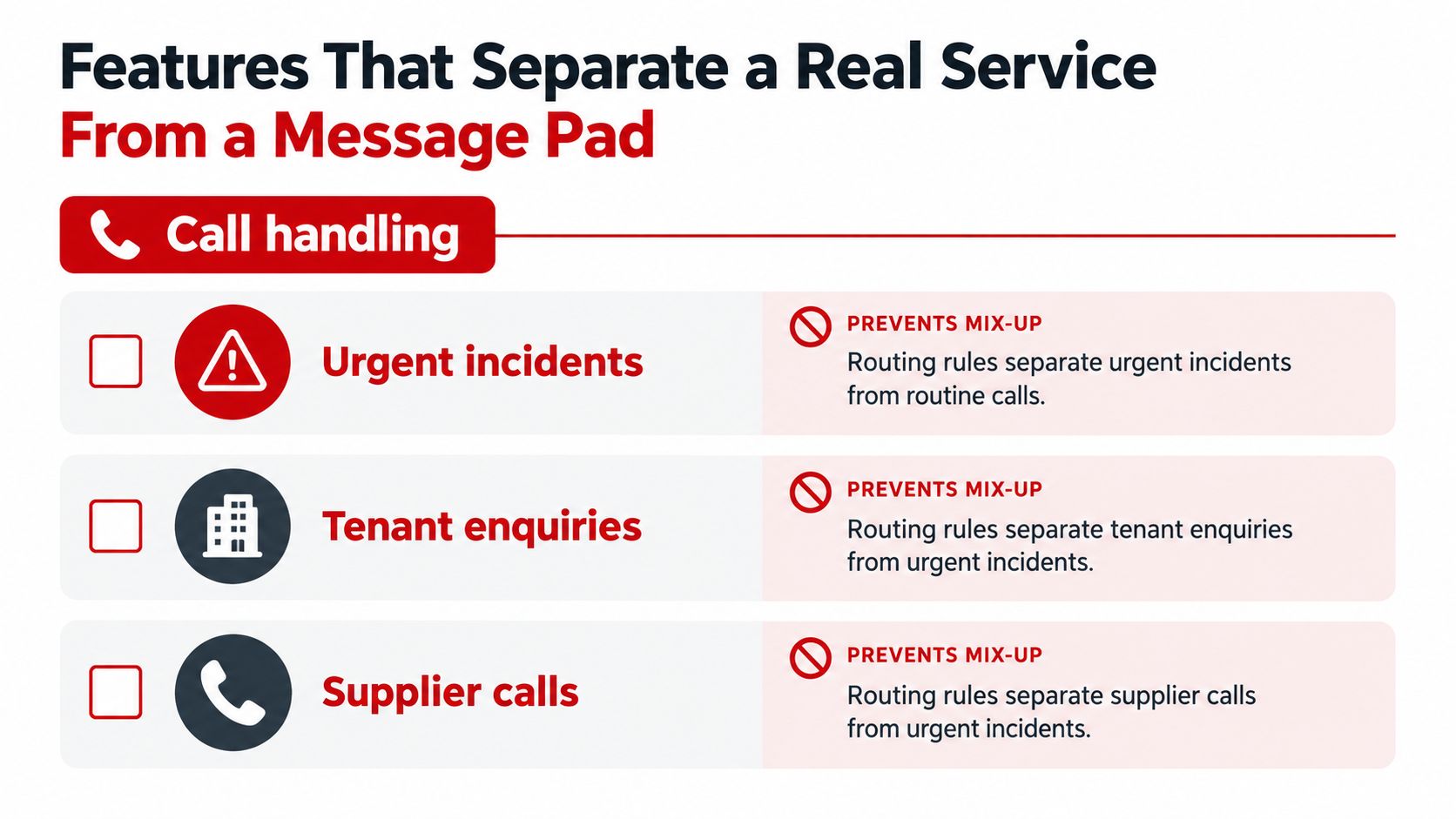
Start with routing rules that separate urgent incidents from tenant enquiries, supplier calls and routine messages. A building directory should identify who is authorised to receive each type of call, and the provider should have a controlled process for updating it. Otherwise, a security alert can be sent to a former manager.
Give operators scripts for common questions, but make sure they can follow instructions when a caller doesn't fit the script. Ask how the service accommodates callers with hearing, speech or language needs, including relay calls and clear, unhurried prompts. Rigid menus or rushed questions can turn a straightforward request into a failed handover. For the wider reception role, see the guide to front-of-house reception.
Message capture
Require the operator to record the caller's name, company or unit, callback number, location, issue, urgency and requested action. The provider should deliver the message in writing within a set time, using an agreed route such as email, SMS or your ticketing system.
A message with no callback number often wastes the call: the site team knows something has happened but can't reach the person who reported it. A message that says only “please call back” is not a useful incident record either. Define which fields are mandatory and what happens if the caller can't provide one.
Control and records
Ask for call logs or recordings, a stated retention period, secure portal access and a named account manager. Agree how often you can request audit samples, and check that data storage and handling meet UK GDPR requirements. These controls matter when a tenant disputes an instruction or a site manager needs to check what was reported.
A feature list is only a starting point. Ask the provider to demonstrate each requirement on a sample call, from greeting and identity checks through to message delivery and escalation. If the operator can't show how the call is captured and handed over, the service may be little more than a message pad.
Why Facilities and Property Managers Use Answering Cover
Consider a resident who calls late in the evening because their access fob isn't working. If the call goes to voicemail, the building team may not learn about the problem until the resident tries another route or calls again. In research reported by Accountex from Moneypenny's Customer Communications Trend Report, 35% of UK consumers said they disliked calls not being answered, and 54% said they wouldn't leave a voicemail if they couldn't get through (Accountex report on unanswered calls). In practice, that often means the information is lost, not merely delayed.
Continuity matters. A single receptionist's holiday or sickness shouldn't leave the lobby phone uncovered. Overflow or temporary answering cover can keep calls moving while the on-site receptionist handles visitors or the office arranges replacement cover.
Predictable cover can be easier to plan. Compare the provider's per-hour, per-call or retainer model against the cover the site needs. A serviced office may need evening support on selected nights rather than a staffed night desk. Don't assume a particular pricing model will be cheaper; request the cost of a quiet month and check whether out-of-hours calls carry separate charges.
One voice and one record improve handovers. If operators use the same greeting, ask the same key questions and record each enquiry in one agreed place, staff can follow up without reconstructing the conversation. That record is particularly useful when an issue later needs to be checked against a site incident log.
The service may suit commercial offices, property managers and landlords, retail and hospitality sites, event venues, serviced offices and coworking spaces. Each site has different risks, so the operator's instructions should reflect its access rules, escalation contacts and hours of operation.
For businesses requiring professional support, Solomon's Call Handling Services in London include inbound call answering, tailored scripts, call routing, message-taking and overflow cover. Calls can be transferred to the appropriate team member, with real-time message delivery when a transfer is unavailable.
The benefits only hold when the rules behind the service are clear. Without them, answering cover adds a middleman between the caller and the site, and the message can still stall.
How Answered Calls Flow Into FM Services
Treat every call as the beginning of an incident record, even if it is ultimately a routine request. That doesn't mean every enquiry is an emergency. It means the call should be documented well enough for the right person to decide what happens next.
Answer and verify. The operator answers, then checks the caller against the site directory or access list where the call requires it. An outdated directory can send an alert to the wrong person or lead staff to admit someone who shouldn't be authorised.
Capture the details. Record the caller's identity, location, issue, urgency, callback number and requested action. A missing visitor name, for example, can hold up an access request while the site team tries to establish who needs collecting.
Classify the call. Mark it as an emergency, security incident, access request, maintenance fault, cleaning issue, supplier call or routine enquiry. If an access-system fault is misclassified as a routine message, it may sit in the wrong queue while people continue to encounter the problem.
Escalate when required. Use the site's escalation matrix to contact the appropriate on-call person and record the handover time. A vague instruction such as “contact security if needed” doesn't say who decides, who gets called or what happens if there's no answer.
Create the ticket. Link the call record to the site and, where relevant, to an existing visitor record or incident. Without a shared record, two teams may open separate tickets for the same fault and work from different information.
Connect security calls to security action. Pass the relevant details to the patrol or CCTV operator and request footage when needed under site procedures. If nobody records that CCTV footage may be relevant, staff may not preserve or review the appropriate material in time.
Close the loop. Confirm the outcome with the caller where appropriate, assign ownership of any open action and include the record in reporting by site and shift. Otherwise, a ticket can remain open without anyone knowing who is responsible.
Scripts, verified directories and current site instructions can help resolve calls at first contact. Every unnecessary transfer or callback adds delay and creates another opportunity for a detail to be lost. A single-supplier arrangement can also reduce re-keying when answering, security and other FM teams work from a shared site record. For examples of how site teams structure incident handling, see these incident response procedures.
The same handover logic can apply in a hotel environment, where calls may need to connect reception, security and facilities teams; this overview of integrated facility management for hotels offers relevant context. The contract should then specify how the provider reports whether each handover worked.
Service Levels to Write Into Your Contract
Write measurable service levels into the contract. “Calls answered promptly” gives you little to check when a queue fails. The figures below are drawn from a UK contact-centre benchmarking report and should be treated as reference points rather than universal service standards.
Metric | 2024 benchmark, source | Contract wording |
|---|---|---|
Mean speed to answer | 17.11 seconds, UK contact-centre benchmarking report | Set a target for the percentage of calls answered within a stated time, reported by queue |
Median speed to answer | Not specified | Report median and 90th-percentile results by queue and shift |
Call abandonment | 4.41% mean, UK contact-centre benchmarking report | Set a maximum per queue and review weekly |
Average handle time | 7.82 minutes, UK contact-centre benchmarking report | Set expected handling times by call type, rather than one blended figure |
First-call resolution | Not specified | Set targets by call type and count transfers and callbacks |
Out-of-hours response | No benchmark specified | Name an escalation contact and set the maximum time to reach a person for each incident type |
A UK contact-centre benchmarking report, based on responses from 449 customer-care and technical-support professionals, gives a mean speed to answer of 17.11 seconds, a mean abandonment rate of 4.41% and mean average handle time of 7.82 minutes. It also reports that 25% of surveyed teams answered within 6–10 seconds. That describes survey results, not a target every provider can meet. Use the figures to inform a discussion, then agree service levels suited to your call types and coverage (UK contact-centre benchmarking report).
For out-of-hours calls, the contract must set out the handover arrangements because the benchmarking figures do not establish an appropriate response time for every type of incident. Name who receives each incident type and how long the provider has to reach a person. A contact list without a time limit does not define an escalation.
Use clauses that match the site's risks. For example: “At least [X]% of calls to the main line are answered within [Y] seconds, measured daily and reported by queue and shift.” Add: “Abandonment on any queue must not exceed [Z]% in any week. Review results weekly and provide a written remediation plan after a breach.” These bracketed figures are negotiated commitments, not published benchmarks. State whether a breach triggers service credits.
Speed alone isn't enough. Require a monthly sample audit of message accuracy and routing. Check whether urgent calls are classified correctly and whether transfers and callbacks reach the right team. For calls that start an incident record, include whether the handover and resulting action are captured in the provider's reporting.
Choose a London Provider and Confirm the Terms
Begin with a site profile. Record when calls tend to arrive, when reception gets busiest, how much coverage is needed outside normal hours, what incidents callers report and whether a call can trigger a security response. Then match that profile to the cover types in the earlier table.
For a London site, check whether the provider can cover the relevant postcode and whether its arrangements work across Central, East and North London if your portfolio spans those areas. Where a call can trigger a security response, establish whether the responding personnel are SIA-licensed. Confirm how the provider protects caller data under UK GDPR, whether callers will reach a consistent team and whether true round-the-clock availability is available if the site needs it.
Compare the cost model with the work
A per-hour rate may suit defined shifts or planned reception cover. Per-call pricing can fit a site with irregular demand, while a monthly retainer may provide predictable access to a service. None is automatically the right choice. Ask each provider what an out-of-hours call costs, whether there's a minimum-hours charge and what you'll pay during a quiet month. Make sure you understand how a longer call, an escalation or a transfer affects the bill.
Put operational questions to the provider before agreeing terms:
Medical emergency: What does the operator do, and who has authority to escalate the call?
Overnight contact: Who receives the call at 3am, and what happens if that person doesn't respond?
Handover time: What is the maximum time allowed before an urgent call reaches a person?
Message quality: Can the provider supply a sample message with caller identity, location, issue and action requested?
Reporting: Will its reports include the service-level fields you negotiated, broken down by site and shift?
Ask for a two-week pilot and compare the provider's call log against your own records before signing a longer contract. Check missed calls, incomplete messages and calls sent to the wrong person. A high answer rate can look reassuring while an urgent issue is sitting in the wrong queue.
The provider should show you how it maintains the site directory, updates contact changes, samples calls for accuracy and reports on escalations. Solomon's Facilities Management is one London option, offering call answering and switchboard support alongside security, reception and cleaning under one contract, so its reporting and escalation terms can be checked against the same service-level table.
Don't sign until the written terms match the coverage you need, define who owns each handover and specify how you'll check performance. For site managers, that's the difference between a call being picked up and an incident being properly recorded and acted on.
Need professional call answering services in London?
Solomon's Facilities Management provides call answering, switchboard and reception support for London businesses, including tailored call routing, message-taking and overflow cover.
Whether you need support during busy periods or a more coordinated approach to handling incoming enquiries, our team can discuss your requirements.

Comments