
How to Get a SIA Badge in 2026: Training, Fees and Checks

You have a start date on a London site, and someone has told you to "just get the badge" before Monday. That is where the delays start. People book the wrong training course, discover their qualification is too old for a first licence, or try to apply before the awarding organisation has notified the SIA that they have passed.
How to get a SIA badge is a sequence, not a shopping list. The licence has to match the role, the course has to be the licence-linked qualification, and the checks have to be in order before you can work a licensable front-line post. The walk-through below follows that order, and each step flags the trap that usually costs the next month.
Table of Contents
Meet the Eligibility and Training Rules - The timing trap after you pass
Gather Evidence and Avoid Refusal - What to line up before you type - What the refusal counts are actually telling you
How to Apply Online and Pay the Fee - If you have lived abroad
Renew or Vary Your SIA Licence on Time - Same sector, or a new one
Choose the Right Licence Sector Before You Book Training
A vacancy asks for an office reception guard, but the course starting Monday is door supervision. Both lead to SIA licences, and some activities overlap. For example, a door supervision licence also covers security guarding duties, but a security guarding licence does not cover all door supervision activities. Understanding which licence covers your intended role can help you avoid unnecessary training costs.
An SIA badge is a licence for a particular sector. Match the licence-linked qualification to the job you plan to do. The GOV.UK training guidance lists six sectors: security guarding, door supervision, close protection, public space surveillance (CCTV), cash and valuables in transit, and vehicle immobilisation. For a first licence, the qualification must normally have been achieved within the previous 3 years. The awarding organisation also has to notify the SIA before the qualification appears in your online account.
Course hours vary by sector and by whether you complete self-study. The table gives the published hours and typical classroom durations for each route.
Sector | With self-study | Without self-study |
|---|---|---|
Security guarding | 30 hours over 4 days | 38 hours over 5 days |
Door supervision | 44 hours over 6 days | 52 hours over 7 days |
Public space surveillance (CCTV) | 22 hours over 3 days | 30 hours over 4 days |
Close protection | 194 hours over 18 days | 194 hours over 18 days |
Cash and valuables in transit | 24 hours over 3 days | 27 hours over 4 days |
Self-study shortens the classroom block for some sectors, but it does not reduce the qualification you must complete. It moves part of the work outside the classroom. If shift work leaves little time for that, choose the longer classroom option where one is offered.
Your SIA licence must cover the activities you intend to perform. Some licences cover more than one type of security work. For example, a door supervision licence also allows you to work as a security guard, while a close protection licence covers both door supervision and security guarding. However, specialist activities such as certain types of CCTV monitoring may require a separate public space surveillance (CCTV) licence. That matters whether you are applying for a guarding role or looking to explore fire and security careers. Employers and clients need the licence to cover the work being done. Read more about what an SIA licence means for businesses.
Before paying a deposit, check three things:
Which role are you applying for? Match the job advert to a sector, rather than choosing the course with the earliest start date.
Can you complete self-study? If not, choose the longer classroom route for that sector, if available.
Does the course name match the sector? Compare it with the official guidance, especially if an advert bundles several licences into one price.
Meet the Eligibility and Training Rules
A cheap weekend course can look identical to a genuine course on a flyer. If the title is "security awareness" or "introduction to guarding", it will not qualify you to apply. The course title has to be the licence-linked qualification for the sector you chose, and the provider has to be approved by an awarding organisation that offers those qualifications. A general training company, or a mate who "used to be on the doors", is not that approval.
You also need a legal right to work in the UK, and you need to be old enough to apply. Right-to-work evidence is dealt with in the document list below, so sort the status first if a visa, settled status, or a recent name change is in play. Training booked before that is sorted is money you can't get back if the application can't proceed.
The timing trap after you pass
Passing the assessment is not the same as being ready to apply. The awarding organisation has to notify the SIA, and only then does the qualification show in your online account. Some applicants receive their certificate and immediately try to apply, only to discover that their qualification has not yet been recorded by the SIA. This can delay the application process. Open the account first. If the qualification is missing, pause and contact the awarding organisation. Do not send a second application to "speed it up".
For a first licence, a certificate from several years back may sit outside the window, so you retrain rather than argue with an old scan. Keep the certificate, the course reference, and the provider's approval evidence in one folder. You will want the same papers when the licence comes up for renewal.
Practical rule: If the qualification is not listed in the online account, you are not ready to pay, however official the paper certificate looks.
Run this check before you hand over the course fee.
Course title: It names the sector you are applying for, word for word.
Provider approval: You have seen that an awarding organisation offering SIA licence-linked qualifications approves them, not a generic "accredited" badge on a website.
Certificate date: It still falls inside the window that applies to a first licence.
Study route: Self-study fits the week you have, including evening shifts.
Paperwork: Certificate and course reference are saved, not left in an email you might lose.
Refresher habits matter once you are working, not only on the first course. A useful outline of what ongoing competence looks like on a live site is this guide to security personnel training.
Applicants taking relevant training must hold an appropriate first-aid qualification before starting the licence-linked training. For example, security guarding and door supervision generally require Emergency First Aid at Work or an accepted equivalent, while close protection requires the higher First Aid at Work standard.
For security guarding, door supervision and close protection, the relevant first-aid qualification must have at least 12 months of validity remaining when the licence-linked training begins. Check the official SIA training requirements before booking a course.
Gather Evidence and Avoid Refusal
A passport in your old surname and a training certificate in your new one can make one application look like two people's. Include evidence of the name change, such as a marriage certificate, and explain the difference on the form. Check other documents too: a middle name on your driving licence and a shortened first name on a bank statement can also cause a mismatch.
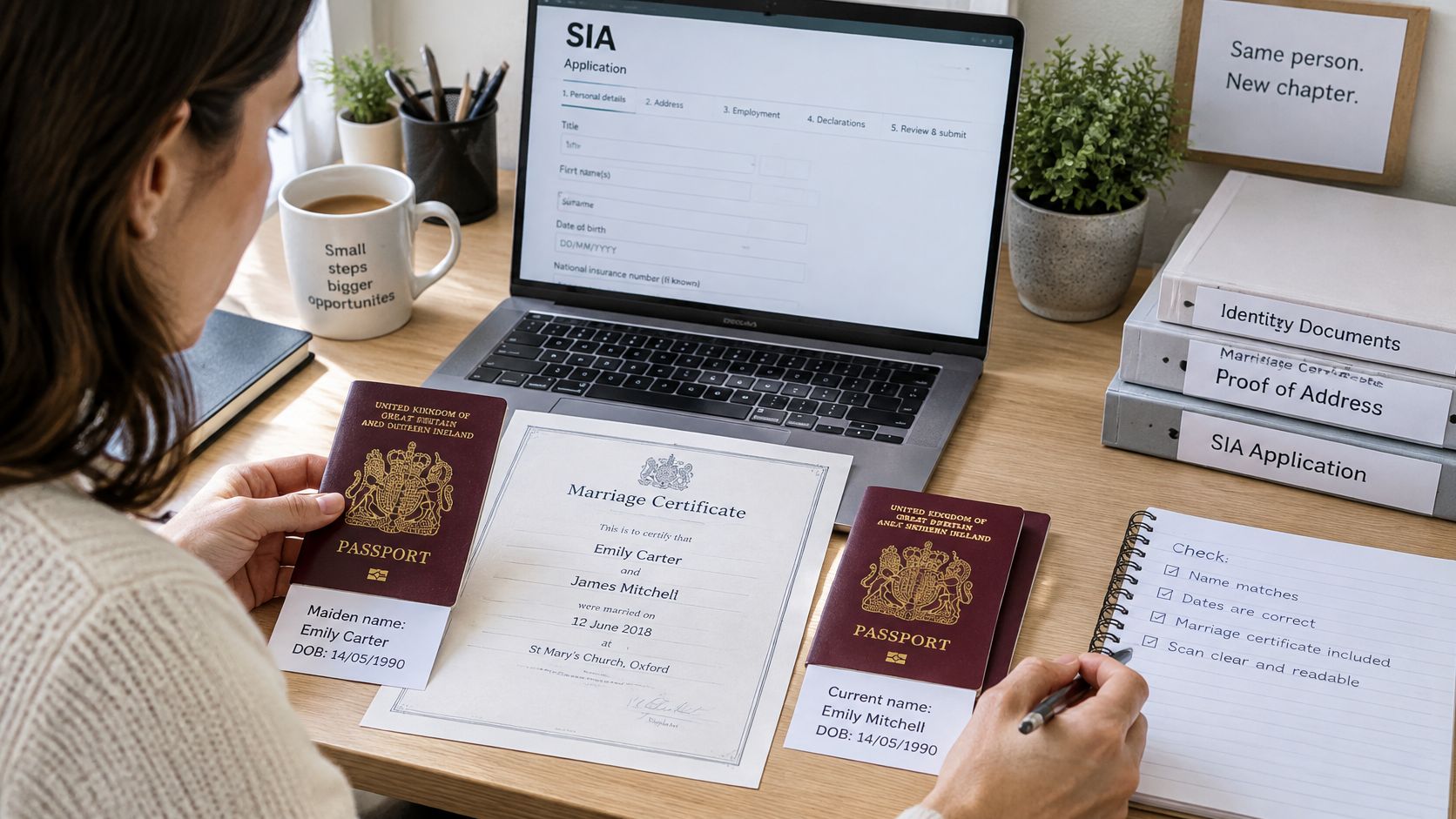
What to line up before you type
The SIA normally requires applicants to provide one Group A identity document and two Group B documents, with at least one Group B document showing their current address. Check the official SIA identity-document requirements before applying, as acceptable documents and validity rules vary.
Answer the SIA's criminal-record questions accurately, including any information you are specifically required to disclose about previous convictions or cautions. Prepare your address history carefully, recording the relevant dates and checking that there are no unexplained gaps. Provide any additional personal or employment information requested during the application.
What the refusal counts are actually telling you
An SIA Freedom of Information response published in June 2024 identified the most common categories behind licence refusals in the 2022–23 and 2023–24 financial years. These historical figures illustrate the importance of meeting the licensing criteria but should not be treated as current refusal rates or as a prediction of an individual application's outcome.
Refusal category | Refusals reported |
|---|---|
Violent or abusive behaviour | 988 |
Right-to-work issues | 883 |
Drug offences | 614 |
Dishonesty offences | 445 |
Weapons or firearms offences | 222 |
Criminal damage | 166 |
Sexual offences | 83 |
Right-to-work issues were close in number to refusals for violent or abusive behaviour. Check that your evidence matches your status before applying. The other categories are a reminder to disclose relevant information accurately, not a way to estimate your own odds.
A complete history helps prevent avoidable questions. Keep names consistent across documents, explain any changes, and ensure your address history is complete and accurate.
Processing times vary depending on the checks required and whether the SIA needs further information. The SIA provides an online decision-timescale indicator to help applicants estimate how long their application may take, but this is not a guarantee. If an application is refused, read the reasons carefully and follow the formal appeal process rather than immediately submitting another application.
Tick these off before you open the form.
Photo ID: An in-date passport or UK photocard driving licence with the name you will use on the form.
Name-change evidence: A marriage certificate, deed poll, or equivalent if a document still shows an old name.
Right to work: Evidence that matches your actual status.
Address history: Every address requested by the SIA, with accurate dates.
Criminal record: Convictions and cautions recorded accurately.
Qualification record: Visible in the online account, with the certificate stored alongside it.
How to Apply Online and Pay the Fee
The application goes more smoothly when you select the correct sector and have your details ready before you begin. Use the GOV.UK SIA application guidance to check the current fee. The qualification, application and payment need to line up: choosing the wrong sector or applying before your qualification appears in your account can delay the process.
As of November 2026, the standard SIA licence application fee is £204, following the end of the previous £20 rebate on 1 April 2026. This fee is separate from the cost of training, which is set by individual training providers. The application fee is non-refundable if your application is unsuccessful.
Work through the application in this order:
Create or sign in to your SIA online account. Start an application for the licence sector that matches your qualification and intended role.
Check your qualification record. Make sure the SIA has received confirmation of your licence-linked qualification from the awarding organisation before submitting your application.
Complete the application form. Enter your personal details, address history and other information requested by the SIA. Check everything carefully before making your declaration and submitting.
Follow the next-steps instructions. After submission, the SIA will provide an application reference and explain what you need to do next.
Complete identity verification and payment. Applicants living in the UK will usually be directed to a participating Post Office to show original identity documents, have their photograph taken and, if paying for themselves, pay the application fee. Other arrangements may apply to overseas applicants or employer-supported applications.
Wait for the licensing decision. Monitor your SIA online account and respond promptly to requests for further information. Do not assume that submitting or paying for an application means your licence has been approved.
If you have lived abroad
If you live outside the UK, or have spent six continuous months or more outside the UK during the previous 10 years, you will need to provide evidence of overseas criminal-record checks. If you have lived in several countries, the SIA may require evidence from more than one country. Start gathering these documents early, as obtaining overseas criminal-record checks can take time.
Once your licence is granted, the work can still differ by site and shift. For a comparison with fixed reception or door posts, read about mobile security patrol jobs.
Where possible, complete the form in one sitting. If you need to return later, check each date against your prepared history before submitting.
Renew or Vary Your SIA Licence on Time
A licence that expires on a Friday still stops you working on Saturday. The fix is a date in a calendar, not a hope that the badge in your wallet is "probably fine".
Check Whether Refresher Training Is Required
Renewing an SIA licence may involve additional training. If you are renewing a door supervision, security guarding or close protection licence, you must meet the SIA's refresher training requirements.
You must also hold an appropriate first-aid qualification before starting refresher training. For door supervision and security guarding, this normally means Emergency First Aid at Work or an accepted equivalent. Close protection requires a higher-level first-aid qualification. In each case, the first-aid qualification must have at least 12 months of validity remaining when you start your refresher training.
Check the official SIA renewal guidance before booking training, and allow enough time to complete it before your licence expires.
Stage | Timing or rule |
|---|---|
Licence term | Check the expiry date in your SIA online account |
Renewal application | Apply within four months before expiry. |
Refresher training | Required when renewing door supervision, security guarding or close protection licences. |
First-aid qualification | An appropriate qualification with at least 12 months' validity remaining is required before refresher training. |
Application Decision | Processing times vary depending on the checks required. |
Additional sector application | A separate licence and relevant qualification may be needed if your current licence does not cover the new activities. |
Same sector, or a new one
If you are renewing your licence in the same sector, you can apply up to four months before it expires. Set a reminder for the beginning of this window, allowing time to complete any required refresher training and gather supporting documents. Applying early does not mean losing the remaining time on your existing licence.
If your licence has already expired, you must apply for a new licence rather than renew it. You should also check whether overseas criminal-record evidence is required if you have spent time outside the UK.
Adding another licence sector is not simply a tick box on your existing licence. For example, someone holding a door supervision licence may already be permitted to carry out certain CCTV duties involving the protection of premises or property. However, monitoring CCTV to identify people or observe their activities for public safety purposes may require a separate public space surveillance (CCTV) licence.
Before applying for another sector, check whether your existing licence covers the intended duties. If a separate licence is required, you will normally need the appropriate licence-linked qualification and must complete the relevant application checks.
One decision covers where you are today. If you have no licence, book the course for the sector on the job advert, after you have matched the hours and the provider. If you already hold one, set the renewal reminder now, and only then look at a second sector.
Solomon's Facilities Management provides SIA-licensed security, reception, and concierge cover for offices, residential buildings, retail sites, and events across Central, East, and North London. If you are a facilities or property manager lining up licensed staff rather than applying for a badge yourself, the same sequencing rules decide who can stand on your site. Visit Solomon's Facilities Management to see how static guarding, mobile patrols, and CCTV monitoring sit under one contract.

Comments