
Cleaning Services for Business: How to Buy and Manage

Choosing commercial cleaning services for a business involves more than comparing prices or deciding how many hours a cleaner should attend. For offices and commercial properties in London, the right cleaning contract should reflect building occupancy, hygiene requirements, working hours and the standards expected by employees and visitors.
A well-managed cleaning service should deliver consistent results, clear responsibilities and measurable quality standards. This guide explains how to assess cleaning requirements, compare commercial cleaning companies, prepare a cleaning specification and manage performance throughout the contract.
Table of Contents
How Often Each Area Needs Cleaning - Adjust the schedule to use
How to Write a Scope Suppliers Can Price - Build the specification in sequence - Make exceptions priceable
Quality KPIs That Show Real Hygiene, Not Just Shine - Set targets that expose failures - Check evidence, not just ticks
Managing Chemicals, Schedules and Handover - Follow the chemical through its working life - Schedule work and record the handover
How to Tender and Vet Cleaning Suppliers - Compare operational fit before price - Run a controlled tender
Linking Cleaning With Reception, Security and Waste - Assign duties across the building - Use one report without losing specialist responsibility
How Often Each Area Needs Cleaning
Most business sites need daily cleaning of washrooms, kitchens, entrances and high-touch surfaces, with less frequent cycles for internal glass, carpet extraction and high-level dust removal. Treat the schedule below as a proposed starting specification, not a universal standard or a substitute for a site assessment.
Cleaning requirements vary depending on the size of the premises, daily occupancy, building use and the nature of the business. The following table provides indicative frequencies for a typical commercial office environment.
Typical cleaning frequency by area
Area | Typical frequency | Why it matters |
|---|---|---|
Entrances, lobby and reception glass | Daily, plus spot cleans at peak times | High footfall and first impressions |
Washrooms | Twice daily in busy offices, daily otherwise | Sanitary hygiene and replenishment checks |
Kitchens and tea points | Daily | Food-contact surfaces and shared appliances |
Desks, door handles and lift buttons | Daily, plus a mid-shift wipe in high-traffic offices | Frequently handled surfaces |
Meeting rooms | Daily if used, otherwise weekly | Frequency should follow actual use |
Hard floors | Daily soil removal and damp mopping where needed, with a weekly scrub where appropriate | Soil tracked in from entrances |
Carpets | Vacuum two to three times a week, with quarterly extraction considered after inspection | Dust removal and embedded soil control |
Internal glass and partitions | Weekly | Fingerprints and visual finish |
Waste and recycling points | Daily or before each collection | Segregation, spills and odour control |
Deep clean of accessible vents, upholstery and ceilings | Quarterly or six-monthly after condition checks | Dust and soil beyond routine reach |
Adjust the schedule to use
Footfall sets the frequency, not the calendar. Say an office has a busy shared kitchen and regular client visitors, while another operates mainly as a lightly occupied back office. Giving both buildings the same attendance pattern ignores where people create work.
A meeting room booked only occasionally doesn't automatically need daily cleaning. Spending time polishing its unused table can take labour away from washrooms that run out of soap before lunch.
Practical rule: A completed evening visit isn't a successful service if nobody addresses the touchpoints and consumables that fail during occupation.
Use vacuuming or another suitable low-dust method rather than automatically dry sweeping hard floors. Check floor finishes before specifying machine scrubbing, and don't treat carpet extraction as a calendar obligation when inspection shows a different need.
Build your task list with a commercial cleaning checklist, then walk the building during a busy working period. Observe queues, fingerprints, food spills and bin use, and mark which areas need scheduled work, occupancy-triggered checks or immediate intervention.
How to Write a Scope Suppliers Can Price
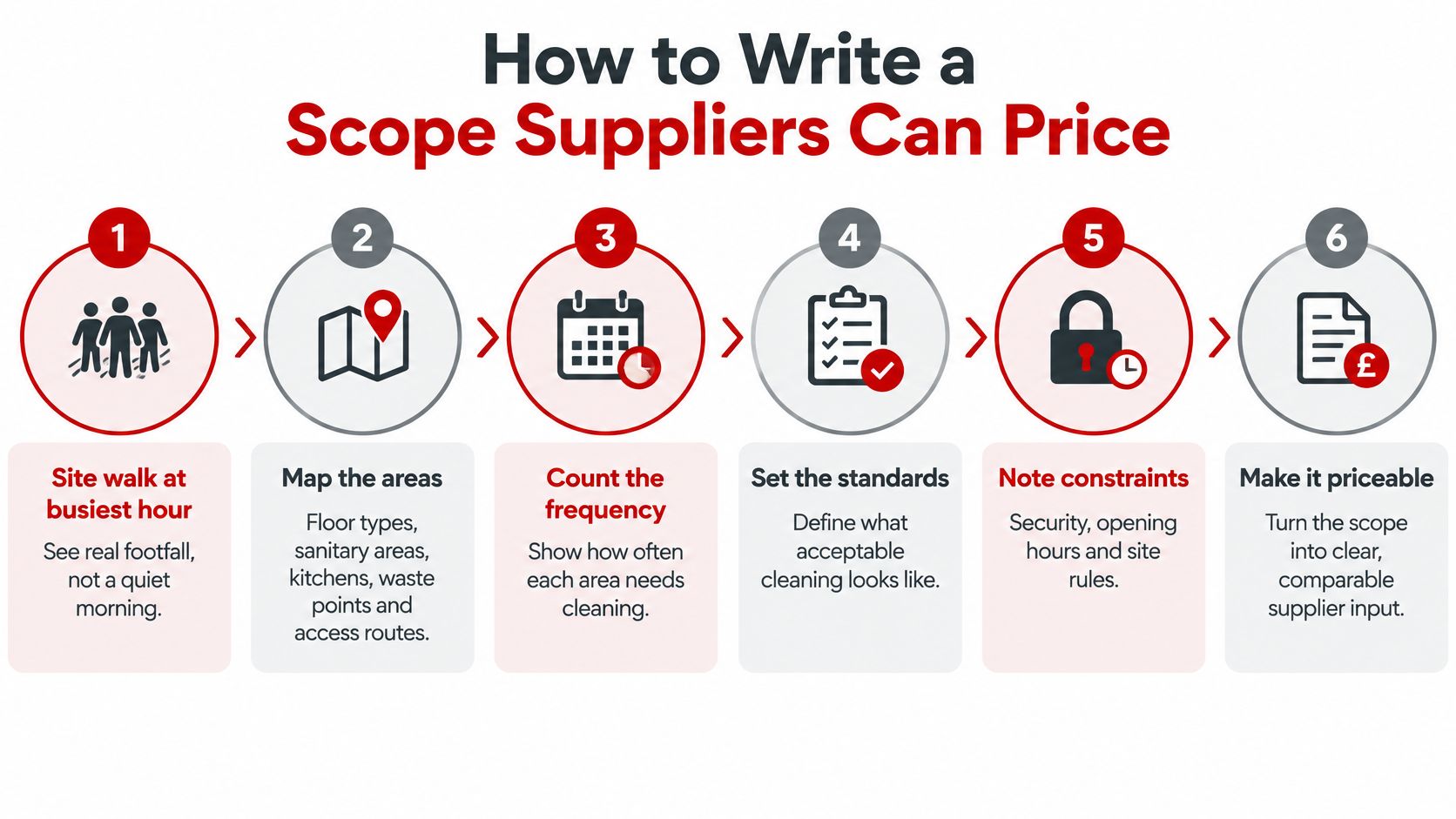
Start the site walk at the busiest hour, not on a quiet morning before staff arrive. The supplier needs to see kitchen queues, occupied meeting rooms, delivery movements and the routes cleaners can use.
The Clean Space guide to commercial cleaning standards supports combining task frequencies with observable outcomes and ongoing verification. That distinction matters: a contractor can complete a task and still leave an unacceptable result.
Build the specification in sequence
Map the building and access routes. Record floor types, sanitary areas, kitchens, waste points, touchpoints and storage locations on site drawings. Include after-hours routes, restricted rooms and any areas where cleaners need an escort.
Group spaces by risk and required outcome. Washrooms need sanitary fittings and available consumables; reception needs presentable glass and controlled tracked-in soil. Don't give every room the same acceptance criteria just because it occupies the same floor.
Assign the working method and responsible role. State the equipment, approved products, frequency and role accountable for delivery. For example, distinguish the operative's routine kitchen clean from the supervisor's check that shared appliance handles and splashbacks haven't been missed.
Write standards a supervisor can inspect. Use descriptions such as no visible soil on accessible desks, residue-free sanitary fittings, controlled dust on skirting and correctly replenished dispensers. Avoid relying on the word clean without defining what passes.
Set the verification plan. I would start with weekly zone sampling and a monthly review of recurring faults, adjusting the inspection effort to the site's risks. Record who inspects, how defects are classified and who confirms corrective work.
Assemble a single controlled document. Include drawings, access hours, out-of-hours rules, exclusions, consumable responsibilities and the process for approving changes. Give each revision an owner so bidders don't price different versions.
Use this process diagram to check that the scope covers both the work and its constraints.
Make exceptions priceable
A fixed routine needs explicit triggers for extra work. Specify what happens after a catered meeting, a wet-weather rush through reception or an unusually busy day in the shared kitchen.
Separate included responsive checks from chargeable additional work. Otherwise, the client assumes spot cleaning is covered while the contractor assumes every unscheduled request requires approval.
Could a supplier price the scope without guessing what you meant?
Questions about delivery methods are useful. Questions about which rooms are included, who supplies soap or whether the cleaner can enter the building reveal gaps in the specification. Close those gaps before comparing prices, not after appointing the contractor.
Quality KPIs That Show Real Hygiene, Not Just Shine
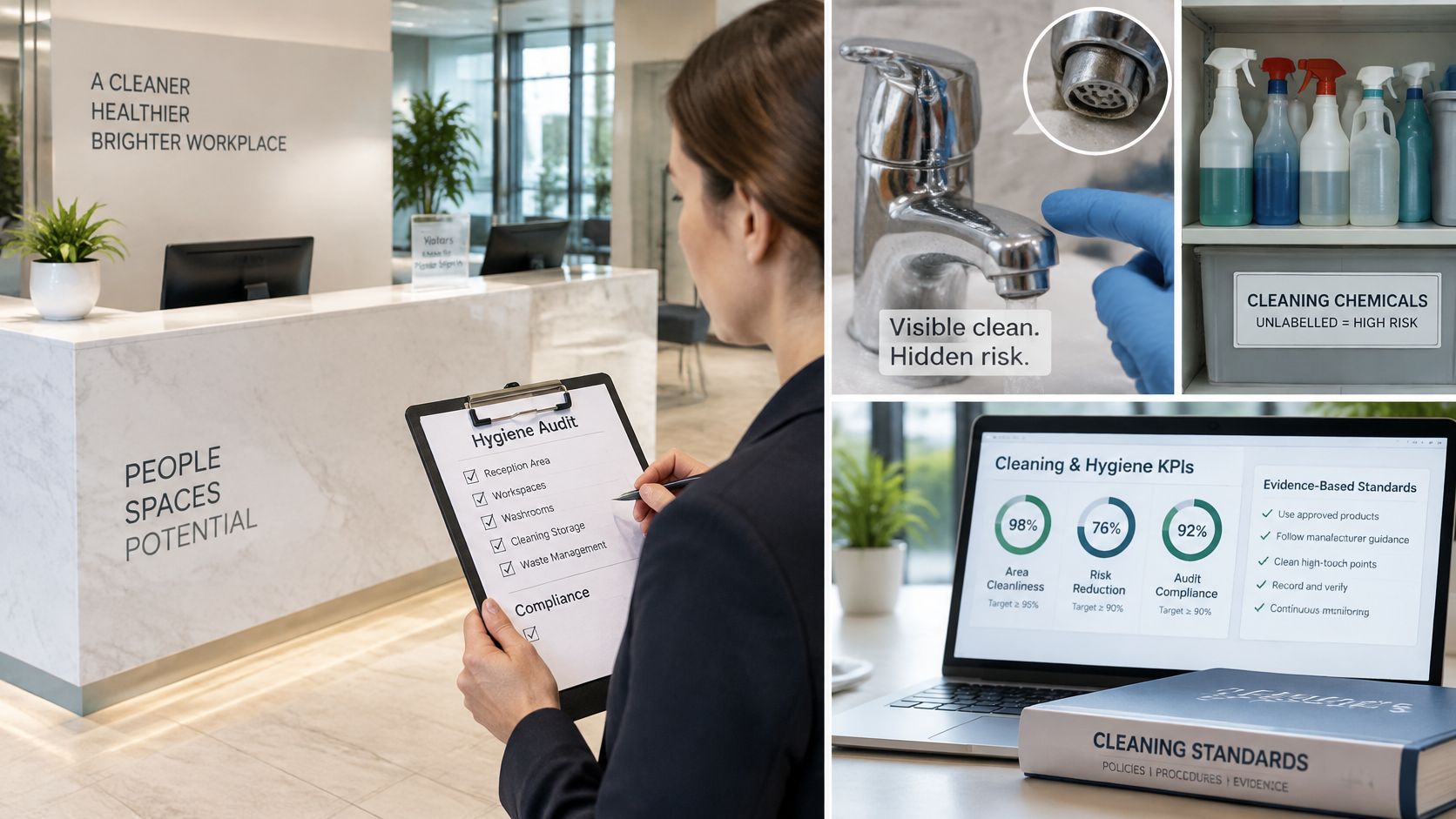
Visible cleanliness isn't proof of infection-risk reduction. A tidy office can still contain a poorly cleaned washroom tap, an empty soap dispenser or equipment used across incompatible areas. Your dashboard should show whether staff delivered the controls you specified, not imply that an attractive room is microbiologically safe.
The Office for National Statistics sickness-absence release puts the UK sickness-absence rate at 2.0% in 2025, equivalent to 4.4 days per worker. Compare cleaning records with complaints and aggregate absence patterns if useful, but don't claim that cleaning caused a change in sickness absence.
An audit should connect the observed condition to a recorded action and accountable owner.
Set targets that expose failures
The following are proposed contract targets, not published industry benchmarks. Agree them with the supplier, distinguish urgent hazards from routine defects and recalibrate after an initial operating period.
Cleaning KPIs with starting targets
Measure | How to record it | Starting target |
|---|---|---|
Inspection pass rate by zone | Supervisor checks per zone each week | Every critical hygiene check passes; agree a baseline for cosmetic items |
Repeat defects per 100 inspection points | Count defects found on re-inspection | Proposed threshold below 2 |
Hygiene failure response time | Time from client report to corrective action | Proposed washroom attendance within 2 hours; make hazardous spills safe immediately |
Washroom consumables availability | Spot checks at scheduled rounds | No empty essential dispensers at checks |
Scheduled tasks completed with evidence | Signed task sheets or app records | Every scheduled task evidenced or logged as an exception |
COSHH compliance review | Review risk assessments, records and corrective actions | At agreed intervals and following relevant changes |
Client satisfaction score | Monthly short survey | Proposed score of 4 out of 5 or above |
Don't report one building-wide average without the zone results underneath it. Strong reception scores can conceal persistent washroom failures, especially when inspectors check many easy cosmetic items and few critical controls.
Record repeat defects separately from new defects. A recurring empty dispenser may indicate inadequate stock, a damaged unit or poorly timed rounds. Repeatedly asking the cleaner to refill it won't resolve every cause.
Check evidence, not just ticks
During the proposed monthly COSHH review, check safety data sheet availability, staff competency records, chemical incident logs and corrective-action closure. A signed attendance sheet proves attendance, not competent dilution or safe storage.
For food debris, bin hygiene and overlooked harbourage points, the pest prevention tips from FullScope Pest Control provide a useful companion to the inspection checklist. Treat pest evidence as an escalation requiring investigation, not something to wipe away before the client arrives.
Routine inspections don't certify specialist decontamination. If an illness incident calls for a different response, document the trigger, authorised method, competent personnel and reopening decision separately from the normal cleaning round.
Managing Chemicals, Schedules and Handover
Chemical control is part of the cleaning specification, not a separate paperwork exercise. A COSHH assessment should cover how products are used, stored, handled and disposed of, including accidents and emergencies.
Follow the chemical through its working life
Inventory the products. Keep the supplier label and current safety data sheet for every chemical, including products stored in satellite cupboards.
Identify exposure during dilution, spraying, wiping, waste handling and spill response. Consider who else may enter the area while work is under way.
Remove or substitute higher-risk products where reasonably practicable. A familiar aggressive chemical is not a good reason to keep using it if a lower-risk method achieves the required result.
Specify controls in the assessment. These may include closed dosing, ventilation, segregated storage, suitable gloves, eye protection and written spill procedures. Never mix products or decant them into unlabelled containers.
Train for the actual task. Demonstrate dosing, equipment use and spill escalation, then check the operative can carry out each step. Keep records of instruction and competency.
Review the assessment after incidents, product changes or building changes. A relocated cupboard or altered ventilation can change exposure conditions.
Safety check: Gloves do not fix uncontrolled dilution, incompatible storage or inadequate ventilation.
Schedule work and record the handover
Set cleaning times around building use. Early-morning or evening shifts can make floor cleaning and equipment movement easier in occupied offices, but allow for drying time and secure access. Agree who authorises out-of-hours call-outs and how they are charged.
An office cleaning schedule should separate routine attendance from daytime response duties. A night team cannot resolve a lunchtime failure unless someone is available to attend.
Keep stock planning tied to the site's approved-product register. The resource on stocking essentials for offices and cafés can inform the purchasing list, while the register sets out which products cleaners may use.
Use a shared handover log with these fields:
Shift and owner: Date, work period, outgoing operative and incoming responsible person.
Exceptions: Faults, unusual spills, restricted rooms, missed tasks and temporary controls.
Closure: Action owner, agreed deadline, completion evidence and supervisor sign-off.
The outgoing shift records unresolved items before leaving. The incoming lead acknowledges them before starting work. The supervisor closes each entry only after checking the action.
How to Tender and Vet Cleaning Suppliers
The cleaning market offers plenty of choice, but business size doesn't tell you whether a supplier can reliably cover your building. The UK Government's 2025 Business Population Estimates identify 15,190 microbusinesses with 1 to 9 employees, representing 78.0% of employer businesses in cleaning activities.
A small local firm can offer direct owner involvement and flexible decisions. A larger contractor may have a deeper cover team, central reporting and established supervision across multiple locations. Neither advantage is automatic: ask for evidence of the resources assigned to your contract, not the resources shown in the sales presentation.
Compare operational fit before price
For a compact office, a local provider with a nearby relief team may be entirely suitable. For a multi-tenant building with daytime washroom rounds, controlled access and evening cleaning, you need a more developed management structure.
Check how much of the proposed service will be subcontracted. Ask who employs the operatives, who supervises them and whether the same reporting and training requirements apply throughout the delivery chain.
Supplier vetting criteria
Criterion | What to ask for | Red flag |
|---|---|---|
Insurance | Public and employer's liability certificates, checked for current cover | Certificate expired or not provided |
Chemical and COSHH practice | A sample COSHH assessment and the safety data sheet library | Cannot produce them on request |
Staffing depth | A named supervisor and a cover plan for absences | Dependent on one person |
Training and vetting | Training records and the process for site access checks | No documented training |
Reporting | A sample monthly report | Verbal updates only |
Pricing transparency | Price itemised by task and labour hours | One lump sum with no breakdown |
A low lump sum isn't automatically poor value. An unexplained lump sum is difficult to evaluate. Without a labour and task breakdown, you can't tell whether the bidder has omitted periodic work, underestimated access time or assumed that your receptionist will replenish washrooms.
Ask bidders to separate routine service, periodic work, consumables and additional attendance. Clarify equipment ownership and replacement, because a failed vacuum or scrubber should have a defined remedy rather than an improvised delay.
Run a controlled tender
Shortlist suitable firms: Select providers that can demonstrate comparable site types, access requirements and management demands.
Issue the same pack: Give every bidder the scope, drawings, access windows, frequency schedule, KPI definitions and waste responsibilities.
Walk the site together: Test assumptions about storage, loading, staff facilities and security restrictions before bids close.
Score delivery as well as cost: Assess resilience, supervision, training and reporting using consistent criteria.
Check references against failures: Ask how the supplier handled missed attendance, recurring defects and urgent replenishment, not merely whether the referee was happy.
Digital systems can help, but don't award marks just because a supplier uses an app. JobsiteStack's overview of tools for managing recurring cleaning visits is useful when assessing scheduling and record-keeping options. Ask the bidder to demonstrate how its chosen system records an exception, assigns corrective work and exports your report.
If the bidder can't name the supervisor and explain absence cover, it hasn't answered the continuity question.
When you're ready to tender, request itemised pricing, a written cover plan, a sample report and assessments for the principal chemicals. Set an initial review period to compare zone results, repeat defects, response performance and replenishment failures against the agreed targets.
Change frequencies only where the operating evidence supports it. Count failures and management time before deciding that the lowest headline price represents the cheapest contract.
Linking Cleaning With Reception, Security and Waste
A clean waste area can still be managed badly. If a cleaner empties correctly sorted recycling into a mixed sack, the floor may look tidy while the building's waste arrangements fail. Treat separation as an operational control, with named owners at each handoff.
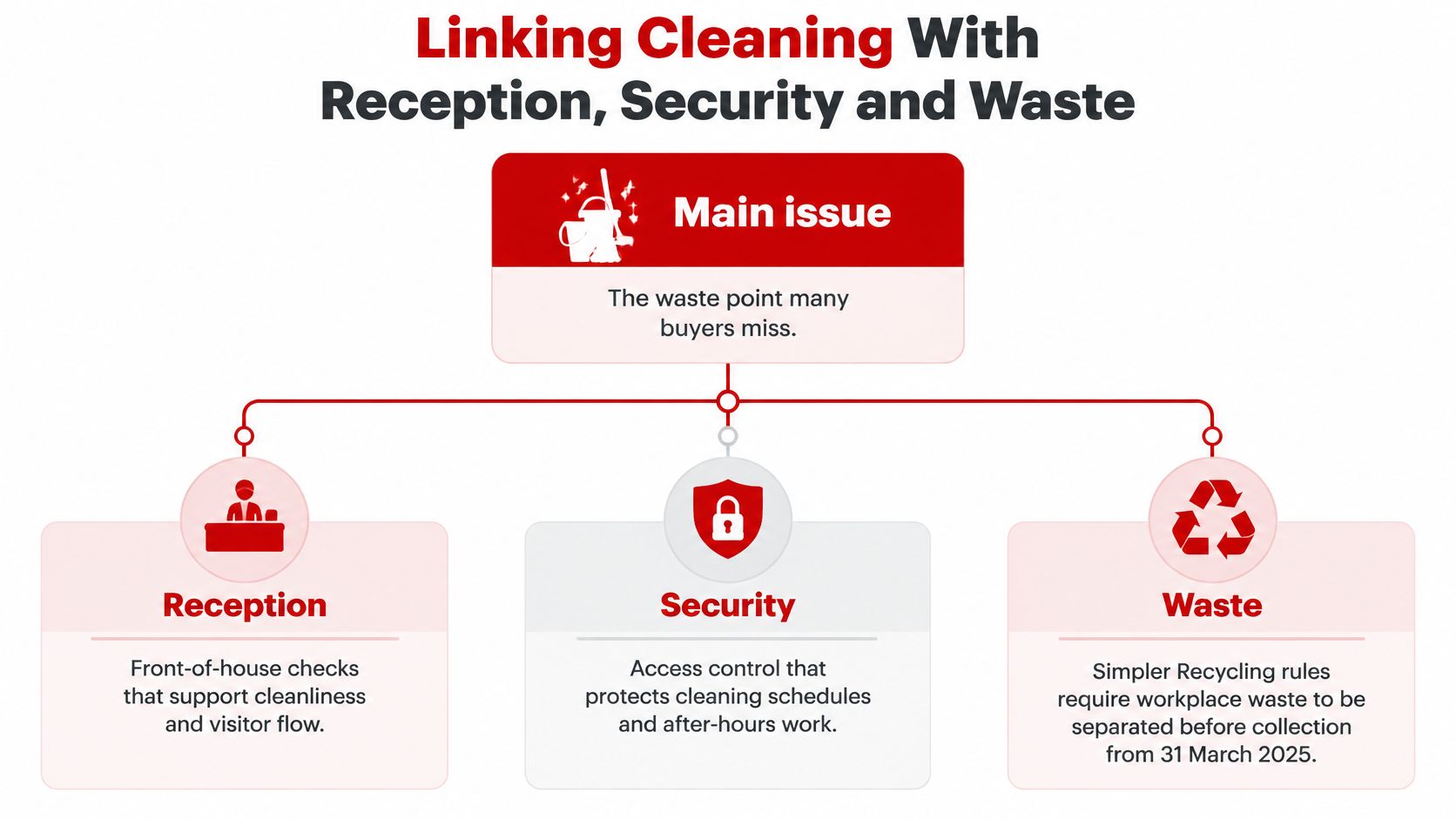
The government's Simpler Recycling workplace guidance sets out the requirement to separate workplace waste in England, including waste from employees, customers and visitors, before collection. The stated deadline is 31 March 2025 for most workplaces, with 31 March 2027 applying to micro-firms with fewer than 10 full-time equivalent employees.
Assign duties across the building
Recycling depends on tenant behaviour, container placement, signage and collection arrangements, as well as the cleaning team's handling. In a multi-tenant property, unclear boundaries leave each party assuming someone else owns the task.
Settle these responsibilities before service starts:
Internal segregation: Does the cleaning team preserve separated streams during collection and transfer?
Containers and signage: Who supplies and maintains them: landlord, occupier or contractor?
Contamination: Who records incorrectly sorted waste and contacts the responsible occupier?
Collections: Who retains collection evidence and investigates rejected loads?
Storage: Who checks that the waste area stays accessible, secure and free from unmanaged spills?
The service interfaces need to be explicit, as illustrated below.
Use one report without losing specialist responsibility
Cleaning, reception, security and waste handling sit at the operational level. The site supervisor coordinates exceptions, while the facilities manager receives a consolidated report showing named owners and unresolved actions.
Reception can pass on tenant instructions and report overflowing bins. Security can control contractor access and record failed collections outside normal hours. Cleaners can log contamination by location, so the manager can address its source instead of repeatedly correcting the same symptom.
An integrated facilities management model can reduce handoff gaps and give the client one accountable contact. The trade-off is greater dependence on the prime contractor, particularly if it lacks specialist depth or restricts access to essential records.
Keep service responsibilities distinct, even under one contract. Require access to your records, identify specialist subcontractors, and agree an exit handover covering keys, equipment, outstanding faults and waste arrangements.
Before signing, assign every waste task, from the desk-side container to the collection point. A shared contract cannot resolve a responsibility that nobody owns.
Solomon's Facilities Management provides office cleaning and janitorial services alongside reception, concierge and SIA-licensed security under a single accountable contract for London properties. Visit Solomon's Facilities Management to discuss a site assessment. Bring floor plans, access requirements and current service failures so the proposed scope can be priced and measured against the building's needs.

Comments