
What Is Included in Office Cleaning in London

At 08:00 on a Monday, the office may look ready for business. The security officer is checking visitors at reception, the first calls are coming through, and a cleaner is finishing the washrooms before the meeting rooms fill. Yet a tidy reception desk doesn't tell you whether lift buttons were disinfected, kitchen surfaces were sanitised, or soap dispensers were replenished.
That distinction matters when you're deciding what is included in office cleaning. A credible contract should state what gets cleaned, how often, by whom, to what standard, and with what evidence. Emptying bins is only one task inside a wider operating system that covers workstations, shared areas, washrooms, kitchens, waste, consumables, periodic work and response to problems during the day.
Table of Contents
What Office Cleaning Actually Covers on a London Site - Scope is not the same as appearance
Core Tasks by Zone in a Typical Office - Workstations and meeting rooms - Communal areas, kitchens and washrooms
Daily, Weekly, Monthly and Periodic Cleaning Frequencies - What belongs on each cycle
Hygiene Standards, Touchpoints and Compliance - Chemicals and equipment need controls - Evidence should test outcomes
Service Levels, SLAs and Proof of Completion - Write the outcome into the SLA - Keep an audit trail
How Solomon's Delivers Consistent Cleaning Standards - Handover prevents small misses becoming morning complaints - One escalation route simplifies accountability
Checklist for Reviewing Your Cleaning Contract - Check the building zone by zone - Test the contract against real failures
What Office Cleaning Actually Covers on a London Site
A London office cleaning specification can be organised by zones and frequencies. The formal UK classification for general building cleaning sits under SIC 81210, and the British Cleaning Council describes a sector that directly employs over 1,006,400 staff, rising to over 1.47 million people when broader hygiene and waste work is included (British Cleaning Council sector research). Office cleaning is therefore part of an established facilities category, not an informal add-on.
On a typical managed site, the scope is divided into four parts:
General cleaning: Workstations, meeting rooms, floors, reception, corridors, lifts, kitchens, washrooms and bins.
Janitorial or day duties: Spill response, touchpoint checks, waste movements, consumable replenishment and support for heavily used communal areas.
Periodic cleaning: Carpet extraction, internal window cleaning, high-level dusting, upholstery care, hard-floor treatment and restorative washroom work.
Specialist exclusions or extras: IT equipment, external façades, specialist ventilation work, pest control and internal windows that require unusual access equipment.
The contract can also identify who supplies toilet roll, hand soap, paper towels, sanitary-bin liners and general bin liners. If responsibility isn't written down, the gap normally appears on a Friday afternoon when a dispenser is empty and each supplier assumes somebody else is dealing with it.
Scope is not the same as appearance
The British Cleaning Council's wider industry research describes cleaning, hygiene and waste work as a substantial, structured service base rather than simple tidying (BCC cleaning, hygiene and waste research).
Pricing may be calculated by floor area, staffing hours, headcount or a hybrid model. The method matters less than the output.
Practical rule: Every zone needs an owner, a frequency, an acceptance standard and a record that someone can inspect.
Core Tasks by Zone in a Typical Office
The most useful answer to what is included in office cleaning starts with the building map. Cleaners shouldn't work from a single generic list because a reception desk, a quiet workstation neighbourhood and a busy breakout kitchen have different patterns of use and different failure points.
Workstations and meeting rooms
At workstations, the usual work includes wiping accessible desk surfaces, sanitising shared phones and keyboards where permitted, emptying bins, removing visible marks and vacuuming around desks. Staff-owned papers, personal items and open laptops need to remain undisturbed, so the method statement should explain what the cleaner may move and what must be left in place.
Meeting rooms need a reset rather than a quick pass. That means wiping tables, cleaning accessible glass, removing cups and rubbish, cleaning whiteboards where included, checking chair presentation and vacuuming around the table. In offices with heavy room bookings, the contract may need a daytime porter or room-turnaround routine instead of relying solely on an evening visit.
Communal areas, kitchens and washrooms
Corridors, stairwells, reception areas and lifts need floor care plus attention to hand-contact points such as lift buttons, bannisters, push plates and door handles. Kitchens require worktop sanitisation, sink cleaning, appliance exteriors and, where specified, microwave interiors, fridge fronts and tea-point replenishment. Fridge clearance and internal appliance cleaning must be explicit, because many contracts cover only external wiping.
Washrooms receive the most defined hygiene treatment. The routine normally includes toilets, basins, taps, mirrors, partitions, floors, bins and replenishment of soap, hand towels, toilet roll and sanitary-bin liners. UK workplace requirements also require welfare facilities to be kept clean and sanitary, which is why a washroom scope should describe both the tasks and the condition expected after completion (UK office deep-cleaning and workplace hygiene guidance).
Zone | Typical tasks | Notes |
|---|---|---|
Workstations | Surface wiping, bin emptying, spot vacuuming, shared-device cleaning | Personal items and IT equipment need clear handling rules |
Meeting rooms | Table cleaning, glass wiping, rubbish removal, chair reset | High turnover may require daytime checks |
Communal areas | Vacuuming or mopping, lift and bannister wiping, mark removal | Footfall should determine inspection frequency |
Kitchens | Worktop and sink cleaning, appliance wiping, waste removal, replenishment | Internal appliance cleaning is often an extra |
Washrooms | Sanitary cleaning, mirror polishing, floor mopping, dispenser checks | Consumables and sanitary waste ownership must be stated |
A commercial cleaning checklist for office zones is useful during mobilisation, but it shouldn't replace a site-specific schedule. The cleaner needs a practical route, the supervisor needs an auditable inspection, and the client needs to know which tasks are included rather than assumed.
Daily, Weekly, Monthly and Periodic Cleaning Frequencies
Frequency should follow use, risk and disruption, not habit. A lightly occupied back office doesn't need the same intervention as a reception, washroom bank or kitchen used continuously by several tenants. The schedule also needs to distinguish between work that protects hygiene each day and work that maintains finishes over a longer cycle.
What belongs on each cycle
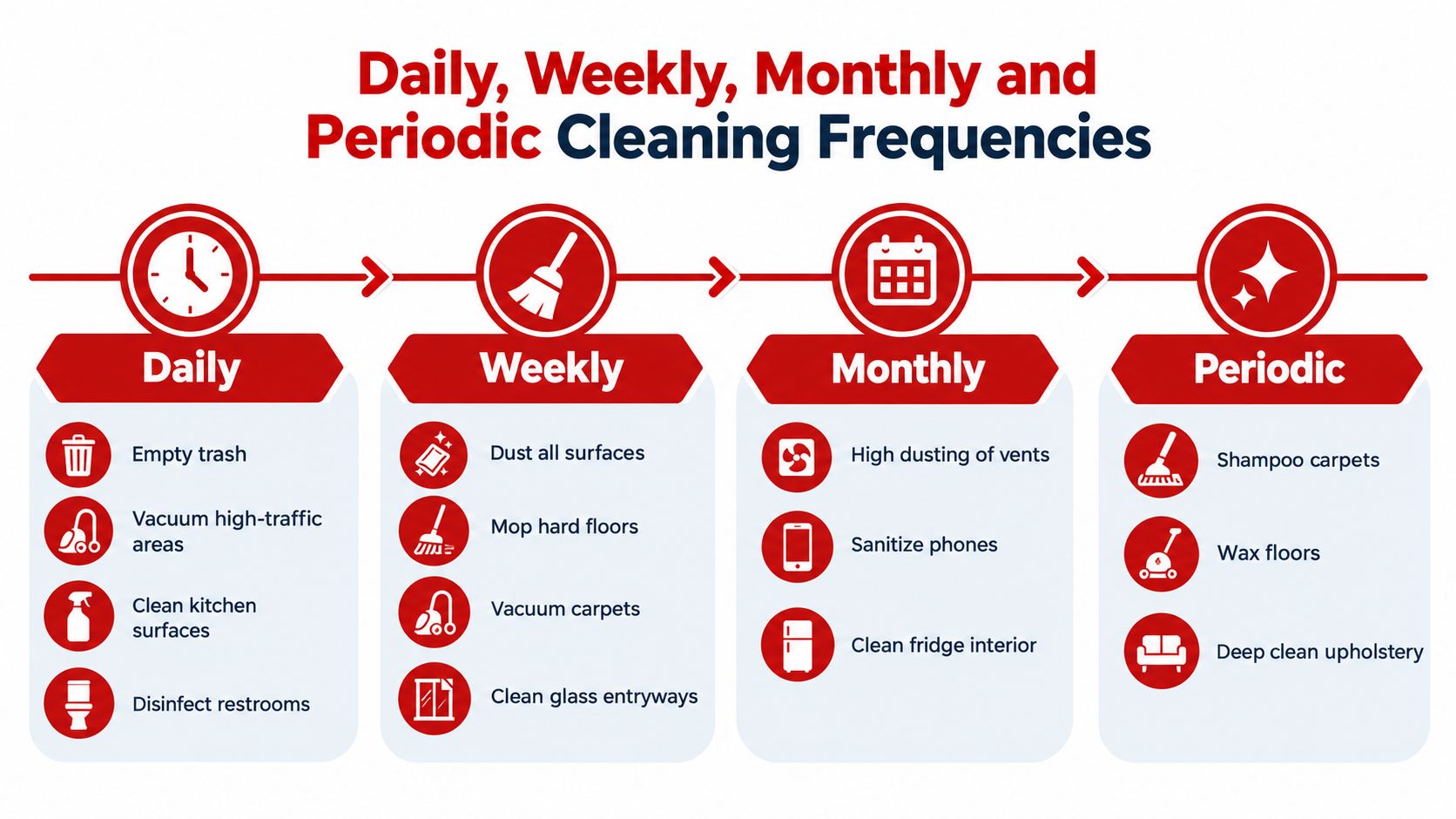
Daily work normally includes emptying waste, cleaning washrooms, mopping washroom floors, wiping kitchen surfaces, vacuuming busy routes and replenishing soap, paper products and other agreed consumables. High-touch points should be checked as part of that routine, with additional visits where footfall or shared use justifies them.
Weekly work can include a fuller vacuum of workstation areas, desk-phone sanitisation, internal glass, skirting boards and lift interiors. These tasks often need more time and access than a nightly reset allows, particularly where employees leave equipment and documents on desks.
Monthly work commonly covers high-level dusting, light-fitting wipes, upholstery spot cleaning, appliance deep cleaning and ventilation-grille cleaning. Periodic work may include carpet extraction, hard-floor strip and seal, restorative washroom cleaning, internal window cleaning and chair steam cleaning. Not every building needs every task at the same interval, so the specification should state the trigger and approval process.
Out-of-hours cleaning, often after the working day or at weekends, reduces interference with calls, visitors and meetings. Daytime janitorial cover is different. It deals with spills, overflowing bins, washroom presentation and unexpected use while the building is occupied. A planned office cleaning schedule should show both patterns, rather than treating the evening visit as the answer to every operational problem.
A frequency is only useful if somebody can verify that the task happened and can explain why the interval suits the building.
The schedule should also include seasonal or event-driven adjustments. A tenant move, refurbishment, recruitment campaign or unusually busy reception can change the workload without changing the floor area.
The accompanying video gives a practical visual reference for how recurring office cleaning tasks can be organised across a working schedule.
Hygiene Standards, Touchpoints and Compliance
Visual presentation is the easy part to inspect. A hygiene-focused specification asks whether the cleaner has treated the surfaces most likely to receive repeated hand contact, used equipment correctly and left evidence that the required method was followed.
High-touch points include door handles, push plates, light switches, lift buttons, tap handles, flush buttons, shared keyboards, mice, remote controls and bin rims. The task frequency should be linked to occupancy and risk. A reception desk and lift lobby may need attention during the day, while a private workstation zone may be covered during the scheduled evening clean.
Chemicals and equipment need controls
The product label sets the required contact time. Wiping a disinfectant on and immediately drying it can undermine the method, even if the surface looks polished. The specification should identify approved products, dilution rules, surface compatibility and what happens when a product isn't suitable for a particular finish.
Colour-coded cloths and mop heads help separate washroom work from general areas and kitchens. The common system uses red for washrooms, blue for general areas, green for kitchens and yellow for clinical or isolation work. The exact scheme can vary, but the site must use one documented system and train every cleaner against it.
Consumables form part of hygiene control too. Toilet roll, hand towels, soap and sanitary products should be stored and replenished through an agreed process, not left to an informal stock check. The supplier should state minimum stock levels, storage arrangements and who authorises emergency purchases.
Evidence should test outcomes
Some UK commercial cleaning specifications use ATP swabbing and audit scores to move beyond visual checks. ATP results are expressed in relative light units, and one UK office-cleaning benchmark cites pass levels around 100 RLU for desk surfaces and kitchen counters (UK office cleaning checklist and ATP guidance). That figure is a contract benchmark, not a universal legal limit, so the client and supplier must agree the threshold, test locations, frequency and corrective action in advance.
The file should also contain COSHH information, Safety Data Sheets, method statements, training records and inspection results.
Service Levels, SLAs and Proof of Completion
Cleaning tiers should differ by control and accountability, not merely by the number of hours a cleaner spends on site. A basic evening service may suit a small, predictable office. A multi-tenant building with reception traffic, meeting-room turnover and active kitchens needs faster intervention and stronger reporting.
Tier | Visit pattern | Rectification window | Scope inclusions | Reporting |
|---|---|---|---|---|
Basic | Scheduled evening visit | Agreed window, commonly 24 to 48 hours | Waste, vacuuming, kitchen wipe-down and washroom reset | Visit sheet and issue reporting |
Standard | Evening service with daytime presence | Defined same-day response, commonly within four hours | Basic scope plus periodic glass, higher-touch checks and selected high-level work | Supervisor inspections and digital task logs |
Enhanced | Scheduled cleaning with rapid daytime response | Agreed urgent response, potentially within one to two hours | Broader periodic programme, deeper janitorial cover and planned reactive work | KPI dashboard, named sign-off and evidence trail |
These are service-design examples, not automatic market standards. The contract should define the actual times, exclusions and escalation route.
Write the outcome into the SLA
Useful KPIs might cover washroom readiness before the building's opening time, completed inspection points, agreed ATP thresholds and rectification of reported defects within the stated window. The wording should identify the sample, the responsible person and the consequence of failure.
Keep an audit trail
QR-coded checkpoints, time-stamped photographs and digital logs can show who attended, which zone they visited, what task they completed and when the supervisor checked it.
If the data stays inside an inaccessible portal, you may have activity records without usable contract evidence. Proof should help you resolve complaints, identify recurring failures and test whether the service is delivering the agreed result.
How Solomon's Delivers Consistent Cleaning Standards
A cleaner finds an overflowing recycling point beside a fire-exit route in a busy City office. The response involves more than removing waste. Someone must clear the obstruction, protect access, record the incident and keep security and reception informed.
Under separate suppliers, that observation can become an email chain between the cleaning supervisor, security team and building manager. A consolidated FM contract gives the cleaner one reporting route through the site duty manager. That manager assigns the action, confirms the owner and keeps the incident in the same operational record as other building issues.
Handover prevents small misses becoming morning complaints
Shift handover is where integrated delivery proves its value. The outgoing team should record unfinished washroom work, damaged dispensers, spills, unusual meeting-room use, waste collection problems and access restrictions. Reception and security can confirm who is entering or leaving, while cleaners can identify spaces requiring extra attention. The next shift then receives a current site picture rather than an empty checklist.
Handover must be usable, not ceremonial. A short log should identify the location, risk, action required, responsible person and deadline. That information also gives the facilities manager evidence when the same room, washroom or kitchen repeatedly creates complaints.
A site lead should walk agreed zones, inspect representative tasks, record defects and confirm corrective work. The client needs same-day visibility when an entrance, kitchen or washroom falls below the agreed standard.
One escalation route simplifies accountability
If a kitchen surface fails an agreed ATP check, one ticket should reach the cleaning supervisor, facilities manager and relevant duty manager. It should show the result, location, time and corrective action. The issue then has a clear owner instead of moving between companies while the condition remains unresolved.
Solomon's Facilities Management provides cleaning and janitorial services alongside security, reception and concierge functions through a single-supplier FM model. Its stated service footprint covers Central, East and North London. The described offer includes scheduled cleaning routines, consumable replenishment, waste handling and communal-area support.
The commercial advantage is practical. One contract can align service reviews, escalation and reporting across front-of-house disciplines. It can also reduce the handovers a facilities manager has to supervise, provided every service has a named operational owner and cleaning KPIs remain visible rather than disappearing inside a broad dashboard. Proof of completion should support that arrangement through signed inspections, logged defects and confirmed close-out actions.
Checklist for Reviewing Your Cleaning Contract
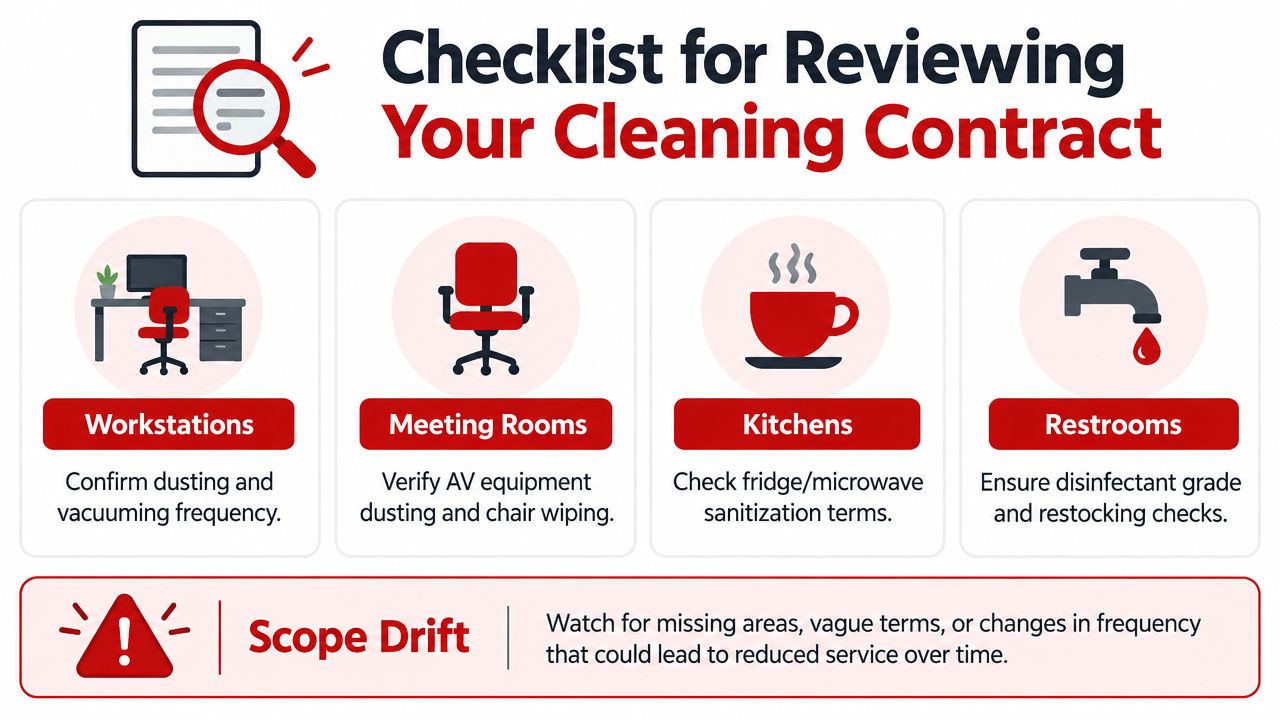
Renewal is the point where scope drift becomes visible. Compare the written schedule with what cleaners do, what occupiers expect and what your complaint log shows. If the contract says “regular cleaning” but doesn't state a frequency, you don't have a reliable service requirement.
Check the building zone by zone
Confirm that the schedule names workstations, meeting rooms, reception, corridors, lifts, stairwells, kitchens, washrooms and waste areas. Then check whether each zone has a task list, frequency, responsible role and acceptance standard.
Pay particular attention to the omissions that create arguments:
IT equipment: Confirm whether monitors, keyboards, phones and docking stations are excluded, accessible only with permission or covered by a controlled method.
Appliance interiors: Check whether microwaves, fridges and dishwashers receive internal cleaning or only external wiping.
Glass and high-level work: Establish whether internal partitions, windows, vents, light fittings and high dusting are included in the periodic programme.
Waste streams: Define general waste, recycling, confidential waste and sanitary waste responsibilities, including collection routes and storage.
Consumables: Name the supplier responsible for ordering, holding and replenishing soap, toilet roll, towels, liners and sanitary products.
Test the contract against real failures
Take a missed washroom, an empty soap dispenser and an unclean meeting room from your recent records. Can you identify the response time, the person responsible, the evidence required and the remedy?
The reporting clause should state whether you'll receive inspection scores, photographs, digital completion logs, ATP results. Also review change control, price-indexation wording, additional-work rates and termination rights. An adaptable contract is useful, but flexibility shouldn't allow the supplier to remove core tasks without approval.
A commercial cleaning contract review should also consider the wider FM arrangement. If security, reception and cleaning each report through different chains, decide who owns issues that cross service boundaries. The strongest specification isn't the longest one. It's the one that makes the expected result, response and proof impossible to misunderstand.
If your London office needs a cleaning scope built around zones, frequencies, consumables, SLAs and documented completion, Solomon's Facilities Management can combine office cleaning and janitorial routines with reception, security and concierge coordination. Visit Solomon's Facilities Management to discuss a single accountable facilities arrangement for your site.

Comments