
Door Supervisor vs Security Guard: Which Role to Hire

The advice you'll hear most often about door supervisor vs security guard work is confident and simple: book a door supervisor, because that licence covers everything a security guard can do. It sounds like the safe call. It's also why plenty of London sites pay for conflict training nobody on the post will ever use, and why some of them still lose a shift at short notice when a licence lapses.
A door-supervision licence does cover guarding work. That licensing fact has hardened into a procurement habit, and the habit carries two costs. You buy intervention training for a lobby where the hardest decision of the day is a delivery driver without a pass, and you concentrate your whole rota on the licence category with the heavier renewal burden. What protects a building is the activity on the shift, the powers it needs, and the paperwork behind the person standing there.
Table of Contents
What the Law Says About Each Licence - The activity test in plain terms
Duties, Powers and Uniforms on Shift - A guard shift, from handover to handover - A door supervisor shift, and its hard stop - What goes in the contract about dress
Training Routes and Renewal Rules Compared - What the extra hours buy - The renewal rule that reshapes cover
Matching the Role to the Site - Why the site decides - A review that tests the choice later
Confirm the Right Licence Before You Hire - The checks that protect continuity
Door Supervisor and Security Guard Side by Side
A door supervisor controls entry and manages disorder at licensed premises, events and busy entrances. A security guard protects premises and property through access control, visitor screening, patrols and incident logging. Both roles require the appropriate Security Industry Authority (SIA) licence, which normally lasts three years. A door-supervision licence also permits security-guarding work, but a security-guard licence does not authorise door-supervision duties.
Criterion | Door supervisor | Security guard |
|---|---|---|
Core purpose | Controls entry and manages disorder at licensed premises and events | Protects premises and property through access control, patrols and incident logging |
Licence | SIA door-supervision licence, normally valid for three years | SIA security-guard licence, normally valid for three years |
Can the holder do the other role? | Yes, the door-supervision licence also permits guarding work | No, a security-guard licence does not permit door-supervision duties |
Typical settings | Pubs, clubs, bars, event entrances and busy retail doors with queues or refusals | Offices, residential buildings, construction sites, retail premises and static posts |
Searching and physical intervention | Trained and assessed in searching and physical intervention | Not part of the guard route, which focuses on presence, access authorisation and escalation |
Main control | Intervention at the point of entry and during disorder | Presence, authorisation, patrols and accurate reporting |
The asymmetry that decides most rotas: an SIA door-supervision licence also permits guarding work, but a security-guard licence does not permit door-supervision duties.
That one line explains why so many contracts are staffed by door supervisors from top to bottom. It's also the line that gets over-applied.
Here's the rule of thumb I'd give anyone specifying cover. If the site holds licensed premises, runs queues, searches people or carries a foreseeable conflict risk, specify a door supervisor. If the site is static, controlled by access and covered by patrols, a security guard is the proportionate choice, and the saving is real money you can spend on a second patrol or better CCTV cover. Where a building does both, such as an office lobby by day and a licensed event space in the evening, the correct answer is a mixed rota rather than one licence type applied everywhere.
What the Law Says About Each Licence
The legal architecture is older than most of the job titles in use on site today. The Private Security Industry Act 2001 created the SIA and, under section 3, made it an offence to carry out licensable private-security activity without a licence. The Act also brought manned guarding at licensed premises inside the regulated framework. The UK regulated professions guidance on door supervisors sets out how the pieces fit: the 2004 Designated Activities Order describes these operatives as people commonly known as door supervisors, while the 2007 licensing regulations define "Door Supervisor" and "Security Guard" activities as two separate categories.
Notice what the legislation is doing. It isn't ranking roles by toughness or seniority. It's drawing a line around a place and an activity, then attaching a licence category to that line.
The activity test in plain terms
A door-supervision licence is generally required for licensable security activities at premises licensed to sell alcohol for consumption on the premises or provide regulated entertainment. The requirement depends on the activities being carried out and the licensing circumstances, rather than simply whether a building holds a premises licence.
A security guard protects premises or property, including offices, construction sites, residential buildings and retail locations. The same guidance is blunt about the limit. A security-guard licence does not authorise door-supervision work, so a guard placed on a licensed door isn't merely a poor match. They're working outside the scope of their licence.
The distinction is operational as well as legal. Door supervisors may control entry to licensed venues, deal with disorder and search people or belongings where site policy and the law permit it.
Take two buildings on the same street. One is a bar with a 200-person capacity, a queue from 21:00 and a search table at the entrance. The other is a serviced office with a reception desk, a badge printer and a loading bay. The bar needs door supervision because the activity is entry control and disorder management at licensed premises. The office needs guarding, because the activity is access authorisation, visitor screening and incident reporting. Swapping either licence type makes the deployment worse and, on the bar side, unlawful.
The test to apply before you sign anything is simple. Match the licence to the activity and the premises, then audit the licence type against the work being done on shift rather than the job title on the rota. If you're unsure how those obligations sit around a contract, our guide to what an SIA licence means for businesses covers the buyer's side of it.
Duties, Powers and Uniforms on Shift
Two shifts start at the same hour on the same night in the same city, and they look nothing alike.
A guard shift, from handover to handover
A security guard's night is built from documented routines. Visitor and contractor screening at the gate or desk, managing who enters and leaves, lock-up where that's in scope, patrols at set intervals with a scan point or digital check-in, and an incident log recording times, names and actions taken. Add CCTV liaison, alarm response and first-response support until an ambulance crew arrives.
Solomon's Facilities Management provides security personnel for access control, visitor and contractor management, patrols and other site-specific security duties.
The skill in that shift is consistency. Anyone can walk a floor once. The value sits with the officer who walks it at 03:40, finds the fire door that didn't latch, and makes sure it's fixed before the morning.
A door supervisor shift, and its hard stop
A door supervisor's night is built from decisions made at speed. The queue, the ID checks, the refusal of entry to someone who's had too much, the bag search at the table where site policy and the law allow it, the two customers squaring up by the smoking area, the welfare check on someone who looks spiked, and the call to police when a physical intervention looks likely. Removing someone from a venue must be handled lawfully, using de-escalation wherever possible and only reasonable, necessary and proportionate force where legally justified.
Where the role stops is just as defined. Neither licence creates police powers. A door supervisor can refuse entry under venue policy and can search a person or their belongings only where site policy and the law permit, then hand a serious incident to the police. A guard's authority comes from the contracted guarding task: access control, patrols and incident reporting, and nothing else.
The guard's control is presence and authorisation. The door supervisor's control is intervention at the point of conflict.
What goes in the contract about dress
Both roles are normally identifiable on site, and the standard is set by the employer or the venue, so write it into the contract rather than settling it after the first invoice. A corporate lobby usually wants a suit, a shirt and a visible licence. A club door often wants black polo shirts, radios and body-worn cameras where the premises licence or your own policy requires them. A construction gate needs high-visibility outerwear and a hard hat.
Specify the uniform, the licence display and any equipment in the schedule, then check the first two shifts against it. Uniform requirements are generally set by the employer or venue, but SIA front-line licence holders must normally display their licence while working, subject to specific exceptions.
Training Routes and Renewal Rules Compared
Route | Hours | Days | Main focus |
|---|---|---|---|
Door supervisor, with self-study | 44 hours | 6 days | Conflict management, searching, physical intervention, terror-threat awareness, vulnerable-person protection |
Door supervisor, without self-study | 52 hours | 7 days | Same curriculum, delivered in class |
Security guard, four-day route | 30 hours | 4 days | Protecting premises, access control, patrols, incident response |
Security guard, five-day route | 38 hours | 5 days | Same focus with more time for practical guarding tasks |
The published requirements behind those numbers are set out in the SIA guidance on changes to licence-linked training: approximately 44 hours over six days for door supervision with self-study included, or 52 hours over seven days without it, against 30 hours over four days or 38 hours over five days for security guarding. Both routes also require valid first-aid training before the licence-linked course begins, so check the certificate date before you book, not after.
What the extra hours buy
The added days aren't padding. The door-supervision curriculum covers common security knowledge, conflict management, searching, terror-threat awareness, keeping vulnerable people safe and physical-intervention skills. The security-guard route is narrower by design and concentrates on protecting premises, access control, patrols and incident response.
That shapes what you can reasonably ask of each officer. A guard is the efficient baseline for static guarding, reception support, visitor screening, locking and opening duties, and patrol reporting. A door supervisor is the stronger specification where the assignment includes licensed premises, event entrances, searching, crowd-facing work or a foreseeable need for physical intervention. The extra training cost buys a broader competency envelope, and on a quiet office site that envelope stays folded.
The renewal rule that reshapes cover
From 1 April 2025, refresher training became compulsory for renewals of both door-supervisor and security-guard licences, the SIA confirmed in its 2024 announcement. A licence is no longer a one-off qualification you bank and forget. Every renewal now carries a training commitment, which lands on your rota as time off the floor.
The planning consequence is straightforward. A door supervisor costs more to train and may take longer to replace, so cover planning has to start earlier for licensed venues than for a static office post. Where a provider holds a bench of already-qualified officers, a replacement arrives in days. Where it doesn't, you're waiting for a course. Our page on security personnel training explains how the routes map onto deployment.
Matching the Role to the Site
Match the licence to the risk on the site, never to the job title. That single principle removes most of the guesswork.
Site type | Recommended role | Main reason |
|---|---|---|
Nightclub or pub | Door supervisor | Licensed premises with disorder, searching and entry control |
Event venue entrance | Door supervisor | Queues, crowd-facing work and frequent refusals |
Busy retail entrance with frequent refusals | Security guard or door supervisor | Depends on the duties, risk assessment and licensing requirements |
Daytime office lobby | Security guard | Visitor screening, access control and low conflict |
Residential block | Security guard | Access control, patrols and incident logging |
Construction site | Security guard | Protection of property, patrols and access control |
Office by day, events by evening | Both, by shift | Guard for daytime cover, door supervisor for licensed events |
Why the site decides
The operational difference between the roles is capability scope, not a universal incident rate. SIA guidance describes door-supervisor training as requiring practical assessment of searching and physical-intervention skills, alongside examination topics including terror-threat awareness, vulnerable-person protection, spiking and conflict-related knowledge. The security-guard route is shorter and concentrates on the competencies guarding uses: presence, access authorisation, patrols, communications and accurate escalation, as the SIA guidance on the delivery of licence-linked training sets out.
A licensed venue with a queue, a search table and a refusal policy is the textbook door-supervision post. The work is public-facing, it means saying no to people who have been drinking, and it can turn physical in seconds. A daytime office lobby is the opposite. The traffic is known, the access rules are documented, and the hardest moment is usually a contractor who isn't on the list.
A review that tests the choice later
Set the categories before you start, then read them back after a quarter. Record incidents as unauthorised access, refusal of entry, aggression, medical emergency, safeguarding concern, and police escalation, rather than lumping everything into one line marked "incident". Then ask a single question of each category: did the assigned licence and training cover the intervention that was needed?
If a residential block regularly records refusals of entry or safeguarding concerns, the security arrangements should be reviewed. This may justify additional training, revised procedures or deploying a door supervisor, depending on the risks involved.
Track licence status, qualification dates, first-aid expiry, refresher completion and incident-report quality for every deployed officer. Solomon's Facilities Management provides manned guarding and door supervision alongside cleaning, reception and concierge services, allowing businesses to arrange multiple services through a single provider.
Why a Door Supervisor Is Not Always the Better Buy
Most hirers default to the broader licence. The reasoning sounds prudent: a door supervisor can guard, so why risk a guard who can't work a door? The licence numbers explain why that choice is so common, and it isn't site risk. The SIA reported approximately 365,000 active door-supervision licences against about 58,000 security-guarding licences in 2026, according to its consultation on SIA qualifications.
A pool that size shapes what an agency can supply quickly, which is not the same as what your building needs.
The skills data undercuts the stereotype as well. The same SIA research found communication, customer care and conflict resolution among the most frequently used skills for door supervisors. That is the job: talking someone down, explaining a refusal, keeping a queue calm. It isn't primarily a physical role, and hiring on the assumption that it is gets you the wrong officer behind a reception desk.
A broader licence tells you what an officer is permitted to do. It says nothing about what the post asks them to do.
Say an office lobby runs a visitor desk from 07:00 to 19:00 with a documented access list, a badge printer and a loading bay. A door supervisor on that desk is paid for conflict and physical-intervention training the post will draw on a handful of times a year at most. A guard briefed on visitor screening, escalation and incident reporting is the better fit, and the difference funds a second patrol or extra CCTV cover.
What separates two candidates is deployment context, de-escalation, access control, incident reporting and escalation procedure. Where one supplier covers reception, CCTV and guarding under a single operating plan, the strongest team usually mixes licence categories rather than parking the broadest licence on every chair. Our guide to security guard costs in London shows what that difference looks like on an invoice.
Confirm the Right Licence Before You Hire
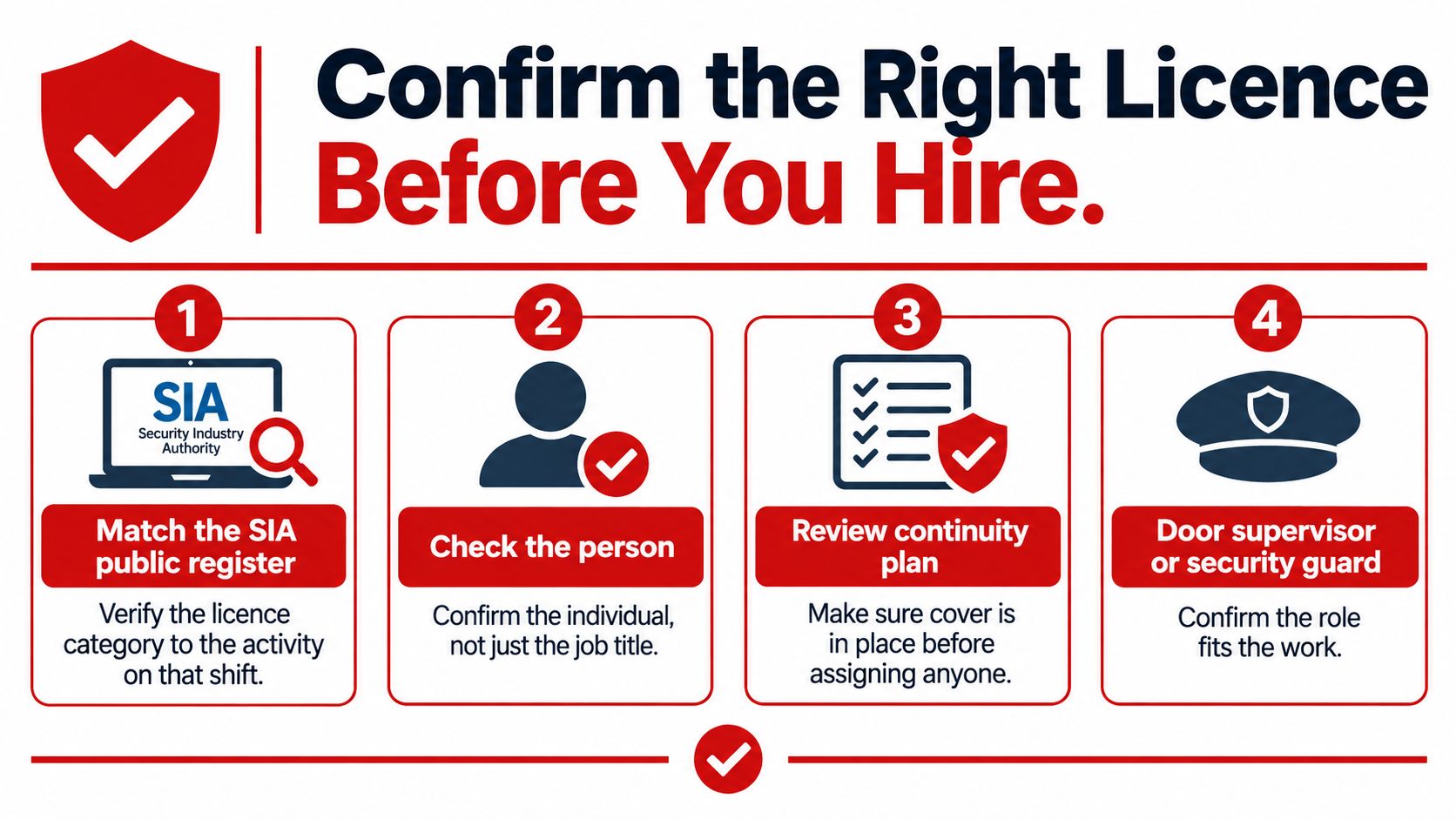
Choosing the right role is half the job. The other half is confirming that the person turning up holds it, and that someone else can turn up if they don't.
The compliance record shows where deployments fail. In 2025-26 the SIA recorded 2,164 licence suspensions and 8,286 revocations, with more than 94% of revocations resulting from holders no longer having the right to work in the UK. The same report records more than 155,000 paid licence applications, around 45,000 fewer than the previous year, partly because some applicants renewed early before the refresher requirement took effect, according to the SIA annual reports and accounts 2025 to 2026.
Read those figures for what they are. Continuity risk comes from documentation and renewal control, not from capability, and it arrives after you've already picked the right role.
The checks that protect continuity
Match the register entry to the shift activity. Door supervision for licensed premises, queues, searching and disorder. Security guarding for static access control and patrols. The register tells you the category; the rota tells you whether it fits.
Confirm the licence is live and in date, with an expiry that covers the whole booking rather than the first week of it.
Check the right to work, and ask how often the provider re-checks it rather than whether it was checked once at induction.
Confirm refresher training is recorded for anyone renewing, for both licence categories.
Check that officers have completed the required first-aid training and ask whether their qualifications remain current. First-aid certification is required before undertaking SIA licence-linked or refresher training.
Ask how sickness and no-shows are covered, specifically by backup officers holding the same licence type. A guard can't cover a door, so the bench has to be built per category.
Put hours, officer numbers, licence type and incident-reporting duties in the contract. Verbal assurances don't survive a change of account manager.
Solomon's Facilities Management provides SIA-licensed security guards, and every officer assigned to a site is briefed on that site's access procedures and incident protocols before their first shift.
Solomon's Facilities Management provides SIA-licensed security guards and door supervisors across London, alongside reception, concierge and other facilities management services. With 24/7 support and tailored security solutions, we can help you find suitable cover for your premises. Visit Solomon's Facilities Management to discuss your requirements.


Comments