
Retail Security Guard Duties, Licensing and Hiring Guide

A lot of retailers start thinking about guard cover at the same moment. It's usually not during a quiet Tuesday morning. It's when the queue is building, one member of staff is tied up at the till, high-value items are close to the entrance, and a customer interaction has started to turn sharp.
At that point, “we may need security” often means several different things at once. You might want someone visible near the door. You might want a calm pair of hands if tempers rise. You might want cleaner incident records, better closing procedures, or a stronger feeling of control on the shop floor.
That's where many first-time store operators get stuck. They picture a retail security guard as a person who stands near the entrance and stops shoplifters. In practice, the role is broader and more useful than that, but it also has clear legal limits and licensing rules that you need to understand before you hire anyone.
In the UK, that matters because retail crime pressure remains significant. The British Retail Consortium’s 2025 Retail Crime Survey reported more than 20 million theft incidents over the previous year — around 55,000 per day — with customer theft costing retailers approximately £2.2 billion. Violence and abuse against retail workers also exceeded 2,000 incidents per day, as summarised in Cobac Security's retail security overview.
A sensible retail guard plan starts with a simpler question. What changes on the shop floor when the right person is present, in the right place, with the right brief?
Table of Contents
Introduction What a Retail Security Guard Actually Changes on the Shop Floor - What changes in practical terms - Who this matters to
Understanding the Retail Security Guard Role and Core Duties - Duty one is visible deterrence - Duty two is customer-facing conduct - Duty three is incident response - What guards don't do
SIA Licensing and Legal Limits Every Retailer Should Know - Which licence usually applies in retail - Contracted and in-house are not the same thing - What powers a guard actually has
Shift Models and Peak Cover That Match Retail Risk - The main guard cover patterns - Choosing the Right Retail Guard Cover Model - What buyers often overlook
How to Hire and Specify a Retail Security Guard Service - Start with the operating brief - Vet the provider properly - Put service detail into the contract - Questions worth asking before signing
Where Guards Fit Alongside Technology Store Design and Training - When guards beat technology - When technology or design should come first
Next Steps for Retailers Planning Guard Cover - A practical brief for tomorrow morning
Introduction What a Retail Security Guard Actually Changes on the Shop Floor
The biggest change isn't always an arrest or a dramatic intervention. Most of the time, it's behaviour. Customers tend to settle into the store's rules more quickly when someone is clearly in charge of the entrance area. Staff feel less isolated when they know there's a named person dealing with tension, suspicious behaviour, and the first response to incidents.
That's why a retail security guard shouldn't be treated as a theft-only fix. In a working shop, the role sits across three areas at once. It supports deterrence, de-escalation, and customer experience.
What changes in practical terms
On a normal shift, a good guard helps shape the tone of the store before anything goes wrong. Their presence near the entrance, self-checkout area, fitting rooms, or a high-risk aisle can discourage opportunistic behaviour. They can also greet people, assist with directions, and make the store feel organised rather than hostile.
When a situation starts to drift, the guard becomes the first person to steady it. That might mean noticing someone repeatedly moving between aisles and exits, standing nearby while a refund dispute becomes heated, or separating a stressed colleague from a difficult exchange so the issue can cool down.
A guard often changes the outcome before there's an incident to report.
The point many operators miss is that prevention and reassurance are part of the job. The guard isn't there only for the worst five minutes of the day. They're there for the ordinary hours that decide whether the worst five minutes happen at all.
Who this matters to
This applies whether you run:
An independent shop with a small team and uneven busy periods
A multi-site retail estate where consistency matters across locations
A shopping centre or managed scheme where public-facing standards are as important as security response
You don't need a complex security background to make good decisions here. You need a clear view of what role you're buying, what that person can legally do, and when guarding is the right answer compared with cameras, layout changes, or extra staff training.
Understanding the Retail Security Guard Role and Core Duties
Think of a retail security guard as the store's visible anchor. Not because they do everything, but because they help hold the environment steady. Staff know where to turn. Customers know someone is watching the floor. Problems are noticed earlier.
Duty one is visible deterrence
Deterrence sounds abstract until you see it working. In retail, it usually comes down to presence and positioning. A guard standing in the wrong place can disappear into the background. A guard placed where customers enter, queue, browse high-value goods, or exit can change how people behave.
This isn't about staring people down. It's about being obviously available, alert, and hard to ignore.
A typical deterrence brief may include:
Entrance presence: Being seen as customers enter and leave
Floor circulation: Moving through known pressure points rather than staying static all day
Observation: Watching patterns, not just people. Repeated visits to one area, unusual bag behaviour, distraction tactics, and team movement matter
Closing support: Staying visible during lock-up, cashing down, and final checks
Duty two is customer-facing conduct
A retail security guard is still part of the customer experience. That's especially true in fashion, grocery, shopping centres, and mixed-use sites where the first person a customer notices may be the guard rather than a sales assistant.
Done properly, this part of the role is simple. Be approachable, be calm, and don't create friction where none is needed.
Good guards often help with:
Wayfinding: Directing customers to departments, tills, or exits
Queue calming: Standing near pressure points so staff aren't left alone when tempers rise
Tone setting: Making the store feel controlled without making it feel accused
Duty three is incident response
Expectations need to stay realistic. A guard's response begins long before physical intervention. It usually starts with observation, then a verbal approach, then de-escalation, then reporting and escalation if needed.
Practical rule: If you can't describe the guard's reporting duties, you haven't fully defined the role.
A proper incident response brief often includes:
Spot the issue early. The earlier a guard notices unusual behaviour, the more options the store has.
Approach calmly. A measured verbal presence can stop a situation hardening.
Protect staff first. The guard should reduce exposure for shop-floor staff, not increase it.
Record what happened. Time, location, people involved, action taken, and handover notes all matter.
What guards don't do
Confusion usually starts when retailers expect guards to act like police officers, store detectives, and customer-service managers all at once. That's not realistic.
A retail security guard doesn't solve weak staffing, poor stock placement, or confused store rules. They also shouldn't be used as a substitute for basic management decisions such as where expensive items sit, how returns are handled, or how lone working is controlled.
SIA Licensing and Legal Limits Every Retailer Should Know
Before you discuss shift patterns or uniforms, deal with the legal basics. In the UK, the regulatory framework for modern retail guarding rests on the Private Security Industry Act 2001, which received Royal Assent on 11 May 2001. The Security Industry Authority (SIA) was created to regulate the private security industry, and manned guarding became a licensable activity from 20 March 2006 under the legislation at the Private Security Industry Act 2001.
For retail sites, that matters because security guarding sits within that manned guarding framework. Working without the required licence is a criminal offence. So if you're using contract guards, licensing isn't a box-ticking exercise. It's the foundation.
Which licence usually applies in retail
A retail security guard in the UK will normally need a front-line Security Guard licence from the SIA when the role is a contracted service protecting premises or property against theft, damage, unauthorised access, or disorderly behaviour. The licence is valid for three years, and the application fee is £204 according to the regulated profession profile for security guards.
That detail affects operations in very practical ways. Contracted guarding roles need the right licence category. In-house employees usually fall outside that licensing requirement. So your workforce model changes compliance, onboarding speed, and the way the contract should be written.
If you want a simple business-side primer, this guide on what an SIA licence means for businesses is a useful place to start.
Contracted and in-house are not the same thing
First-time buyers often get caught out. They assume “security is security”. It isn't.
With contracted guarding, you need to verify that the individual and the role line up properly. With in-house staff, the legal position is different, but the operational questions remain. Who trains them, who supervises them, and what exactly are they expected to do on the shop floor?
Key legal takeaway: Don't assume a familiar face at the door equals compliant cover. The role, employer model, and licence category all need to match.
What powers a guard actually has
A retail security guard doesn't have police powers because they wear a uniform. Current UK commentary is actively debating whether licensed retail security staff should have a limited statutory detention power, but the present position matters more than the debate.
The Centre for Social Justice notes that guards currently have no powers beyond a citizen's arrest and cannot carry defensive equipment such as batons or incapacitant sprays. It also records a proposal that guards could detain suspects only until police arrive and only after immediate police notification, in a context where retail-worker violence remained 1,600 incidents per day, including 118 physical-violence incidents and 36 weapon-related incidents per day, with 53% of recorded shoplifting cases closed without a suspect identified in the cited discussion at the Centre for Social Justice report on high street crime.
That means your brief to the guard has to be lawful and proportionate. Observation, communication, de-escalation, witness evidence, staff protection, and rapid escalation are the core functions. Anything beyond that needs very careful handling.
Shift Models and Peak Cover That Match Retail Risk
Not every shop needs a guard all day, every day. Some do. Many don't. The better question is when human presence adds more value than cameras alone, and when a fixed post is better than flexible coverage.
Retail risk tends to bunch up. It often appears around opening, lunchtime, school finish, late trading, delivery windows, refund periods, promotions, and seasonal peaks. If your cover doesn't follow those pressure points, you can spend money without really improving control.
The main guard cover patterns
A static guard suits stores that need a reliable visible point at the entrance or on the floor for the whole trading period. It works well where there's constant public traffic, regular tension points, or a need for one person to become familiar with staff, repeat visitors, and store rhythm.
A peak-time shift works better where the risk comes in bursts. That might mean a late afternoon to close pattern, weekend-only support, or extra hours over high-pressure dates.
A flexible uplift model is useful for launches, sales, stock events, and holiday trade. In that setup, the guard plan changes with the retail calendar rather than staying fixed all year.
Where the building or estate is larger, mobile patrols and remote CCTV support can complement on-site guards. If you're weighing those options, this comparison of static guards and mobile patrols for London sites helps frame the trade-off.
Choosing the Right Retail Guard Cover Model
Store Profile and Risk | Recommended Cover Model | Why It Fits |
|---|---|---|
Small high street shop with short busy spikes and limited staff | Peak-time guard cover | Matches the periods when staff are stretched and visibility matters most |
Fashion or convenience store with steady public flow and repeated low-level issues | Static on-site guard during trading hours | Creates a dependable visible presence and supports staff throughout the day |
Store with seasonal rushes, launches, or heavy promotion days | Flexible uplift around key dates | Adds cover when footfall, tension, and stock risk rise together |
Multi-unit retail parade or estate with quieter periods between hotspots | Mobile patrol plus remote monitoring | Spreads coverage efficiently across several points rather than fixing one post all day |
Site with public-facing entrance pressure and out-of-hours concerns | On-site trading cover plus lock/unlock support | Combines daytime presence with stronger opening and closing control |
What buyers often overlook
Continuity matters. The same team learns your problem customers, awkward blind spots, weak handover points, and the moments when staff need support most. Constantly changing personnel make incident patterns harder to spot and customer experience harder to manage.
Logging matters too. A guard should hand over clearly, note what happened, and flag what needs attention on the next shift. Without that, every day starts from scratch.
If you only buy hours, you may get presence. If you buy the right model, you get continuity, judgement, and cleaner control of the site.
How to Hire and Specify a Retail Security Guard Service
Most hiring problems start with a vague brief. “We need a guard” sounds clear, but it leaves too much unanswered. Cover for what hours? Positioned where? Dealing with which situations? Reporting to whom? Expected to act like a concierge, a deterrent, or both?
A better approach is to write the role as if the guard were joining your own store team tomorrow morning.
Start with the operating brief
Set out the basics in plain English.
Include:
Hours and days: Trading cover, peak-only cover, weekends, late nights, or lock-up support
Post locations: Entrance, self-checkout, sales floor, stock transition points, or shared mall areas
Expected conduct: Visible, approachable, calm, and aligned with brand standards
Incident handling: Observation, verbal de-escalation, staff support, reporting, and escalation routes
It helps to describe one normal day and one bad day. That makes the provider respond to your actual operation, not a generic security template.
Vet the provider properly
Ask direct questions and expect direct answers.
A sound screening list includes:
Licensing: Are all deployed guards SIA-licensed for the role?
Coverage model: Who supplies absence cover, and how quickly?
Supervision: Who checks standards once the guard is deployed?
Reporting: Will you receive digital patrol or incident reports?
Local reach: Can they support your part of London consistently?
One option in this market is Solomon's Facilities Management, which provides integrated security and facilities services in Central, East, and North London, including SIA-licensed guarding, incident logging, digital patrol reports, and continuity through dedicated site teams. If you're comparing providers, this practical guide on how to hire a security guard in London is a useful checklist.
Put service detail into the contract
A contract should describe the job clearly enough that a store manager and a guard supervisor would interpret it the same way.
Focus on specifics such as:
Attendance expectations: Start times, relief arrangements, dress code, and post instructions
Escalation lines: Who gets called first when there's violence, suspected theft, or a welfare issue
Evidence handling: Incident logs, CCTV coordination, witness notes, and handover records
Performance routines: Site reviews, issue tracking, and service adjustments around peak periods
The cleaner the brief, the better the deployment. Guards can only deliver consistently when the site's expectations are written down.
Questions worth asking before signing
Who writes the assignment instructions?
How do you replace a guard who isn't the right fit for our shop floor?
What does your handover reporting look like?
How do you balance deterrence with customer service?
Can the same team stay on this site where possible?
Those questions usually tell you more than a polished sales presentation.
Where Guards Fit Alongside Technology Store Design and Training
A guard can improve a shop floor quickly, but a guard on their own won't fix every retail security problem. If the entrance is poorly sighted, the highest-risk stock sits by the door, staff have no de-escalation routine, and CCTV isn't monitored properly, the guard ends up carrying too much of the plan.
That's why the smarter view is to use guarding as one part of a broader control system.
When guards beat technology
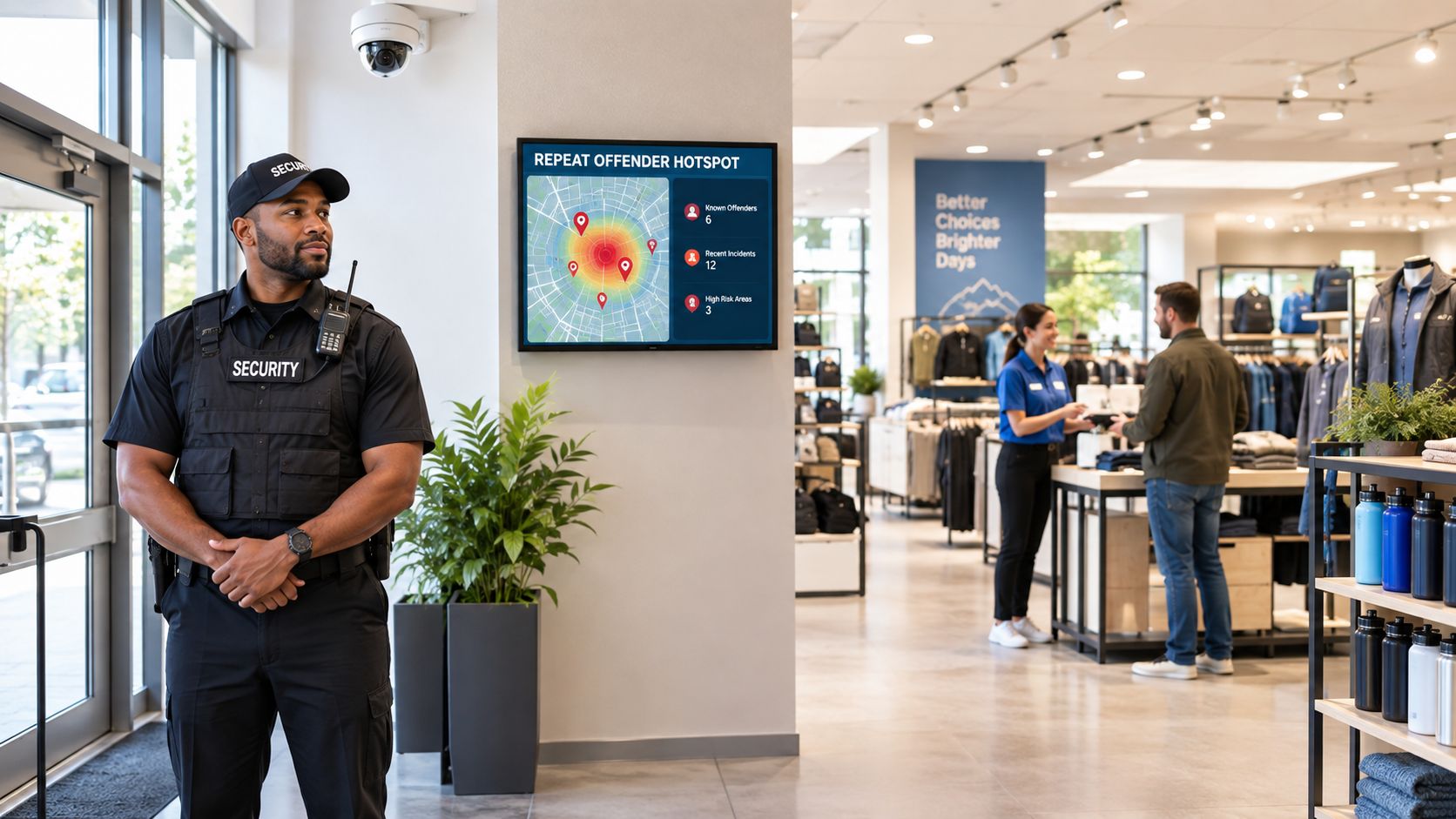
Human presence usually wins where the problem involves judgement. A camera can record an argument. A guard can step in early, lower the temperature, and move staff out of a bad interaction. A monitored system can alert you after a pattern appears. A guard can spot that pattern developing in real time.
That's especially relevant where repeat offending and violence cluster unevenly. A recent BBC report noted that police recorded shoplifting in England and Wales was 502,011 in 2025/26, while the same reporting referenced 5.5 million shoplifting incidents detected by retailers and an estimated £400 million cost in the latest BRC-linked figures. It also highlighted strong regional variation, with Cleveland at 15.9 shoplifting incidents per 1,000 people, compared with an England and Wales average of 8.1, and Northumbria recording nearly 18,000 offences in 2025/26, up almost 90% over a decade, in the BBC's reporting on shoplifting hotspots and retail crime.
That kind of variation matters. Some stores need targeted guard positioning around known repeat-offender patterns. Others may gain more from changing layout, moving stock, or improving floor supervision.
When technology or design should come first
Technology and layout often deserve attention first when:
Blind spots are the issue: Camera placement or shelving design may be weakening oversight
The same aisle keeps producing incidents: Product moves and sightline changes can reduce opportunity
Staff freeze during conflict: De-escalation training may improve outcomes more than extra guard hours
Out-of-hours risk is the concern: Remote CCTV, alarms, and lock procedures may be the better tool
A simple example. A high street store may discover that incidents keep starting near a promotional display by the entrance, then spilling towards self-checkout. Moving that display, improving sightlines, and repositioning the guard can do more than leaving the guard planted at the door all shift.
A guard is most effective when the store has already made it easy to see, report, and respond.
Next Steps for Retailers Planning Guard Cover
If you're planning retail guard cover for the first time, keep the decision grounded in three tests.
First, is the model compliant. If you're using contract guards, the licensing position has to be correct. Second, does the role suit your customer environment. A guard should make the store feel calmer and more controlled, not tense or over-policed. Third, is the cover proportionate to the actual risk. Some shops need full trading-hour presence. Others need focused peak-time support or a wider mix of guarding, CCTV, and layout changes.
A practical brief for tomorrow morning
Start by writing down:
Your busiest periods: Not just opening hours, but the moments when staff are stretched
Your pressure points: Entrance, self-checkout, refund desk, fitting rooms, or exit route
Your incident types: Suspicious behaviour, aggressive customers, repeat visits, closing-time concerns
Your preferred tone: Firm, visible, helpful, and customer-aware
Your reporting needs: What the guard must record and who receives it
Then ask providers to respond to that real operating picture, not to a generic “security guard required” request.
For retailers in Central, East, or North London, it also makes sense to look at the wider facilities picture. If your site needs guarding, CCTV coordination, reception support, lock and unlock, or incident escalation under one roof, a consolidated service model can reduce confusion and make accountability much clearer.
The aim isn't to buy the most security. It's to buy the right control, in the right format, with clear legal boundaries and a guard team that can work properly with your staff.
If you're reviewing guard cover for a shop, shopping parade, or managed retail site in London, Solomon's can provide SIA-licensed guarding, mobile patrols, CCTV support, incident logging, and coordinated facilities cover under one contract. That suits retailers who want a practical service model rather than separate suppliers for each part of the site. You can see the full service scope at Solomon's Facilities Management.

Comments