
Event Security Plan: A Practical Guide for Organisers

Your venue is booked, tickets are moving and the security contractor has sent a staffing proposal. But the venue manager expects your team to stop admissions, your team expects the venue to make that call, and nobody has agreed who speaks to the crowd if the entrance becomes congested.
That's the gap a useful event security plan closes. It turns assumptions into named responsibilities, site-specific instructions and procedures your team can carry out.
Table of Contents
What Your Event Security Plan Must Cover - Event security plan components and owners - Why the controls belong together
Classify the Event and Assess Risk First - Establish the legal scope - Assess the actual site
Access Control, Staffing and Crowd Capacity - Build entry around the slowest task - Staff posts, not a blanket ratio
Emergency Procedures, Evacuation and Police Liaison - Put decisions in operational order
Test the Plan, Review It and Sign Off - Test decisions before testing movement - Close findings before approval - Make the review change the next event
What Your Event Security Plan Must Cover
A UK event security plan should contain nine documented components, each with a named owner. Use the table as a working reference, then replace every role title with the responsible person's name and deputy before handover.
Event security plan components and owners
Plan component | What it documents | Named owner |
|---|---|---|
Event profile | Expected peak attendance, audience type and event format | Event manager |
Capacity and entry | Maximum occupancy, ticketing, entry points and queue layouts | Venue and event management |
Search and screening | Search policy, bag rules, prohibited items and screening points | Security lead |
Officer and steward deployment | Posts, numbers by zone, briefing dates and relief breaks | Security lead |
Restricted areas and CCTV | Backstage, VIP and vehicle zones, camera coverage and radio channels | Security lead |
Emergency routes and medical | Evacuation routes, assembly points, first aid and ambulance access | Venue operations |
Escalation and command | Triggers for evacuation or lockdown and the decision authority | Named incident lead |
Police and agency liaison | Contacts, notification thresholds and a shared site plan | Event manager |
Contractors | Licence checks, insurance certificates and briefing records | Event manager |
A row isn't complete because someone has discussed it. It needs a written procedure, drawing, schedule or record, plus someone accountable for keeping it accurate. Where ownership is shared, nominate a lead so an urgent decision doesn't wait for agreement between departments.
Keep the operational documents together under version control. A master site drawing should use the same gate names, zone labels and assembly points as the radio briefing and post instructions.
Why the controls belong together
The Sports Grounds Safety Authority's legislation overview explains that the Safety of Sports Grounds Act 1975 followed the Ibrox disaster of January 1971, in which 66 people died, while the Fire Safety and Safety of Places of Sport Act 1987 followed the Bradford City fire of 11 May 1985, which killed 56 people.
The practical lesson isn't that every exhibition or corporate reception falls under sports-ground certification. It's that organisers must coordinate capacity, entry, evacuation, fire precautions, stewarding and liaison rather than manage them as unrelated tasks.
For example, moving a search lane may improve entry speed but obstruct an emergency route. The security lead and venue operations manager must resolve that conflict on the same drawing before barriers arrive.
Handover test: Could a replacement manager find the current instructions, identify the decision-maker and run the event without relying on someone's memory?
Classify the Event and Assess Risk First
Start with expected peak attendance, not total ticket sales across the event. Record who may be present together, whether the public can attend, and whether tickets, wristbands or another check control entry.
Don't assume that an attendance band alone settles the legal classification. Establish the event's relationship to the premises, its public accessibility and the applicable exclusions before recording your conclusion.
Establish the legal scope
The Terrorism (Protection of Premises) Act 2025, commonly known as Martyn's Law, introduces requirements for certain public premises and events. The government's guidance on Martyn's Law and the SIA's regulatory role explains the framework and its implementation.
The legislation distinguishes between qualifying premises and qualifying events. Standard-tier premises generally have an attendance threshold of 200–799 people, while qualifying events generally require 800 or more people reasonably expected to be present at the same time, alongside other statutory conditions.
lely because of attendance. | ||
|---|---|---|
Under 200 | Generally outside the Act's premises attendance threshold; standalone events below 800 do not qualify | Continue proportionate risk assessments, emergency planning and compliance with applicable fire safety, licensing and other legal requirements. |
Attendance alone does not determine whether Martyn's Law applies. Organisers must also consider the type and use of premises, public access, entry arrangements and any statutory exclusions. The legislation also treats certain premisWhat organisers should consider differently.
Use a classification sheet to record your reasoning, assumptions and review owner. Revisit it if the event layout or attendance forecast changes.
Assess the actual site
The Health and Safety Executive's crowd-risk guidance expects organisers to identify crowd hazards, assess risks and plan crowd management alongside effective emergency arrangements.
Map movement: Mark ingress, egress, queues, backstage routes and vehicle interfaces. Include neighbouring entrances and pedestrian routes outside your boundary.
Identify credible problems: Examine narrowing routes, crowd surges, suspicious items, fire, severe weather, transport disruption and demonstrations.
Allocate decisions: Give each zone an operational owner and define which decisions they can take without waiting for central approval.
A generic risk assessment might identify overcrowding but still leave a supervisor unsure when to close a gate. Convert each significant risk into an action, a trigger and an owner.
Access Control, Staffing and Crowd Capacity
Notting Hill Carnival attracted around 2 million visitors in 2024, according to the London Assembly. That describes attendance at a major public event, not simultaneous occupancy within a controlled venue, but it illustrates why organisers must plan how they'll understand crowd movement.
Start with the venue's capacity information and the risk assessment. Agree the operating limit for the proposed layout, including any areas lost to staging, production equipment, hospitality furniture or temporary barriers.
Build entry around the slowest task
Ticket scanning, accreditation queries and searches take different amounts of time. Adding scanners won't solve a queue caused by insufficient search space.
Say a London conference uses a shared office reception. A guest with a valid ticket but missing accreditation shouldn't hold up the main admission route while reception searches an email inbox. Provide a separate resolution position that doesn't obstruct the accessible entrance.
For venues coordinating reception systems with security, Purple Access's visitor check-in guide for venue IT teams is a useful reference when discussing that interface. Keep a workable fallback for connectivity or device failure, and assign someone to reconcile manual entries.
Don't confuse a checked ticket with a complete occupancy count. Re-entry, staff movements and alternative doors need explicit counting rules.
Place queue barriers so they don't force pedestrians into the road or cover exits. Our guidance on crowd management at events provides further context for planning flow around the entrance.
Staff posts, not a blanket ratio
Build deployment from tasks and sightlines: screening positions, restricted doors, crowd observation, roaming response and control-room duties. A roaming officer can't provide reliable fixed-post cover while also investigating incidents elsewhere.
Verify suitability: Check the appropriate SIA licence wherever the role legally requires it, and retain contractor due-diligence records.
Protect continuity: Schedule relief so essential posts remain covered during breaks.
Confirm live conditions: Track occupancy, queue length at each entrance and officers present in each zone.
Emergency Procedures, Evacuation and Police Liaison
An emergency procedure must tell the incident lead what to decide and tell everyone else what to do. Separate immediate protective action from decisions that require consultation.
Use the command post to keep maps, communications and incident records together.
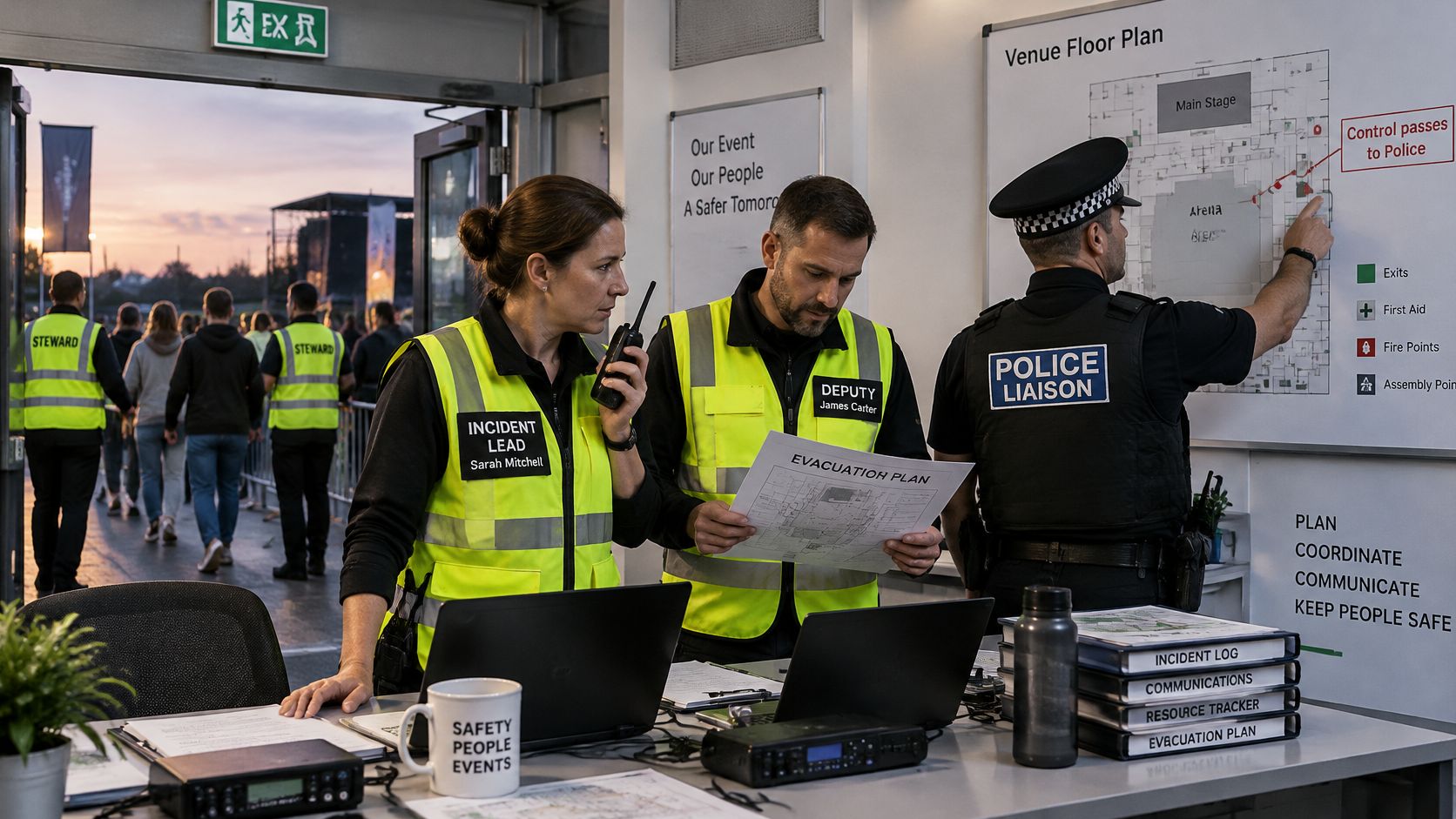
Put decisions in operational order
Name command: Appoint an incident lead and deputy. Agree liaison and handover arrangements with responding services, without assuming the organiser's responsibilities disappear on their arrival.
Set triggers: Define responses to crowd pressure, suspicious items, fire, severe weather, medical emergencies and transport disruption. Give staff authority to report developing danger immediately.
Choose the protective action: Specify evacuation routes and assembly points, invacuation into suitable buildings, lockdown arrangements and shelter-in-place locations. Don't send people towards an external threat because evacuation is the most familiar procedure.
Prepare messages: Allocate radio channels, plain-language reports, public-address wording and a fallback if the main system fails. Include arrangements for people who may not hear or understand announcements.
Protect medical access: Mark first-aid points, ambulance approaches and rendezvous locations. Assign staff to guide responders without abandoning essential crowd-control positions.
Connect the agencies: Record police and emergency-service contacts, notification thresholds Name command: Appoint an incident lead and deputy. Agree liaison and handover arrangements with responding services, without assuming the organiser's responsibilities disappear on their arrival.Set triggers: Define responses to crowd pressure, suspicious items, fire, severe weather, medical emergencies and transport disruption. Give staff authority to report developing danger immediately.Choose the protective action: Specify evacuation routes and assembly points, invacuation into suitable buildings, lockdown arrangements and shelter-in-place locations. Don't send people towards an external threat because evacuation is the most familiar procedure.Prepare messages: Allocate radio channels, plain-language reports, public-address wording and a fallback if the main system fails. Include arrangements for people who may not hear or understand announcements.Protect medical access: Mark first-aid points, ambulance approaches and rendezvous locations. Assign staff to guide responders without abandoning essential crowd-control positions.Connect the agencies: Record police and emergency-service contacts, notification thresholds and the shared site map. Never delay an urgent emergency call while searching for a routine liaison contact.Monitor and record: Give CCTV operators a direct escalation route. Record the time, location, information received, decision-maker and action taken.Use the video as a briefing prompt, then ask supervisors to explain how your own site arrangements would operate.Keep incident response procedures aligned with the venue's arrangements. Leave a printed command chain and contact sheet at the control point.Test the Plan, Review It and Sign OffA signature doesn't demonstrate that a procedure works. Staff demonstrate that by recognising a problem, making the right decision and completing the required action under realistic constraints.peat test. Don't close an action merely because someone acknowledged it.
Check readiness: Confirm the classification sheet, named command team, agency contacts, contractor insurance, applicable licence checks and completed briefings.
Approve the current version: Have the authorised incident lead and deputy confirm readiness against the actual site arrangements.
Use security personnel training to address specific weaknesses exposed by testing. Repeating the same briefing won't resolve a procedure that staff cannot physically carry out.
Our security proposal specifies cover hours, officer numbers and service scope. Paul Enninful, our Corporate Security Consultant, advises clients from risk assessment through to the appropriate mix of guarding, patrols and monitoring for each site.
Make the review change the next event
Set a prompt post-event review date before the team disperses. Compare the incident log, actual attendance, observed queues and response records against the assumptions used for planning.
Date each amendment and explain what changed. Sign-off authorises the current arrangements, but the organiser must still reassess them when conditions change and carry useful findings into the next event.
Planning security for an upcoming event? Solomons Facilities Management can discuss your requirements, including crowd management, access control and securitRecord any deficiencies in an action register and assign responsibility for resolving them.rity arrangements and request a tailored quotation.

Comments