
Janitorial Services in London: What's Included and Why Businesses Need Them

Nearly 46% of cleaning sector turnover comes from facilities management contracts, which shows that janitorial work is usually part of a wider operational service rather than a standalone cleaning task. A useful janitorial services description therefore needs to define cleaning, replenishment, reporting, escalation and accountability in the same document.
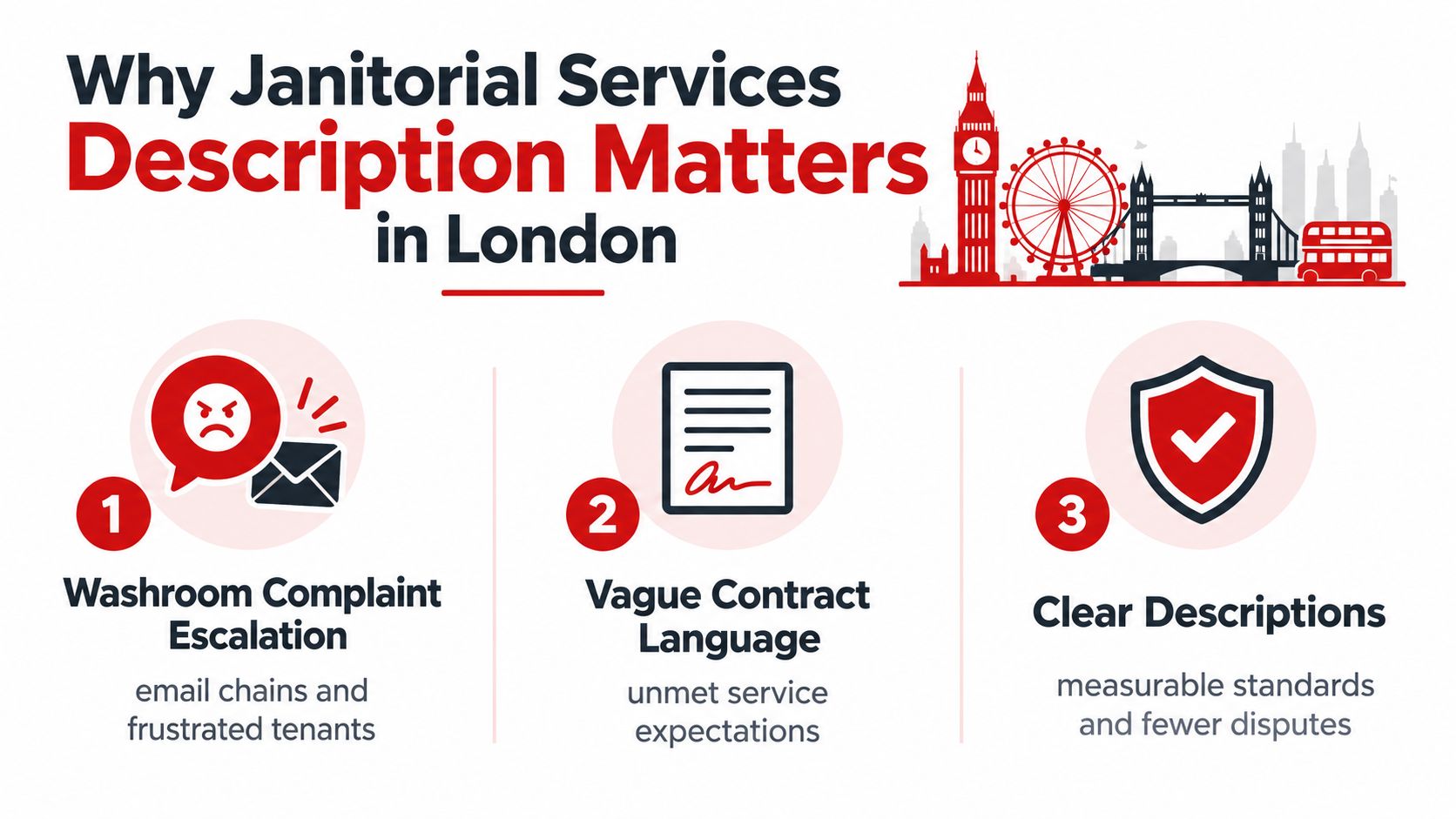
What happens when a tenant reports an unpleasant washroom, an overflowing recycling point and missing hand towels, but nobody can say who was responsible for checking the area? In many London buildings, the complaint doesn't expose a single missed task. It exposes a weak service description.
A list of duties such as “daily cleaning” or “washroom maintenance” sounds professional, but it gives the client and contractor very little to measure. It doesn't define which rooms are included, what “clean” means, how often an inspection takes place, or what happens when a cleaner finds a blocked basin or a persistent odour.
Table of Contents
Why Janitorial Services Description Matters in London - The scale behind the service - Hygiene affects confidence
What a Professional Janitorial Services Description Covers - Washrooms and consumables - Waste and shared areas - Records and escalation
Scheduling, Standards and Compliance Expectations - Use risk-based room zoning - Turn expectations into service levels
Daytime Versus Out-of-Hours Janitorial Cover - When daytime cover works better - Where out-of-hours cleaning still fits
How Janitorial Services Integrate With Broader Facilities Management - One building, connected responsibilities - Reporting makes integration real
How to Write a Strong Janitorial Services Description - Start with the building, not the cleaner - Remove subjective promises
Why Janitorial Services Description Matter in London
A tenant in a multi-tenant office may not distinguish between the cleaner, facilities manager, reception team or maintenance contractor. They see one building experience. If a washroom is dirty, a bin is full or soap has run out, the complaint usually reaches the property manager, regardless of which supplier owns the task.
That is why vague contract language can cause operational friction. A provider may believe the team has completed the agreed routine, while the client believes the building has been neglected. Without room schedules, inspection requirements and escalation rules, both sides rely on opinion after the complaint has already arrived.
The scale behind the service
The UK cleaning, hygiene and waste sector is valued at almost £72bn, up from £67.7bn in 2022, and employed about 1.51 million people in 2025, roughly 5% of the UK workforce, according to the British Cleaning Council industry report. Those figures place janitorial work inside a substantial service ecosystem. It supports the everyday operation of offices, residential buildings, retail premises and shared-use sites.
The same report records 78,915 businesses operating in 2025, compared with 77,535 in 2024. Facilities management accounts for nearly 46% of turnover across the UK's cleaning, hygiene and waste industry, according to the British Cleaning Council. This highlights the importance of integrated building services, where janitorial work can form part of a wider facilities management arrangement. A clear janitorial services description should therefore define cleaning responsibilities, replenishment, reporting, escalation and accountability.
Nearly five out of six businesses are micro businesses with fewer than 10 employees, the report states. That fragmented market makes supervision, continuity and contract clarity important differentiators. A buyer isn't only choosing someone to wipe surfaces. They're choosing a system for making sure the work happens consistently, is checked properly and is connected to the rest of the building operation.
Hygiene affects confidence
Workplace hygiene also has a direct relationship with how people experience a building. In UK research involving 1,012 employees, 46% said an unhygienic workplace was a key factor in making them ill, and the same share reported at least one day off sick in the previous year. The estimated cost to UK employers was £1.56bn, as reported by Elite Business Magazine's workplace hygiene coverage.
The operational lesson isn't that a janitorial contractor controls every absence. It is that washroom hygiene, waste removal, surface cleaning and replenishment are visible controls that influence complaints, confidence and the perceived quality of the premises. A strong description makes those controls clear enough for a property manager to inspect and discuss without argument.
What a Professional Janitorial Services Description Covers
A professional scope describes the building as a set of zones, routines and response obligations. Start with the areas people use most heavily, then define the work required in each area instead of applying one phrase to the whole property.
Washrooms and consumables
Washroom servicing should identify toilets, basins, taps, flush handles, door plates and other high-contact points. The description should state how cleaners move through the room, which tools are dedicated to washrooms and how cloths are segregated from those used in lower-risk areas.
Replenishment must be a defined task. Soap, sanitiser, toilet paper and hand-drying products should be checked and topped up before they run low. Sanitary waste should be removed discreetly and on schedule, with a clear route for reporting full units, leaks, blockages or persistent odours. Guidance on workplace washroom hygiene and replenishment supports this performance-based approach and notes that inspection frequency should reflect occupancy and traffic rather than a universal rule.
Waste and shared areas
Waste handling needs more detail than “empty bins”. A useful scope identifies general refuse, recycling, food waste where relevant and bulky waste, then connects collection frequency to bin capacity and building use. It may also explain what happens when a cleaner finds a contaminated bin, an abandoned item or waste that requires a separate contractor.
Surface cleaning should cover the places that shape daily experience, including workstations, meeting rooms, kitchens, entrances, lifts and communal areas. A café or hospitality setting may need a more specialised programme, particularly where food contact surfaces and preparation areas require controlled methods. A useful reference for that distinction is these food-safe café cleaning programmes.
Records and escalation
The description should connect routine tasks to evidence. Define inspection rounds, consumable checks, missed-task reporting and escalation for maintenance issues. A cleaner may discover a blocked sink, damaged dispenser or leaking toilet, but the janitorial contract should state who receives the report and how the issue is tracked.
For office environments, it also helps to compare the scope against a practical office cleaning inclusion guide. The point isn't to create a longer checklist. It's to make each requirement observable, assignable and capable of being audited.
Scheduling, Standards and Compliance Expectations
A workable schedule reflects how a building is used, not just the number of times a task appears on a calendar.
Use risk-based room zoning
UK healthcare guidance offers a useful operational model even when the building isn't a clinical environment. The National Standards of Healthcare Cleanliness 2025 describes top-to-bottom and clean-to-dirty cleaning, damp cloths or dusting devices to avoid aerosolising dust, floors cleaned last and wet-floor signage left in place until surfaces are dry.
The guidance also places bathrooms, washrooms, toilets and bathroom floors in a separate red category. For a commercial janitorial specification, the practical translation is dedicated washroom tools, room zoning, cloth segregation and a workflow that prevents contamination being carried into lower-risk areas.
Turn expectations into service levels
A contract should define inspection triggers and response obligations. Examples include:
Inspection rounds: Record which zones are checked, when checks occur and who signs them off.
Consumable thresholds: Replenish soap, paper products and sanitiser before the agreed minimum level is reached.
Defect escalation: Report blocked fixtures, leaks, odours, damaged dispensers and unsafe conditions through a named route.
Quality verification: Use documented inspections, defect records and review meetings rather than relying only on visual impressions.
Schedule review: Adjust routines when occupancy, tenant use or the building layout changes.
The right schedule may include daytime checks, planned deep cleaning and reactive attendance. It shouldn't promise a fixed interval just because that wording appears in another contract. A clear commercial cleaning contract framework can help clients test whether the scope defines responsibilities, standards and review arrangements in enough detail.
A compliance-ready description doesn't promise perfection. It defines how the team identifies a failure, records it and puts it right.
Daytime Versus Out-of-Hours Janitorial Cover
The timing of cleaning changes the service experience. Overnight work keeps cleaners out of the way, but it can leave a washroom, kitchen or entrance unchecked for the entire working day. Daytime cover makes hygiene visible and allows staff to respond while tenants and visitors are still in the building.
UK office occupancy stabilised above 40%, reaching 44.1% in January 2026, according to IBISWorld's UK general building cleaning coverage. The same source describes increased appetite for daytime cleaning and movement away from some night-shift models. That matters for hybrid offices because the building may have uneven use throughout the day rather than one predictable morning-to-evening pattern.
When daytime cover works better
Daytime service is particularly useful where tenants share washrooms, kitchens, entrances and meeting areas. Cleaners can remove a spill shortly after it occurs, replenish products before a visitor notices they're missing and report a maintenance problem while the facilities team is available.
It also gives occupants visible reassurance. A cleaner present in a lobby or communal area signals that the building is being maintained rather than inspected only after complaints arrive. The trade-off is disruption, so the specification should identify quiet methods, suitable timings for busy zones and communication rules around wet floors or temporarily restricted areas.
Where out-of-hours cleaning still fits
Out-of-hours work remains practical for tasks that create noise, require more space or interfere with normal use. Carpet care, floor treatment, detailed kitchen cleaning and certain deep-clean activities may be easier when offices are empty.
The strongest model is often layered rather than absolute. A building might use daytime janitorial presence for washrooms, waste and high-contact areas, then schedule more disruptive work outside occupancy. The description should state which activities happen in each window, who handles urgent daytime issues and how the provider hands over unresolved work at the end of a shift.
How Janitorial Services Integrate With Broader Facilities Management
Janitorial work rarely stops at the boundary of cleaning. A full bin affects the appearance of reception, a blocked basin becomes a maintenance issue and a spill near an entrance creates a safety concern. If each supplier treats those events as somebody else's problem, the property manager ends up coordinating the gaps.
An integrated model gives the janitorial team defined reporting lines into the wider operation. The cleaner identifies the issue, records the location and condition, then routes it to the appropriate person. Reception can manage the tenant communication, maintenance can resolve the defect, security can control access if there is a hazard, and management can review whether the incident signals a recurring problem.
One building, connected responsibilities
Facilities management contracts commonly combine cleaning with security, reception, waste and maintenance. That structure matches the industry pattern described earlier, where nearly 46% of sector turnover comes from FM contracts, but the practical benefit is accountability rather than consolidation for its own sake.
A useful operating arrangement might look like this:
Janitorial team: Complete hygiene routines, check consumables and record defects.
Reception or concierge: Receive tenant concerns and communicate temporary access restrictions.
Maintenance team: Resolve plumbing, electrical, fixture and fabric issues.
Security team: Support controlled access, incident response and safe movement through affected areas.
Facilities manager: Review records, challenge missed standards and coordinate supplier performance.
Reporting makes integration real
Integration fails when it exists only in the organisation chart. The service description should specify shared logs, named contacts, escalation routes and review responsibilities. A washroom defect should not disappear into a verbal handover. It needs a record that shows what was found, who owns the next action and whether the issue was closed.
Sustainability also belongs in the operational conversation. Waste segregation, product selection, controlled chemical use and consumables management can be built into the same workflow. For broader context on green cleaning benefits for facilities, procurement teams can review how environmental objectives connect with everyday cleaning decisions.
A connected facilities management model is most useful when it gives the client one accountable route for service questions while preserving clear ownership of specialist tasks.
How to Write a Strong Janitorial Services Description
Write the document as though someone will use it during a complaint, inspection or supplier review. The reader should be able to identify the area, task, standard, timing, evidence and escalation route without interpreting broad language.
Start with the building, not the cleaner
Map the site into zones first. Separate washrooms, kitchens, entrances, lifts, offices, meeting rooms, storage areas and external points where relevant. Mark higher-risk or higher-traffic spaces so the schedule can reflect actual use rather than applying the same routine everywhere.
Then define each service in operational terms:
Name the task: State whether the requirement is cleaning, inspection, replenishment, collection or reporting.
Set the trigger: Use occupancy, visible condition, stock threshold, inspection round or incident type.
Assign the owner: Identify the janitorial team, supervisor, facilities manager or maintenance contact.
Record the evidence: Specify checklists, digital logs, defect reports, photographs where appropriate or review records.
Define escalation: Explain what happens with a blockage, odour, spill, missed visit, damaged fixture or safety concern.
Review the result: Set a reporting cadence and a process for adjusting the scope when building use changes.
Remove subjective promises
Words such as “spotless”, “thorough” and “regular” can support a marketing page, but they don't protect either party in a contract. Replace them with visible standards, inspection points and response requirements. If the client wants a washroom checked during occupied hours, say so. If the provider must top up consumables before a minimum level, define that level in the service schedule.
The description should also show how janitorial work connects with waste, maintenance, reception and compliance records. That makes tenant complaints easier to investigate and prevents the contractor from being judged against expectations that were never written down.
Before signing, walk the document through the building with the provider. Test it against a full bin, an empty soap dispenser, a blocked toilet, a wet entrance and a missed inspection. If the parties can't agree what should happen in those situations, the scope still needs work.
Solomon's Facilities Management provides janitorial services for washrooms, waste handling, replenishment and hygiene routines as part of integrated cleaning, security, reception and concierge support across London. Visit Solomon's Facilities Management to discuss a contract-ready service scope aligned with your building, occupancy pattern and wider FM requirements.

Comments