
Personal Concierge Service: Tasks, Tiers and Costs

A courier is waiting at the lobby desk, a resident wants a spare key released to a cleaner, and an office tenant has asked someone to arrange a client lunch. Your receptionist can probably handle each request. The question is whether they should, who authorises the work, and what happens to the entrance while they're doing it.
That's where a personal concierge service needs a proper specification. Buy it as a vague promise of helpfulness and you'll get disputed invoices and inconsistent decisions. Scope it like an FM service and you can see what the desk handles, what it costs and whether it's worth keeping.
Table of Contents
What a Personal Concierge Service Is and Who Uses It - The boundaries at the desk - Who buys the service
Service Levels for Residential and Corporate Buildings - Residential and corporate priorities - Where shared lobbies become difficult
Pricing Models and What a Typical Bill Looks Like - The cost lines buyers miss - Compare the same basket of work
How a Concierge Request Moves From Call to Close - The working procedure - Make the handover survive a shift change
What Landlords and Occupiers Gain, With Two Examples - Illustrative residential example - Illustrative corporate example
How Integrated FM Providers Keep Front-of-House Consistent - Measure the experience and the controls - Coordination must preserve security responsibility
Confirm the Scope, Data Rules and Exit Terms Before You Sign - Answers worth accepting
What a Personal Concierge Service Is and Who Uses It
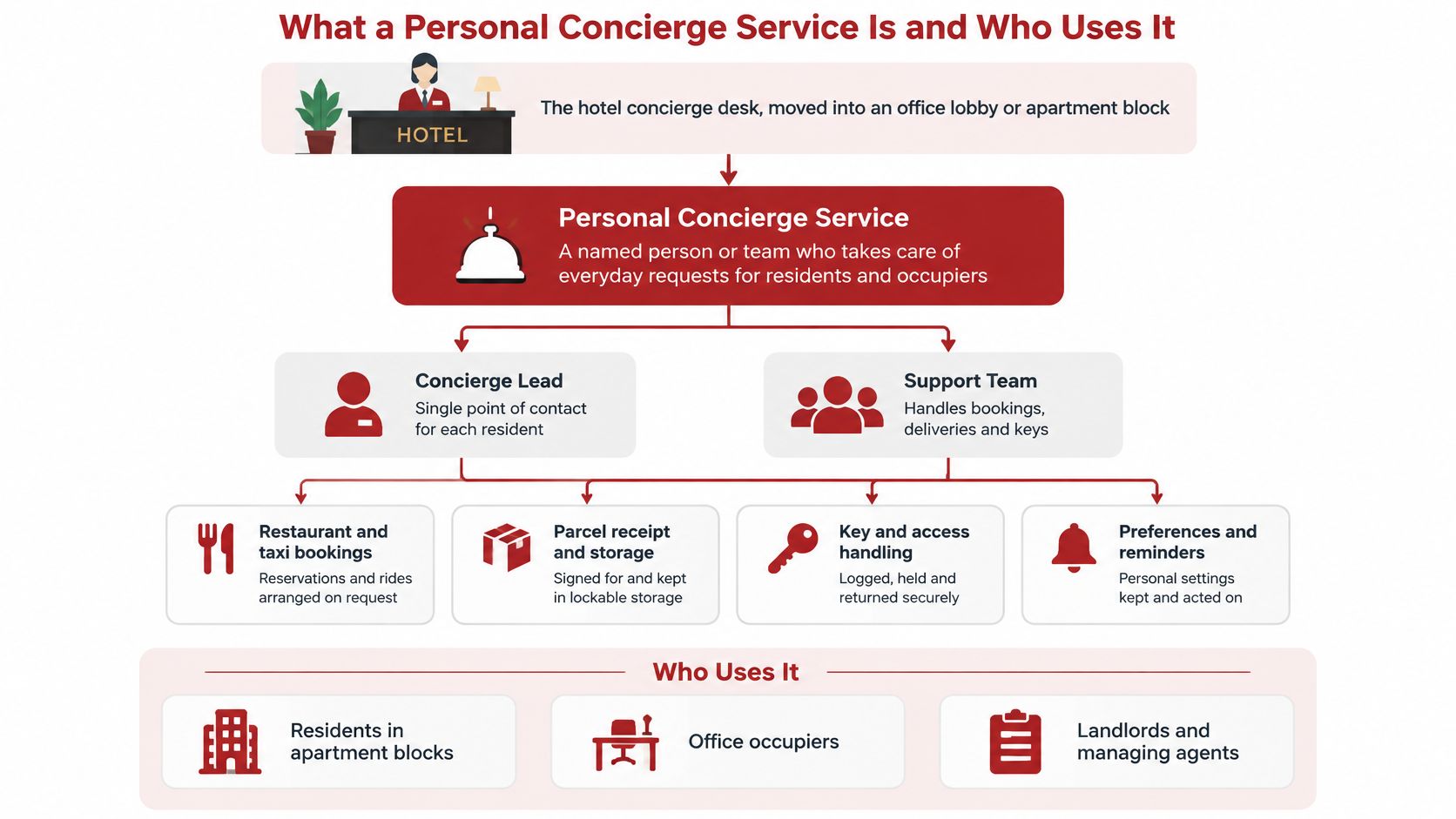
Think of the hotel concierge who books restaurants and taxis, moved into an office lobby or apartment block. A personal concierge service is a named person or team who takes requests from residents or occupiers, then handles them directly or arranges an approved supplier.
The title matters less than the authority behind it. Someone who can accept a parcel doesn't automatically have permission to release a flat key, spend a tenant's money or change an executive's flight.
The boundaries at the desk
Separate the work into distinct layers before asking for quotations.
Reception greets people, answers calls and logs visitors.
Building concierge handles resident or tenant enquiries, parcels, authorised key transactions and contractor coordination.
Personal concierge adds requests about someone's day, such as couriers, restaurant tables, travel changes and gift sourcing.
A personal concierge isn't the same as a security guard, even when a supplier provides both under one contract. If the proposed role includes access control or protective duties, a lobby security guide for property managers from Overton Security is useful for identifying where hospitality ends and security responsibilities begin.
The hierarchy below shows how the desk connects everyday tasks with the people using them.
Who buys the service
Residential landlords and managing agents buy shared support for residents. Corporate occupiers use it for workplace assistance, while serviced offices, coworking operators and mixed-use buildings need staff who can distinguish the operator's responsibilities from those of individual tenants.
According to Grand View Research, the UK concierge services market generated USD 59.8 million in revenue in 2025. That establishes a commercial market, but it doesn't tell you whether your building needs a staffed desk or occasional remote assistance.
Scope test: If the request concerns the building, start with building concierge. If it concerns a person's day, consider personal concierge.
Don't pay for lifestyle assistance when the actual problem is an unreliable parcel process. Equally, don't expect a reception-only contract to absorb open-ended errands without affecting its core duties.
Service Levels for Residential and Corporate Buildings
Service levels run from building cover to personal assistance; most sites need a selected combination, not every available task.
Service levels by task in residential and corporate buildings
Service level | Residential example | Corporate example | Typical scope |
|---|---|---|---|
Building front-of-house | Parcel receipt, resident greeting, key collection | Reception greeting, badge issue, visitor sign-in | Staffed hours on site |
Access and visitor coordination | Contractor and guest access, pre-booked visitors | Pre-registered visitors, host notifications, restricted-area briefings | Daily visitor log and reconciliation |
Errands and bookings | Taxi, grocery delivery, cleaner booking | Client gifts, couriers, restaurant bookings for staff | Per request, billed at supplier cost plus fee |
Lifestyle and executive support | Holiday planning, event tickets | Travel itineraries, executive diary changes | Retainer or subscription with agreed availability |
Out-of-hours and emergency coordination | Burst pipe call-out, lift fault escalation | After-hours incident escalation, emergency contact tree | Round-the-clock call handling with defined escalation |
Residential and corporate priorities
Residential work tends to centre on shared building operations. The desk accepts deliveries within the storage policy, arranges authorised key collection, directs contractors and tells residents when waste collections or maintenance visits will affect them.
For faults, the concierge coordinates rather than repairs. A lift fault needs the maintenance contractor and clear resident communication. A suspected burst pipe needs urgent escalation to the responsible engineer, not an untrained concierge attempting an intervention.
Corporate requests are more often attached to named people, departments and budgets. Visitor pre-registration, host notifications and meeting-room readiness belong to the arrival process; client gifts, staff couriers and executive itineraries need a separate approval route.
A clear front-of-house reception specification helps establish the work that must continue while additional requests are being handled. Reception shouldn't become unattended because someone has gone shopping for a tenant.
Where shared lobbies become difficult
A mixed-use block can have residents and office visitors using the same entrance but different permissions. The desk needs separate instructions for residential guests, commercial contractors and deliveries, rather than a single informal recognition system.
In a serviced office, the operator's concierge may also act for tenant companies. That requires a requester directory showing who can authorise purchases and whether the operator or tenant receives the charge.
Protect the entrance. Off-site errands need relief cover or a separate runner.
Separate cost ownership. Shared building tasks and private purchases shouldn't land on the same invoice without explanation.
Define emergency coordination. Call handling isn't a promise that an engineer is already on site.
Limit specialist work. Booking assistance isn't legal advice, personal care or technical maintenance.
Choose the level from actual demand. Count weekly visitors and parcels, review the previous month's desk requests, and identify when queues form.
Then examine task duration, not just volume. A restaurant booking may be straightforward; repeated travel amendments can occupy the desk while visitors wait. If personal requests are sporadic, retain building cover and buy additional assistance only when it's needed.
Pricing Models and What a Typical Bill Looks Like
Published industry estimates suggest that London accounts for a substantial share of UK personal concierge subscriptions. According to Priority First's commercial market overview, there were approximately 7,500 personal concierge subscriptions in the UK in 2023, with around 60% based in London. It also reports indicative monthly membership fees ranging from £150 to more than £2,500. These figures relate primarily to personal and lifestyle concierge services and should not be treated as quotations for staffed residential or commercial reception services.
Membership prices are particularly easy to misread. A subscription may buy access to a request team, not a dedicated person at your reception desk.
Personal concierge pricing models compared
Model | How it is charged | Suits |
|---|---|---|
Monthly membership | Fixed monthly fee for an agreed scope | Individuals and households with steady needs |
Pay-per-task | Per-task fee, plus any applicable third-party supplier costs. | Occasional one-off requests |
Building service charge bundle | Shared cost spread across units | Residential blocks with shared front-of-house |
Corporate service contract | Fixed monthly fee per site, tied to agreed service measures | Offices needing consistent multi-shift front-of-house |
Hybrid retainer | Base monthly fee plus per-task charges | Mixed needs with a steady base and occasional errands |
The cost lines buyers miss
Ask for an itemised quotation rather than a headline monthly figure. A low fee can exclude the very work you expect the concierge to handle.
VAT treatment. Confirm whether quoted fees include VAT and how it appears on invoices.
Supplier mark-ups. Ask whether the concierge adds a margin to bookings as well as charging an arrangement fee.
Cancellation charges. Establish whether both the supplier and concierge can charge after cancellation.
Emergency surcharges. Separate call handling, dispatch and contractor attendance.
Minimum commitments. Check minimum monthly spend, unused allowances and notice periods.
Staffing extras. Identify relief cover, holiday cover, overtime and any charge for leaving the desk to complete an errand.
Shared residential charging also needs checking against the building's contractual arrangements. A supplier's willingness to invoice the managing agent doesn't establish that every private request belongs in the shared building bill.
Compare the same basket of work
Take a hypothetical month with parcel receipts, key transactions and occasional errands. Give each bidder the same task list, operating hours and escalation requirements, then ask them to show the invoice their model would produce.
Under membership, check included work and excess charges. Under pay-per-task, establish whether routine building transactions attract individual fees. Under a staffed contract, check whether personal errands require extra labour.
A cheaper retainer isn't cheaper if you still need to buy reception cover whenever the concierge leaves the site.
Ask whether single tasks are accepted without an annual commitment. Occasional users, smaller businesses and households may need practical assistance without paying for continuing access they won't use.
How a Concierge Request Moves From Call to Close
Say a parcel arrives before the resident leaves for work. The concierge checks the recipient, records receipt, places it in secure storage and sends a collection notification. The resident later collects it against the agreed identity check.
That sounds simple because the handovers are visible. Problems start when a parcel is signed for without a storage location, or a message is sent before anyone has checked what arrived.
The process graphic shows the main handovers; the operating procedure also needs spending approval and billing controls.
The working procedure
Intake. Record the requester, contact details, time received and requested outcome, whether the request arrives at the desk, by phone, app or email. This creates ownership; the common slip is leaving a verbal request in someone's memory.
Triage. Classify the request as building support, personal assistance or an emergency, then check coverage. Urgency and contractual entitlement are different questions; a confident requester can otherwise push excluded work into the queue.
Confirm details. Establish the deadline, address, spending limit and approving person. For key release, obtain the required authorisation before access is granted. Missing budget limits cause bill shocks; missing access permission causes disputes.
Book or dispatch. Use the approved supplier route and record the reference, instructions and cancellation conditions. Don't treat an unanswered booking enquiry as a confirmed arrangement.
Track. Give updates at agreed milestones and record delays. A supplier's silence isn't evidence that work is progressing.
Close. Confirm the actual outcome with the requester and attach the relevant evidence. A dispatched courier isn't a completed delivery.
Bill and review. Show supplier costs and concierge fees separately, then review response times and unresolved work monthly. Unlabelled extras make it difficult to challenge errors or compare suppliers.
Make the handover survive a shift change
A shared task register should show the current owner, next action and promised update. Visitor management systems can support the arrival-related part of that workflow, but personal requests still need appropriate access restrictions.
The following tutorial demonstrates a package concierge process. Although individual systems and procedures vary, it provides an example of how parcel handling can be organised within a managed building.
If a request can't be completed within the agreed time, escalate it to someone with authority to act. Don't leave it open with no next action just because the original shift has finished.
What Landlords and Occupiers Gain, With Two Examples
Landlords and managing agents benefit when someone takes ownership of routine enquiries instead of forwarding them between the property manager, maintenance contractor and reception team. Reliable parcel and key records can reduce disputes, while prompt communication gives residents a clear route for help.
For corporate occupiers, concierge services can reduce the time employees spend arranging deliveries, travel, appointments and other routine tasks. The value depends on how frequently employees use the service, the time saved and whether requests are completed without creating additional administration.
A report in HR Magazine cites an estimate that employees handling personal administration during working hours costs the UK economy approximately £180 billion annually. While this is a broad economic estimate rather than a measure of concierge service savings, it illustrates the potential scale of time spent on personal tasks during working hours.
The same report describes corporate demand moving from occasional incentives towards practical help with household responsibilities. The useful question for an employer is whether delegated tasks genuinely remove work from employees, rather than creating another system they have to manage.
Illustrative residential example
Consider an East London apartment block where parcels accumulate behind reception and residents repeatedly ask who signed for their deliveries. A logged receipt, assigned storage position and recorded collection replace those uncertain handovers.
The benefit isn't the presence of someone in uniform. It's that the managing agent can answer a delivery query without reconstructing events from messages and recollections.
A parcel handover is ordinary desk work, but its records need to be dependable.

Illustrative corporate example
Consider a Central London hybrid office with busy meeting days and quieter periods between them. Pre-registered visitors, prepared meeting rooms and authorised staff errands give the desk a defined workload rather than a succession of improvised favours.
These are scenarios, not measured outcomes. Test them against a monthly report showing request volume, response times, repeat issues and complaints requiring management intervention.
If nobody reviews recurring failures, you're paying someone to absorb the same problem repeatedly rather than helping management fix it.
How Integrated FM Providers Keep Front-of-House Consistent
A visitor arrives to an untidy lobby. Reception cannot reach the host, and security has no contractor list. Each supplier may have followed its own instructions, but the building still presents a disjointed service.
An integrated model puts reception, concierge, visitor management, call answering, cleaning and security under a common management arrangement. That gives a named owner responsibility for failures between services, while making it easier to see which tasks and costs sit within the contract. A shorter supplier list alone does not guarantee better service.
Measure the experience and the controls
Hybrid offices have less predictable attendance, so plan for arrival demand rather than assuming a uniform workload. Set measures around outcomes the desk can influence:
Visitor wait time. Measure from arrival to the agreed check-in milestone, not just the first greeting.
Pre-registration processing. Track how often pre-registered visitors are processed without manual intervention.
Enquiry resolution. Separate a simple acknowledgement from a useful answer.
Escalation completion. Record whether the responsible person acted, not only whether reception sent an email.
Post-interaction satisfaction. Ask about the service received and provide a route to investigate poor feedback.
Agree definitions before comparing results. If a provider closes a ticket when it forwards an email, the report may show a quick response while the requester is still waiting. The measures should show where the desk's responsibility ends and another team's action is due.
Coordination must preserve security responsibility
Set out sign-in and sign-out, identity or clearance checks for sensitive meetings, visible temporary passes, pass return and host accountability in a written workflow. Include what staff should do when a visitor is not expected or a host cannot be reached. Familiarity with a face is not a substitute for a recorded check.
Integration brings a trade-off. One contract can simplify escalation, but a general service score may conceal weak performance in an individual function. Keep separate records for cleaning, reception and security, and name a shared incident owner when duties overlap.
Solomon's Facilities Management describes its integrated facilities management service as combining reception, visitor management, CCTV monitoring and cleaning under one contract, with dedicated site teams and digital incident records. Buyers should check whether the proposed relief arrangements, escalation route and reporting format suit their building. A single contract may make coordination clearer, but it does not remove the need to examine each service line.
Consistency depends on clear instructions and supervision, not headcount alone. A familiar team helps, but the service still needs to work when a team member is absent. Define the measures and responsibilities before comparing providers.
Confirm the Scope, Data Rules and Exit Terms Before You Sign
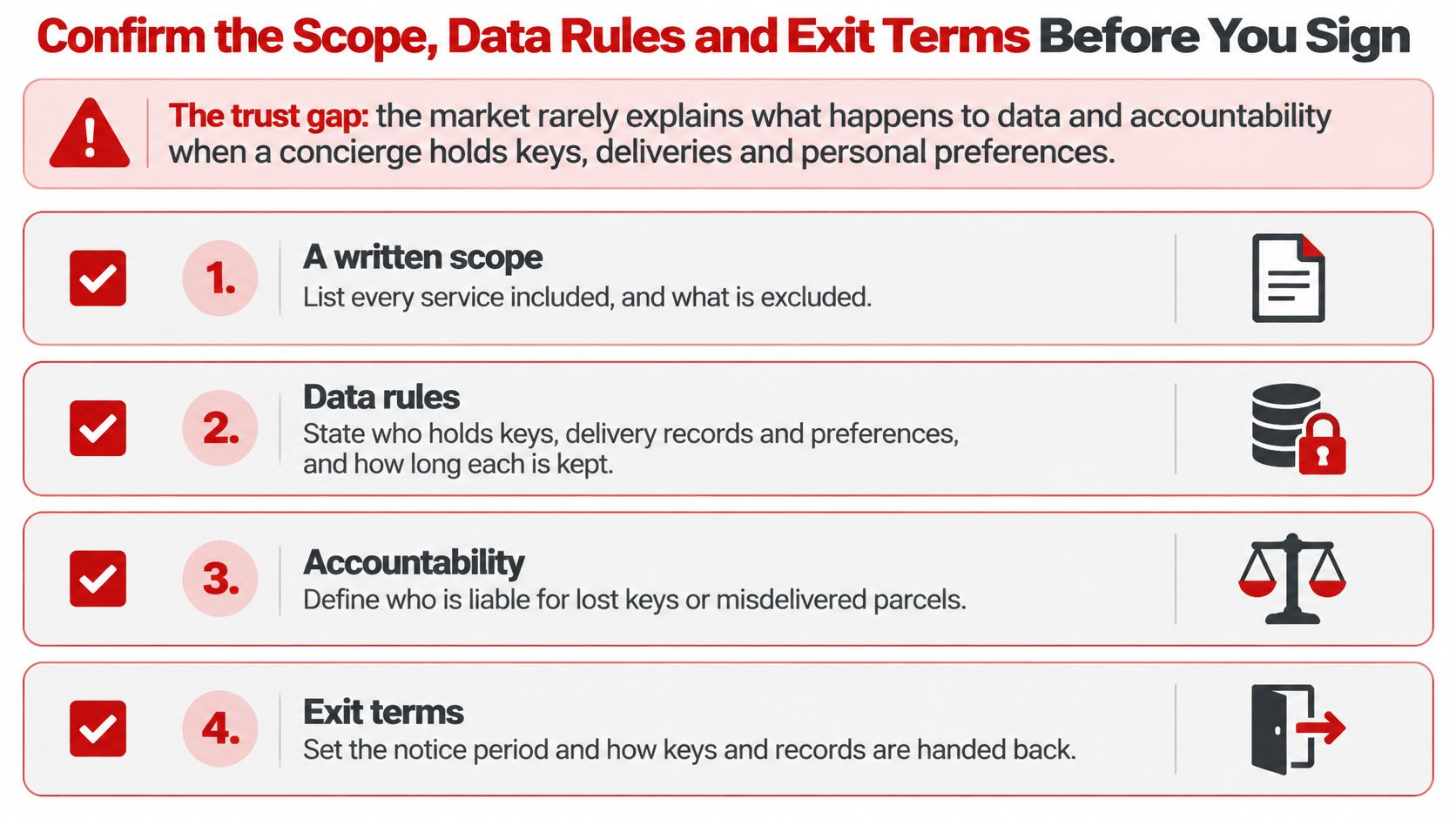
A concierge may hold keys, receive deliveries and know when a resident is away. Put the limits and controls for those tasks in the contract, not just in a promise of discretion.
Privacy and security are practical procurement questions for concierge apps, automation and AI personalisation. Set out who can access information, which decisions require approval and who is responsible when something goes wrong. The checklist below is a starting point; require written answers for your building.
Answers worth accepting
Written scope. List covered tasks, exclusions and staffing assumptions. An open-ended promise of assistance makes it difficult to control workload or assess performance.
Purchase authority. Name the approvers and set recorded spending limits. Staff should not treat a request as consent to buy something just because it seems helpful.
Fee terms. Require a completed schedule that includes the hidden-cost lines identified in the pricing section. Pause if an administration charge is unexplained.
Data access and retention. Define the records collected, role-based permissions and retention rules. Shared accounts and indefinite storage leave access and responsibility unclear.
AI and human review. Specify what automation does and which decisions need a person's approval. A general assurance about personalisation does not explain who is accountable.
Keys and identity. Record who may authorise access and how keys are issued and returned. Familiarity with a resident is not a substitute for verification.
Incidents and recovery. Name escalation owners and set out how staff handle lost deliveries, unauthorised entry or safeguarding concerns. Forwarding complaints to a supplier without a clear plan leaves the response unclear.
Exit arrangements. Set notice requirements, key handback, record transfer and deletion where appropriate. Agree these terms before signing, rather than leaving them for later negotiation.
Accessible communication. Confirm phone and written contact routes, including simplified communication where needed. An app-only service will not suit everyone.
Automation can speed up routing and notifications, but human review and continuity still need a defined place in the service. Map the written scope to actual footfall and request volume, then agree an early review point before a longer commitment becomes binding.
Solomon's Facilities Management offers reception, residential and business concierge, security and cleaning within an integrated service arrangement. Ask for a written scope covering desk duties, personal requests, escalation and reporting for your building through Solomon's Facilities Management.

Comments